


This excerpt is taken from the book Nūr al-ʿAynayn fī Ithbāt Rafʿ al-Yadayn ʿinda al-Rukūʿ wa Baʿdahu fī al-Ṣalāh, authored by the ḥadīth scholar of the era, Ḥāfiẓ Zubayr ʿAlī Zaʾī رحمه الله.
[See: Introduction to Musnad al-Ḥumaydī, pp. 2–3]
The date of transcription of the Saʿīdiyyah manuscript is 1311 AH,
the Deoband manuscript is 1324 AH,
and the ʿUthmāniyyah manuscript is from before 1159 AH.
(Ibid.)
Aʿẓamī al-Deobandī considered the Deoband manuscript as the base text.
(Ibid., p. 3)
Another manuscript of Musnad al-Ḥumaydī exists, known as the Ẓāhiriyyah manuscript.
(Introduction, pp. 4–25)
This manuscript is preserved in Shām, and its photographic copies (photostats) are available in Makkah al-Mukarramah and elsewhere.
The transcription date of the Ẓāhiriyyah manuscript is 689 AH.
[Introduction to Musnad al-Ḥumaydī, p. 19]
Musnad al-Ḥumaydī, vol. 1, pp. 1–15 and others.
In several places, textual alterations (taḥrīf) have also occurred.
For example, see: vol. 1, p. 15, footnote 7, and also p. 71/1.
In many places, the Deoband annotator himself preferred the Ẓāhiriyyah manuscript and corrected the Deoband manuscript accordingly.
See: 2/275, 285, 287, 302, and others.
At some locations, Aʿẓamī al-Deobandī himself admitted that the original text had been altered.
See: Musnad al-Ḥumaydī, taḥqīq al-Aʿẓamī, vol. 1, p. 15 (Arabic footnote), and others.
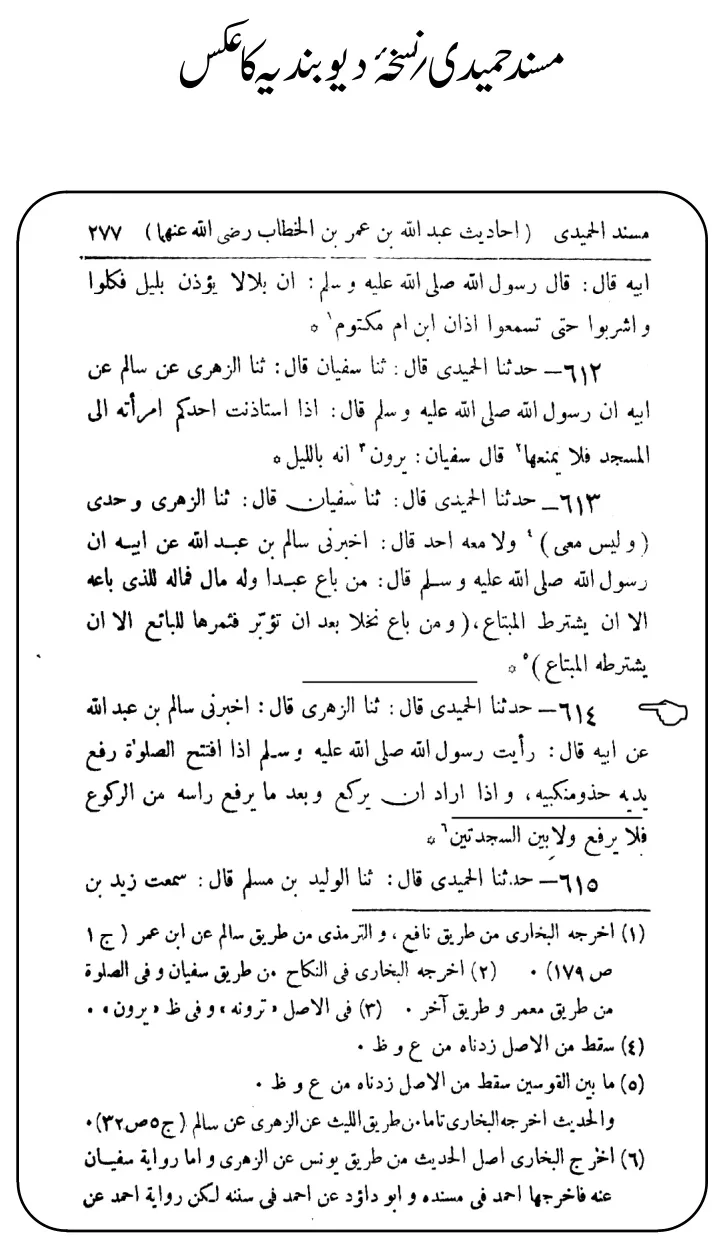
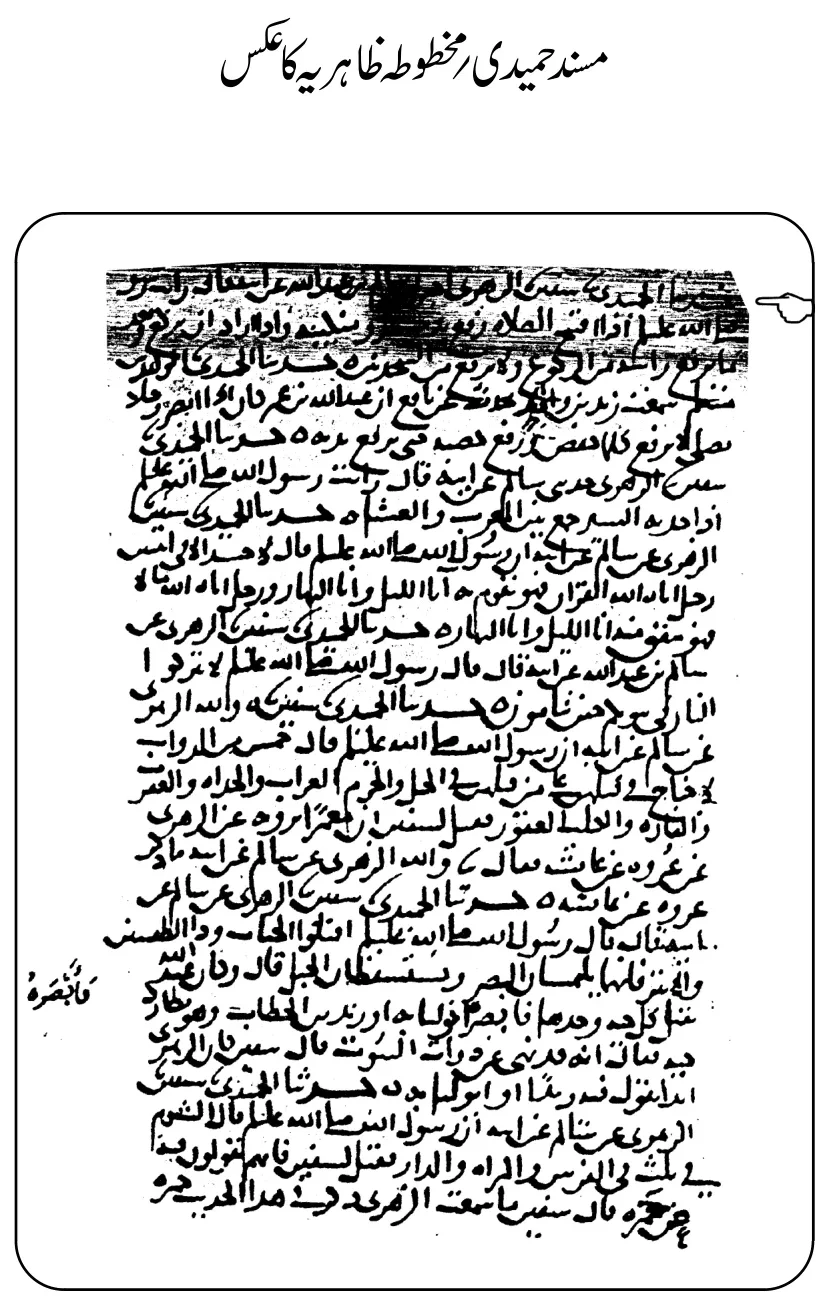
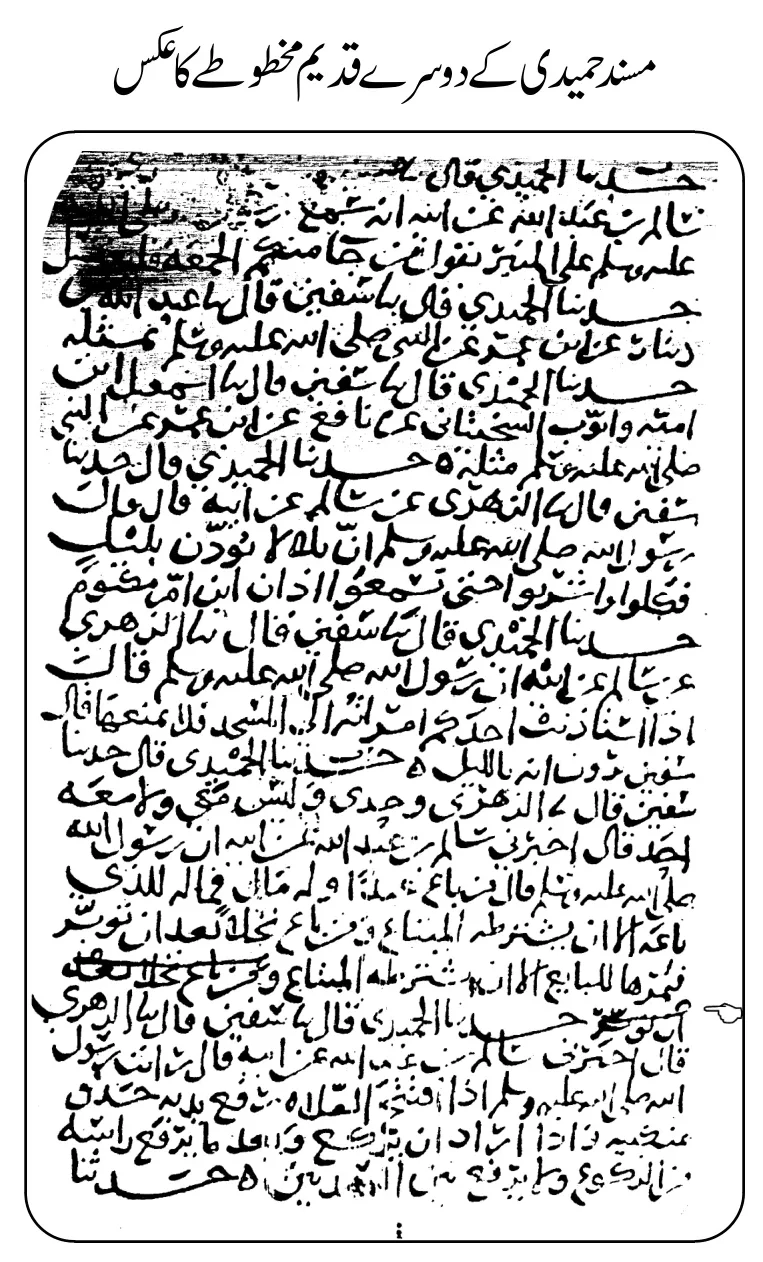
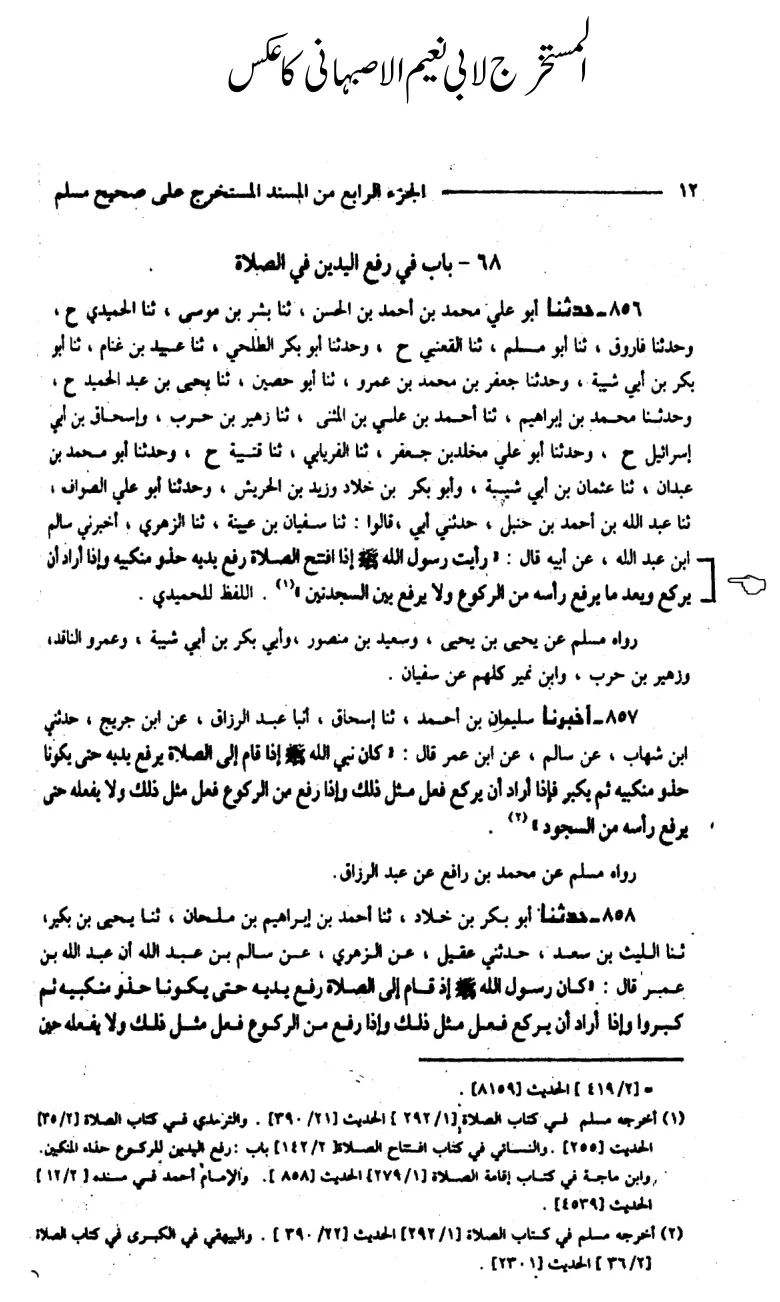
رأيت رسول الله صلى الله عليه وسلم إذا افتتح الصلوة رفع يديه حذو منكبيه وإذا أراد أن يركع وبعد ما يرفع رأسه من الركوع ولا يرفع بين السجدتين
From this wording, it is clearly evident that the addition of “فلا يرفع” in the Deoband manuscript is a fabrication either by the Indian editor or by the copyist.
A similar incident recently occurred when Muṣannaf Ibn Abī Shaybah was published in Karachi based on a Bombay-printed edition, where a biased Deobandī publisher inserted the fabricated words “تحت السرة” at the end of the narration of Sayyidunā Wāʾil ibn Ḥujr رضي الله عنه.
The Ẓāhiriyyah manuscript is the most accurate and reliable among all manuscripts, and this narration is also present in another manuscript exactly as it appears in the Ẓāhiriyyah copy.
Immediately after this narration, Imām al-Ḥumaydī mentions Ibn ʿUmar’s practice:
“He used to pelt with pebbles the one who abandoned Rafʿ al-Yadayn until he performed Rafʿ al-Yadayn.”
This clearly shows that Imām al-Ḥumaydī intended to seal this issue conclusively by mentioning both the ḥadīth and the Companion’s practice, and therefore Imām al-Ḥumaydī himself practiced Rafʿ al-Yadayn.
This further proves that the phrase “فلا يرفع” is incorrect and rejected.
① The disputed wording in the printed Musnad al-Ḥumaydī is altered and corrupted.
② Other trustworthy narrators have transmitted this narration from Sufyān ibn ʿUyaynah with affirmation of Rafʿ al-Yadayn before and after rukūʿ; thus, even if this wording existed in all manuscripts, it would undoubtedly be a gross error and corruption.
③ In the early centuries, this fabricated narration had no existence whatsoever, hence no one presented it.
④ Scholars who authored works on zawāʾid, such as al-Maṭālib al-ʿĀliyah fī Zawāʾid al-Masānīd al-Thamāniyah by Ibn Ḥajar (which includes Musnad al-Ḥumaydī), and Ithāf al-Sādah al-Mahrah by al-Būṣīrī, did not mention this narration. Had it existed, they would certainly have cited it.
⑤ In the ancient manuscript of Musnad al-Ḥumaydī preserved at Maktabah al-Ẓāhiriyyah, this ḥadīth exists correctly, affirming Rafʿ al-Yadayn before and after rukūʿ.
⑥ Ḥāfiẓ Abū ʿAwānah Yaʿqūb ibn Isḥāq al-Isfarāʾīnī stated in Musnad Abī ʿAwānah (vol. 2, p. 91) that it is identical to the narration of Imām al-Shāfiʿī and Imām Abū Dāwūd.
The narration of Imām al-Shāfiʿī affirming Rafʿ al-Yadayn before and after rukūʿ is present in Kitāb al-Umm.
[vol. 1, p. 3, Beirut edition]
The narration of Abū Dāwūd through Aḥmad ibn Fuḍayl is present in Sunan Abī Dāwūd affirming Rafʿ al-Yadayn.
The narration through ʿAlī ibn ʿAbdullāh al-Madīnī is present in Juzʾ Rafʿ al-Yadayn by al-Bukhārī.
[p. 17, ḥadīth: 2]
⑦ From the central narrator Imām Sufyān ibn ʿUyaynah, Rafʿ al-Yadayn before and after rukūʿ is authentically established.
⑧ Imām al-Ḥumaydī himself held the view of Rafʿ al-Yadayn before and after rukūʿ.
Therefore, the fabricated wording found in the Deoband manuscript is false, invalid, and baseless. Presenting it is an act of severe injustice, blatant dishonesty, and extreme audacity.
⑨ After completing this research, al-Mustakhraj by Abū Nuʿaym al-Aṣbahānī (vol. 2, p. 12) was also examined, where this narration is transmitted with the affirmation of Rafʿ al-Yadayn, not negation. Al-ḥamdu lillāh.
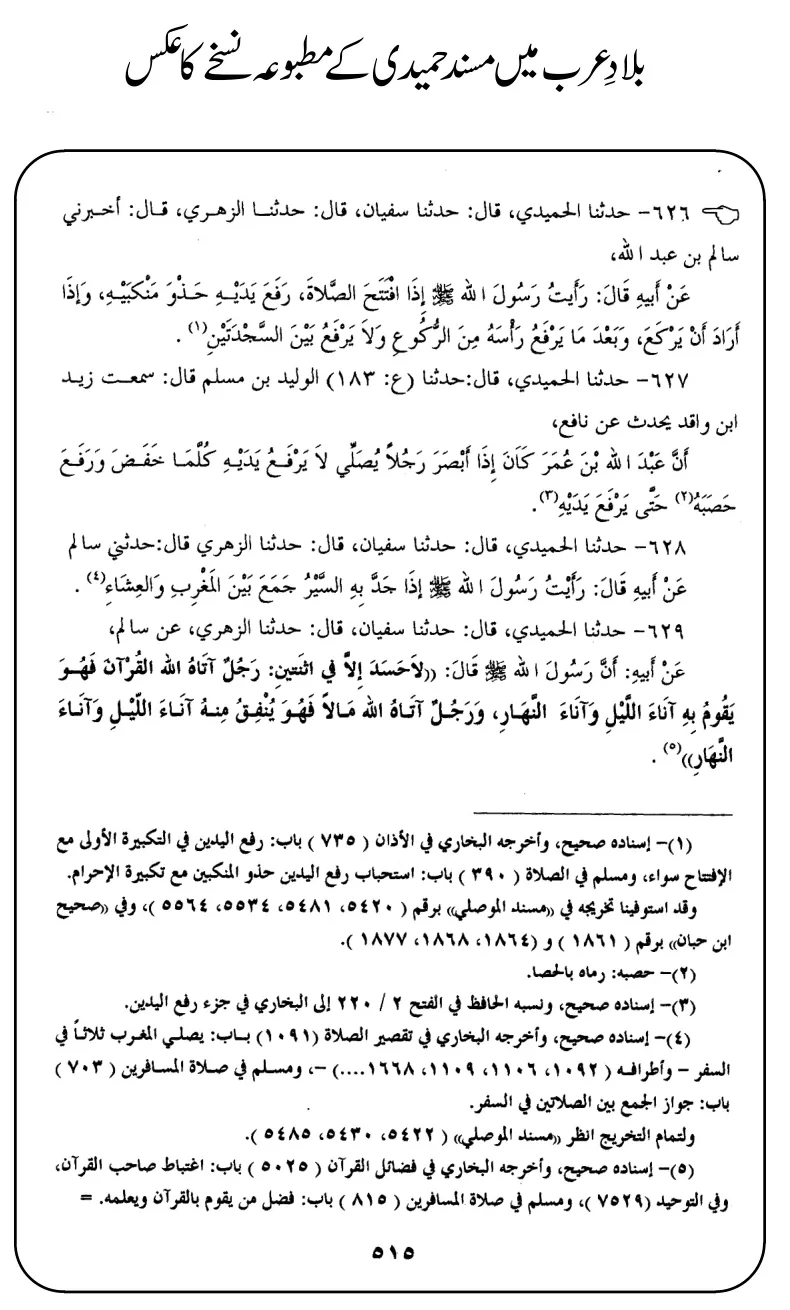
⑩ The Syrian-printed edition of Musnad al-Ḥumaydī also contains the narration affirming Rafʿ al-Yadayn, with no mention whatsoever of negation.
[See: vol. 1, p. 515, ḥadīth: 626]
Musnad al-Ḥumaydī and the Ḥadīth of Rafʿ al-Yadayn
Musnad al-Ḥumaydī was published by its annotator Ḥabīb al-Raḥmān Aʿẓamī al-Deobandī al-Hindī based on the Deoband (Indian) manuscript, with support taken from the Saʿīdiyyah manuscript and the ʿUthmāniyyah manuscript.[See: Introduction to Musnad al-Ḥumaydī, pp. 2–3]
The date of transcription of the Saʿīdiyyah manuscript is 1311 AH,
the Deoband manuscript is 1324 AH,
and the ʿUthmāniyyah manuscript is from before 1159 AH.
(Ibid.)
Aʿẓamī al-Deobandī considered the Deoband manuscript as the base text.
(Ibid., p. 3)
Another manuscript of Musnad al-Ḥumaydī exists, known as the Ẓāhiriyyah manuscript.
(Introduction, pp. 4–25)
This manuscript is preserved in Shām, and its photographic copies (photostats) are available in Makkah al-Mukarramah and elsewhere.
The transcription date of the Ẓāhiriyyah manuscript is 689 AH.
[Introduction to Musnad al-Ḥumaydī, p. 19]
Errors and Alterations in the Deoband Manuscript
The original Deoband manuscript contains numerous errors, for example see:Musnad al-Ḥumaydī, vol. 1, pp. 1–15 and others.
In several places, textual alterations (taḥrīf) have also occurred.
For example, see: vol. 1, p. 15, footnote 7, and also p. 71/1.
In many places, the Deoband annotator himself preferred the Ẓāhiriyyah manuscript and corrected the Deoband manuscript accordingly.
See: 2/275, 285, 287, 302, and others.
At some locations, Aʿẓamī al-Deobandī himself admitted that the original text had been altered.
See: Musnad al-Ḥumaydī, taḥqīq al-Aʿẓamī, vol. 1, p. 15 (Arabic footnote), and others.
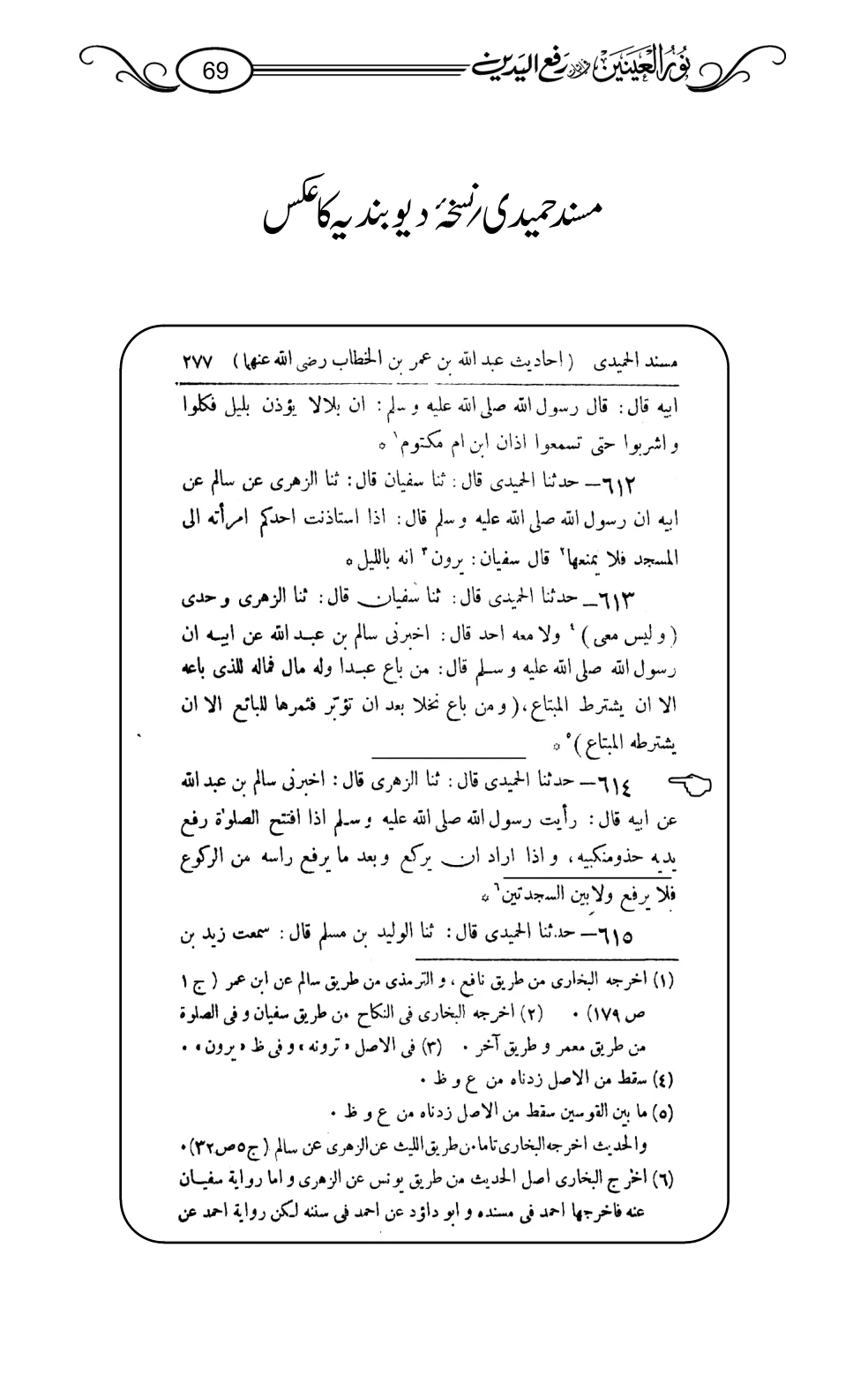
Text of the Ḥadīth in the Ancient Manuscripts
In both ancient handwritten manuscripts of Musnad al-Ḥumaydī, the following text is written:رأيت رسول الله صلى الله عليه وسلم إذا افتتح الصلوة رفع يديه حذو منكبيه وإذا أراد أن يركع وبعد ما يرفع رأسه من الركوع ولا يرفع بين السجدتين
From this wording, it is clearly evident that the addition of “فلا يرفع” in the Deoband manuscript is a fabrication either by the Indian editor or by the copyist.
A similar incident recently occurred when Muṣannaf Ibn Abī Shaybah was published in Karachi based on a Bombay-printed edition, where a biased Deobandī publisher inserted the fabricated words “تحت السرة” at the end of the narration of Sayyidunā Wāʾil ibn Ḥujr رضي الله عنه.
Omission and Reliability of Manuscripts
In the chain of this narration in Musnad al-Ḥumaydī, due to haste and negligence, the words “ḥaddathanā Sufyān” were omitted. The annotator realized this mistake much later, yet even in the error chart at the end of the book, this mistake was not rectified.The Ẓāhiriyyah manuscript is the most accurate and reliable among all manuscripts, and this narration is also present in another manuscript exactly as it appears in the Ẓāhiriyyah copy.
Practice of ʿAbdullāh ibn ʿUmar رضي الله عنهما
Imām al-Ḥumaydī also narrated the mawqūf narration of Sayyidunā ʿAbdullāh ibn ʿUmar رضي الله عنهما regarding Rafʿ al-Yadayn through another chain, proving that Ibn ʿUmar considered Rafʿ al-Yadayn obligatory.Immediately after this narration, Imām al-Ḥumaydī mentions Ibn ʿUmar’s practice:
“He used to pelt with pebbles the one who abandoned Rafʿ al-Yadayn until he performed Rafʿ al-Yadayn.”
This clearly shows that Imām al-Ḥumaydī intended to seal this issue conclusively by mentioning both the ḥadīth and the Companion’s practice, and therefore Imām al-Ḥumaydī himself practiced Rafʿ al-Yadayn.
Supporting Evidence from Other Scholars
Imām Abū ʿAwānah narrated this same ḥadīth from other students of Sufyān, and then also transmitted its opening words through Imām al-Ḥumaydī’s chain, afterwards stating “mithlahu”, indicating that the wording is the same.This further proves that the phrase “فلا يرفع” is incorrect and rejected.
Established Conclusions
From this detailed analysis, the following points become clear:① The disputed wording in the printed Musnad al-Ḥumaydī is altered and corrupted.
② Other trustworthy narrators have transmitted this narration from Sufyān ibn ʿUyaynah with affirmation of Rafʿ al-Yadayn before and after rukūʿ; thus, even if this wording existed in all manuscripts, it would undoubtedly be a gross error and corruption.
③ In the early centuries, this fabricated narration had no existence whatsoever, hence no one presented it.
④ Scholars who authored works on zawāʾid, such as al-Maṭālib al-ʿĀliyah fī Zawāʾid al-Masānīd al-Thamāniyah by Ibn Ḥajar (which includes Musnad al-Ḥumaydī), and Ithāf al-Sādah al-Mahrah by al-Būṣīrī, did not mention this narration. Had it existed, they would certainly have cited it.
⑤ In the ancient manuscript of Musnad al-Ḥumaydī preserved at Maktabah al-Ẓāhiriyyah, this ḥadīth exists correctly, affirming Rafʿ al-Yadayn before and after rukūʿ.
⑥ Ḥāfiẓ Abū ʿAwānah Yaʿqūb ibn Isḥāq al-Isfarāʾīnī stated in Musnad Abī ʿAwānah (vol. 2, p. 91) that it is identical to the narration of Imām al-Shāfiʿī and Imām Abū Dāwūd.
The narration of Imām al-Shāfiʿī affirming Rafʿ al-Yadayn before and after rukūʿ is present in Kitāb al-Umm.
[vol. 1, p. 3, Beirut edition]
The narration of Abū Dāwūd through Aḥmad ibn Fuḍayl is present in Sunan Abī Dāwūd affirming Rafʿ al-Yadayn.
Reference: Sunan Abī Dāwūd: 721
The narration through ʿAlī ibn ʿAbdullāh al-Madīnī is present in Juzʾ Rafʿ al-Yadayn by al-Bukhārī.
[p. 17, ḥadīth: 2]
⑦ From the central narrator Imām Sufyān ibn ʿUyaynah, Rafʿ al-Yadayn before and after rukūʿ is authentically established.
Reference: Jāmiʿ al-Tirmidhī: vol. 2, p. 39, ḥadīth: 256 (taḥqīq Aḥmad Shākir)
⑧ Imām al-Ḥumaydī himself held the view of Rafʿ al-Yadayn before and after rukūʿ.
Reference: Juzʾ Rafʿ al-Yadayn by al-Bukhārī: p. 35, ḥadīth: 1
Final Summary
The narration from al-Zuhrī → Sālim → his father in Musnad al-Ḥumaydī affirms Rafʿ al-Yadayn before and after rukūʿ, and does not negate it.Therefore, the fabricated wording found in the Deoband manuscript is false, invalid, and baseless. Presenting it is an act of severe injustice, blatant dishonesty, and extreme audacity.
⑨ After completing this research, al-Mustakhraj by Abū Nuʿaym al-Aṣbahānī (vol. 2, p. 12) was also examined, where this narration is transmitted with the affirmation of Rafʿ al-Yadayn, not negation. Al-ḥamdu lillāh.
⑩ The Syrian-printed edition of Musnad al-Ḥumaydī also contains the narration affirming Rafʿ al-Yadayn, with no mention whatsoever of negation.
[See: vol. 1, p. 515, ḥadīth: 626]

