
Compiled by: Abu Hamzah Salafi
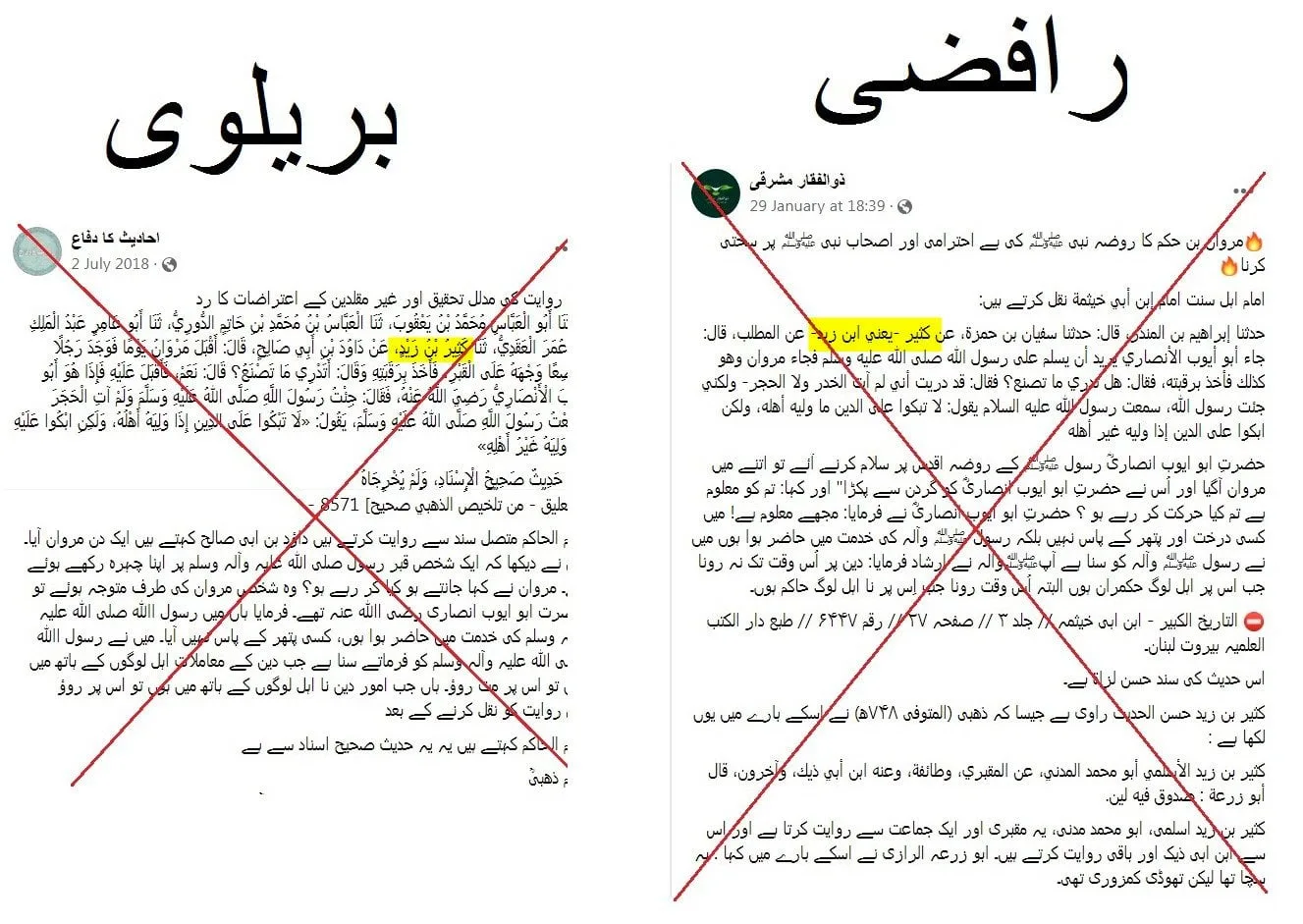
This article systematically presents the statements of Jarḥ wa Taʿdīl by the majority of Hadith scholars regarding Kathīr bin Zayd al-Aslamī al-Madanī (Abū Muḥammad), so that it becomes clear that, according to the critics of Hadith, this narrator possesses weakness / leniency, and especially in the case of tafarrud (solitary narration), relying upon him as proof was not considered appropriate.
The purpose is to bring together before the reader the original Arabic statements, their English translations, references, and brief scholarly analysis, so that it becomes evident that the correct position of Kathīr bin Zayd’s narration is generally in corroborations (mutābaʿāt) and supporting evidences (shawāhid), not as an independent foundation for establishing fundamental or creedal claims.
Kunyah: Abū Muḥammad
Fame / Description (as reported): كثير بن زيد الأسلمي، أبو محمد، المدني، السهمي
General Ruling (reported summary): Weak — lā yuḥtajj bihi
(Meaning: he is not relied upon as an independent proof)
 In this article, terms such as “ḍaʿīf” (weak), “fīhi layn” (there is leniency in him), “laysa bil-qawī” (not strong), “yuktabu ḥadīthuh” (his ḥadīth is written), and “lā yuḥtajj bihi” (he is not used as proof) are understood according to the technical usage of the Hadith scholars. Along with each statement, its translation and intended meaning are clarified.
Arabic Text:
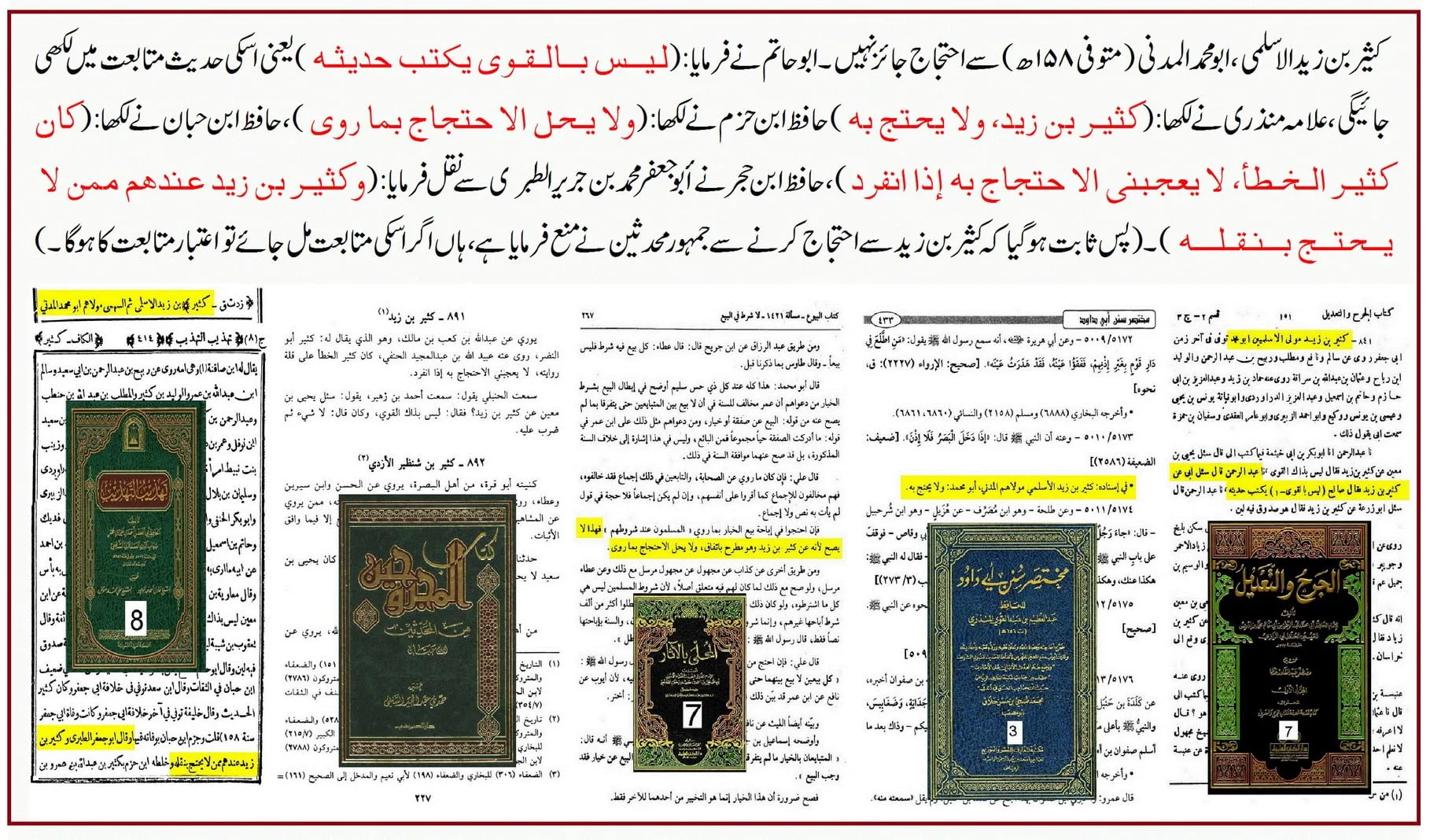
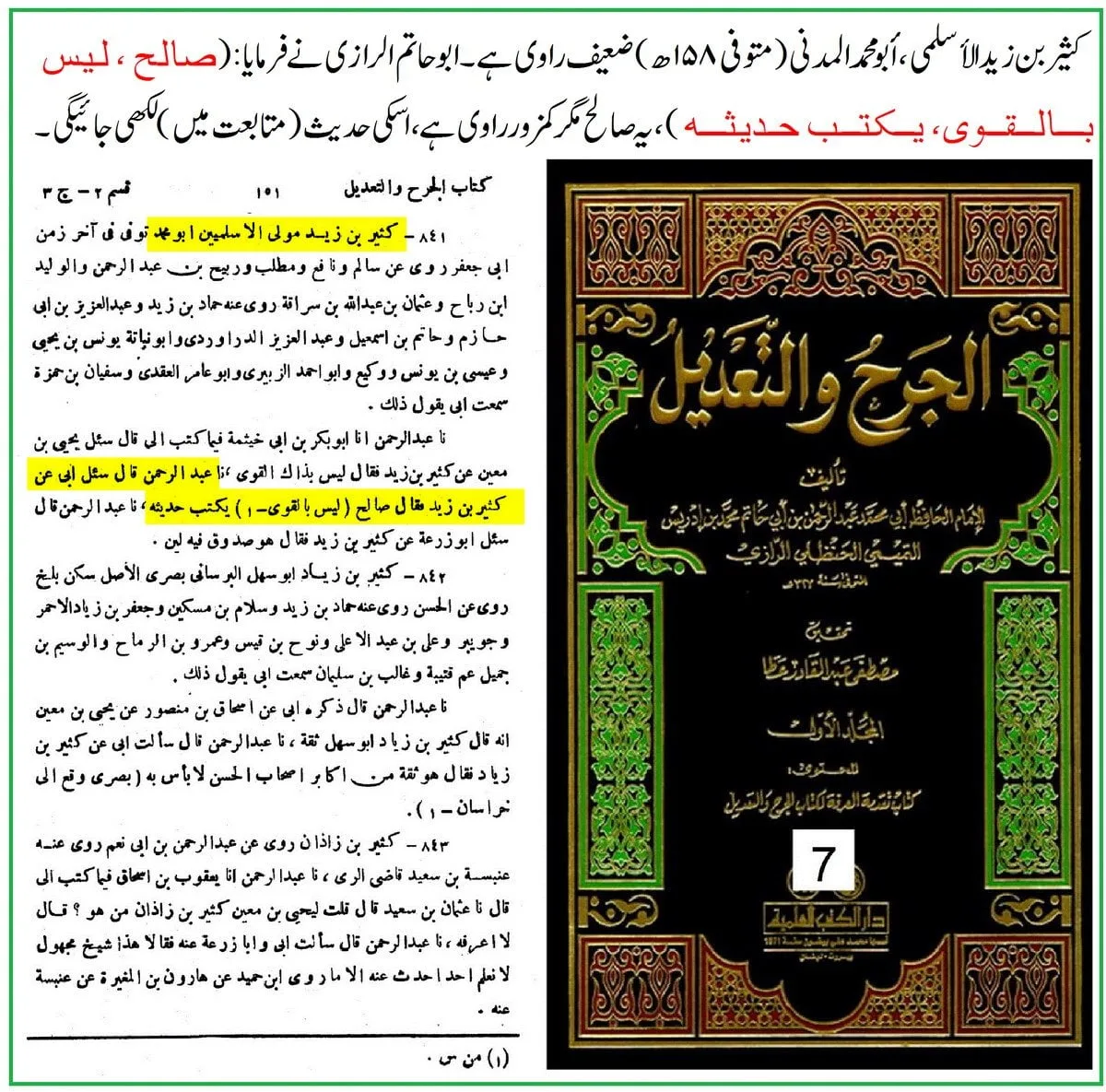
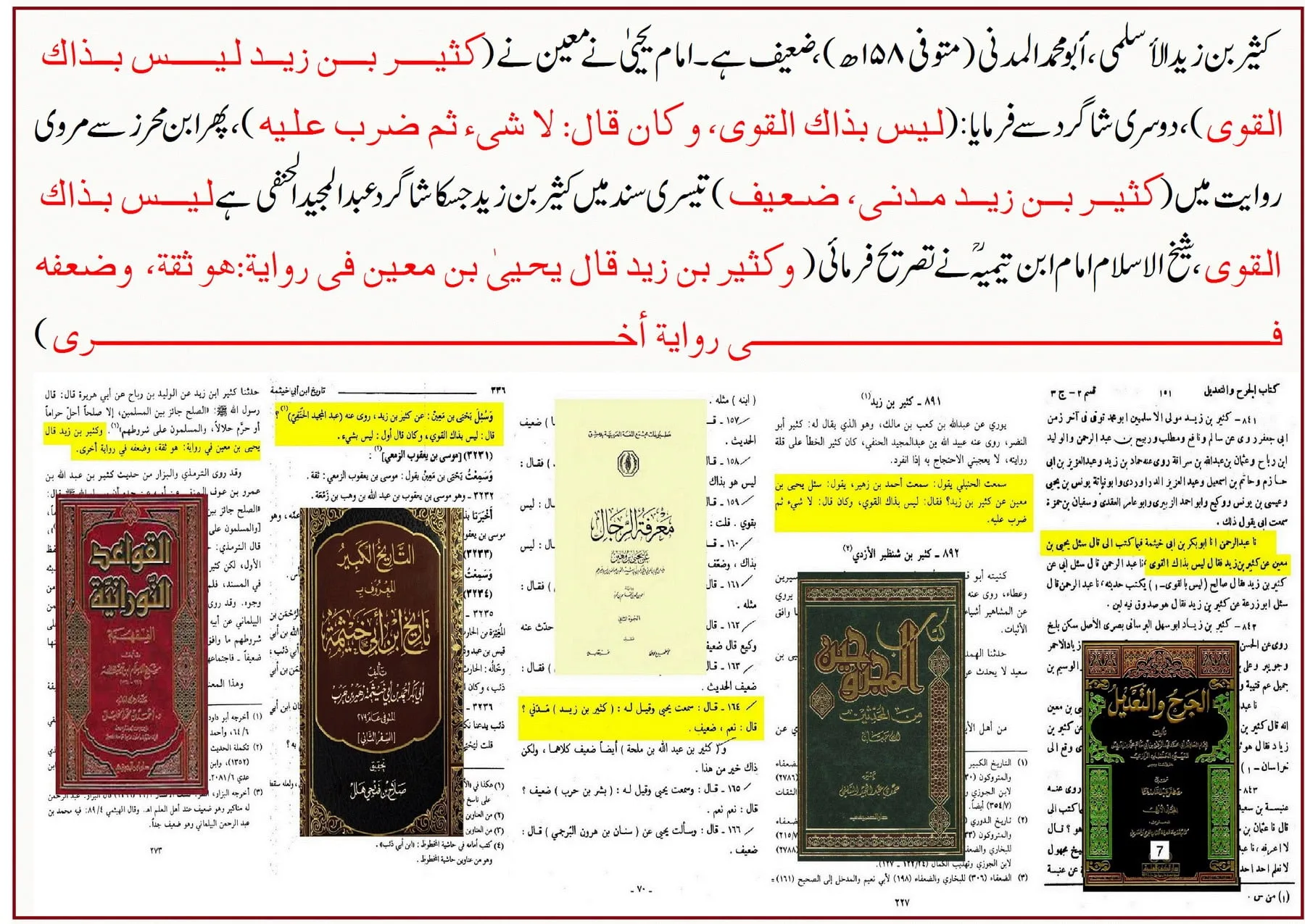
نا عبد الرحمن قال سئل أبى عن كثير بن زيد فقال صالح (ليس بالقوى) يكتب حديثه
Translation:
ʿAbd al-Raḥmān said: My father (Abū Ḥātim) was asked about Kathīr bin Zayd, and he said: “He is righteous (ṣāliḥ), but not strong; his ḥadīth is written.”
 [al-Jarḥ wa al-Taʿdīl]
Brief Explanation:
The phrase “laysa bil-qawī” clearly negates strength in precision, while “yuktabu ḥadīthuh” usually indicates that his narration may be considered for corroboration, not that independent proof is established through him.
Arabic Text:
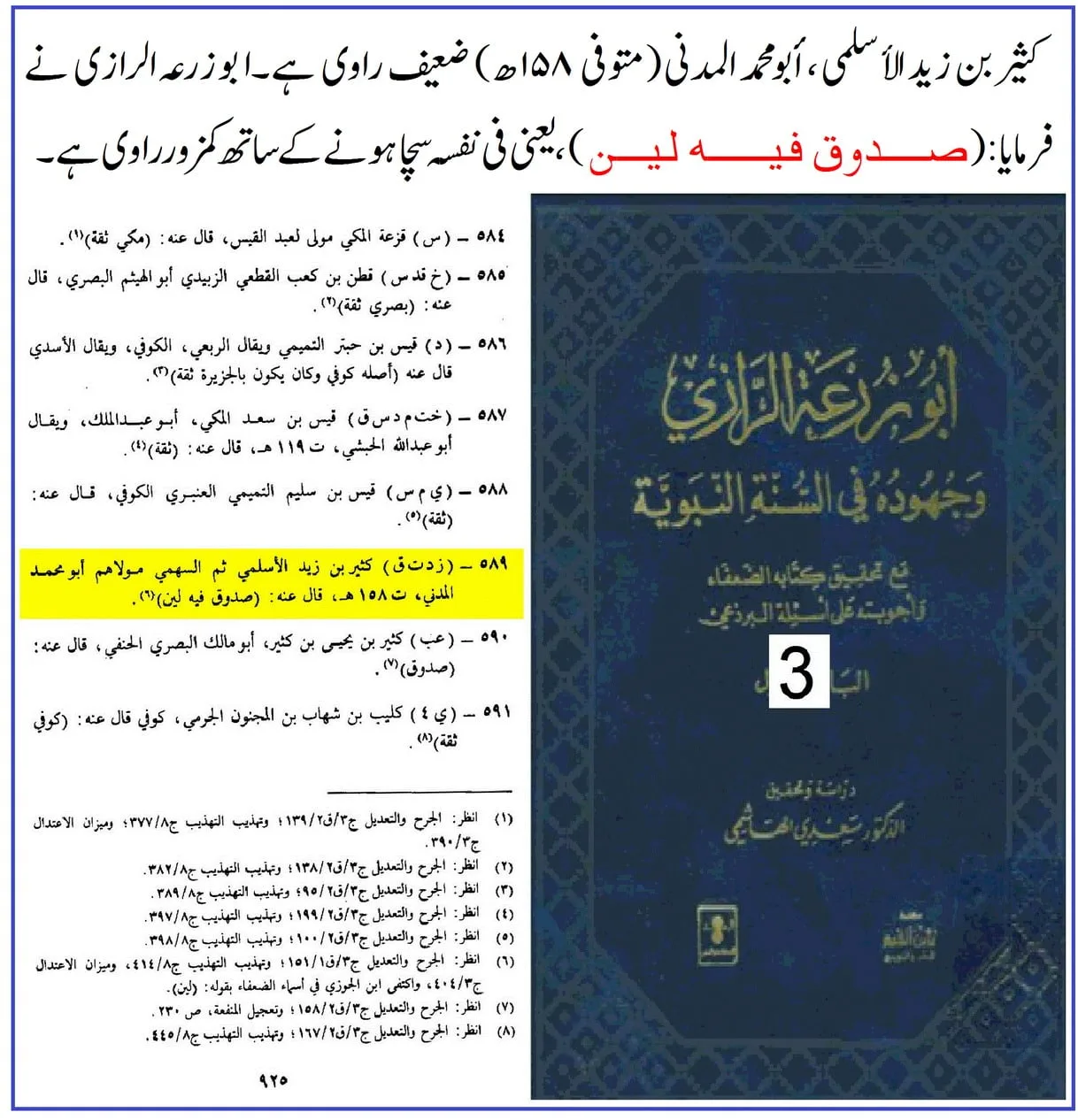
عبد الرحمن قال سئل أبو زرعة عن كثير بن زيد فقال هو صدوق فيه لين
Translation:
ʿAbd al-Raḥmān said: Abū Zurʿah was asked about Kathīr bin Zayd, and he said: “He is truthful (ṣadūq), but there is leniency in him.”
[al-Jarḥ wa al-Taʿdīl]
Brief Explanation:
“Ṣadūq” indicates he is not accused of lying, but “fīhi layn” shows deficiency in precision. Therefore, his solitary narrations are not used to establish principles or beliefs, and are generally considered among supporting evidences.
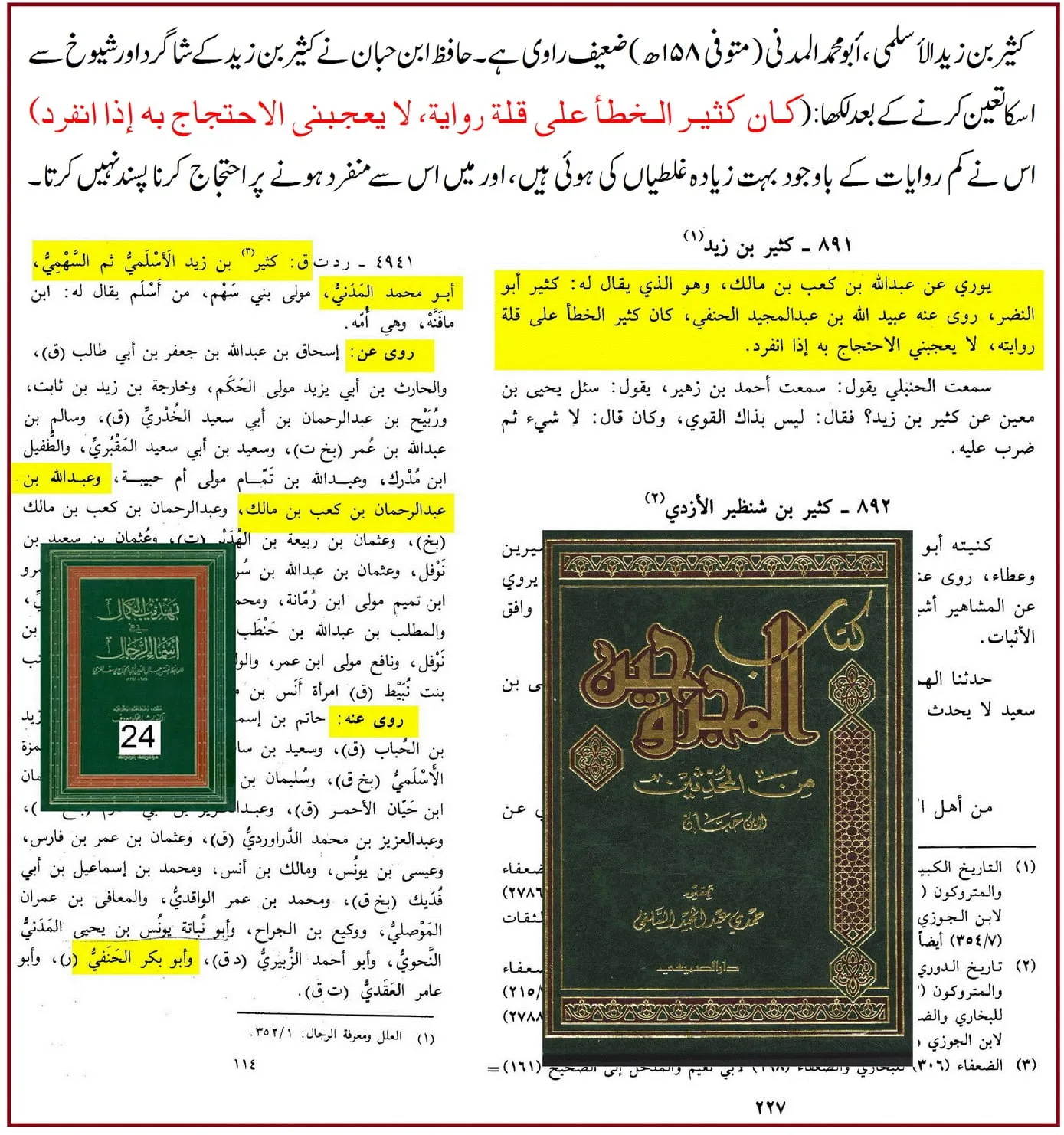
Arabic Text:
كان كثير الخطأ على قلة روايته لا يعجبني الاحتجاج به إذا انفرد
Translation:
Ibn Ḥibbān wrote: Kathīr bin Zayd… despite narrating little, he made many mistakes. I do not like using him as proof when he is alone in narration.
[al-Majrūḥīn min al-Muḥaddithīn]
Brief Explanation:
This explicitly clarifies the issue of tafarrud: Ibn Ḥibbān considered his weakness such that his solitary narrations are not suitable for proof.
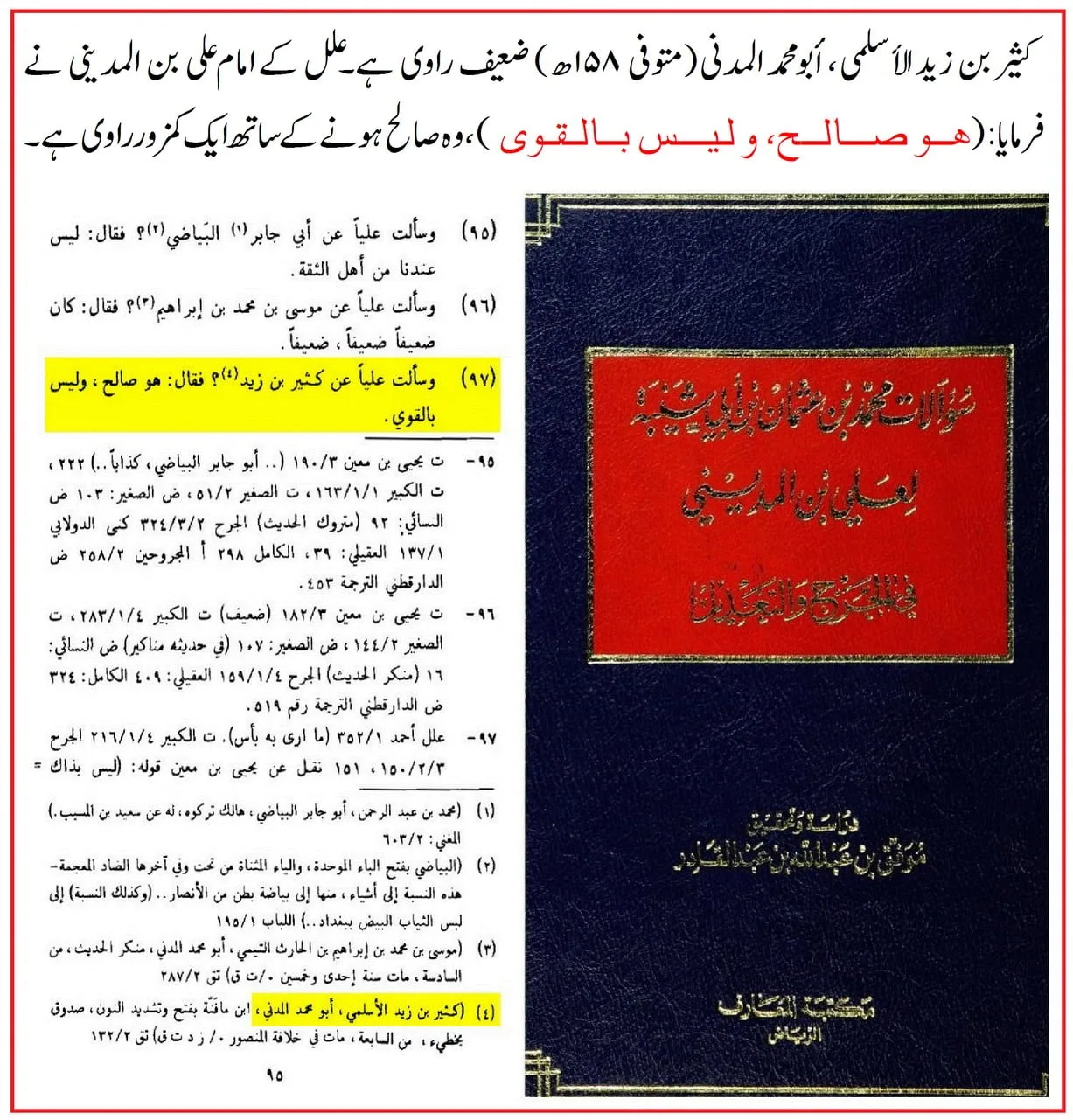
Arabic Text:
وسألت عليا عن كثير بن زيد فقال هو صالح وليس بالقوي
Translation:
I asked ʿAlī bin al-Madīnī about Kathīr bin Zayd, and he said: “He is righteous, but not strong.”
[Suʾālāt Muḥammad bin ʿUthmān bin Abī Shaybah]
Brief Explanation:
This balanced criticism shows that he is not rejected outright, yet does not meet the standard of strong precision, requiring graded acceptance.
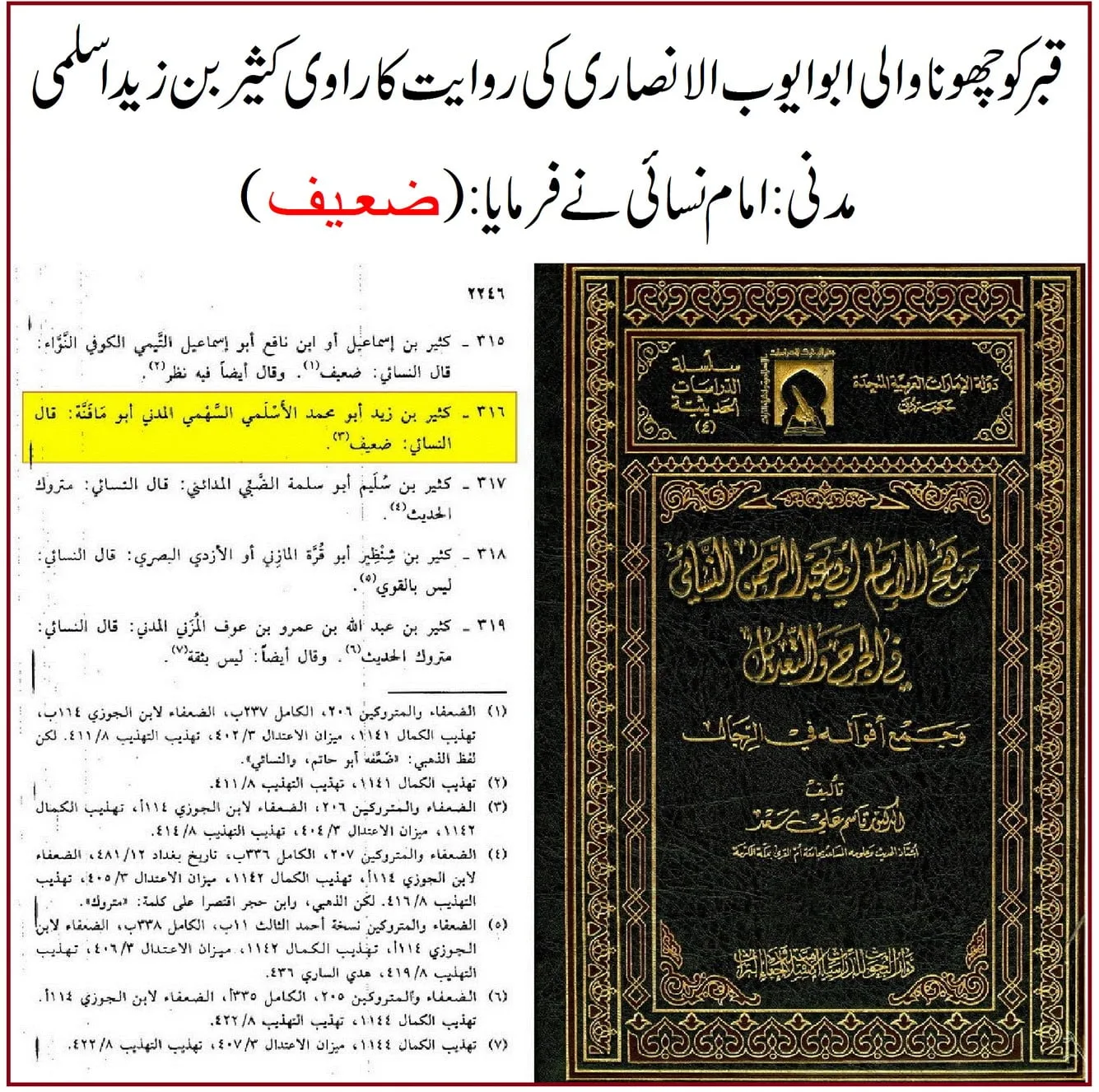
Arabic Text:
كثير بن زيد ضعيف
Translation:
Kathīr bin Zayd is weak.
[al-Ḍuʿafāʾ wa al-Matrūkīn]
Brief Explanation:
The term “ḍaʿīf” is a clear declaration of weakness, generally meaning his narration cannot be taken as independent proof without corroboration.
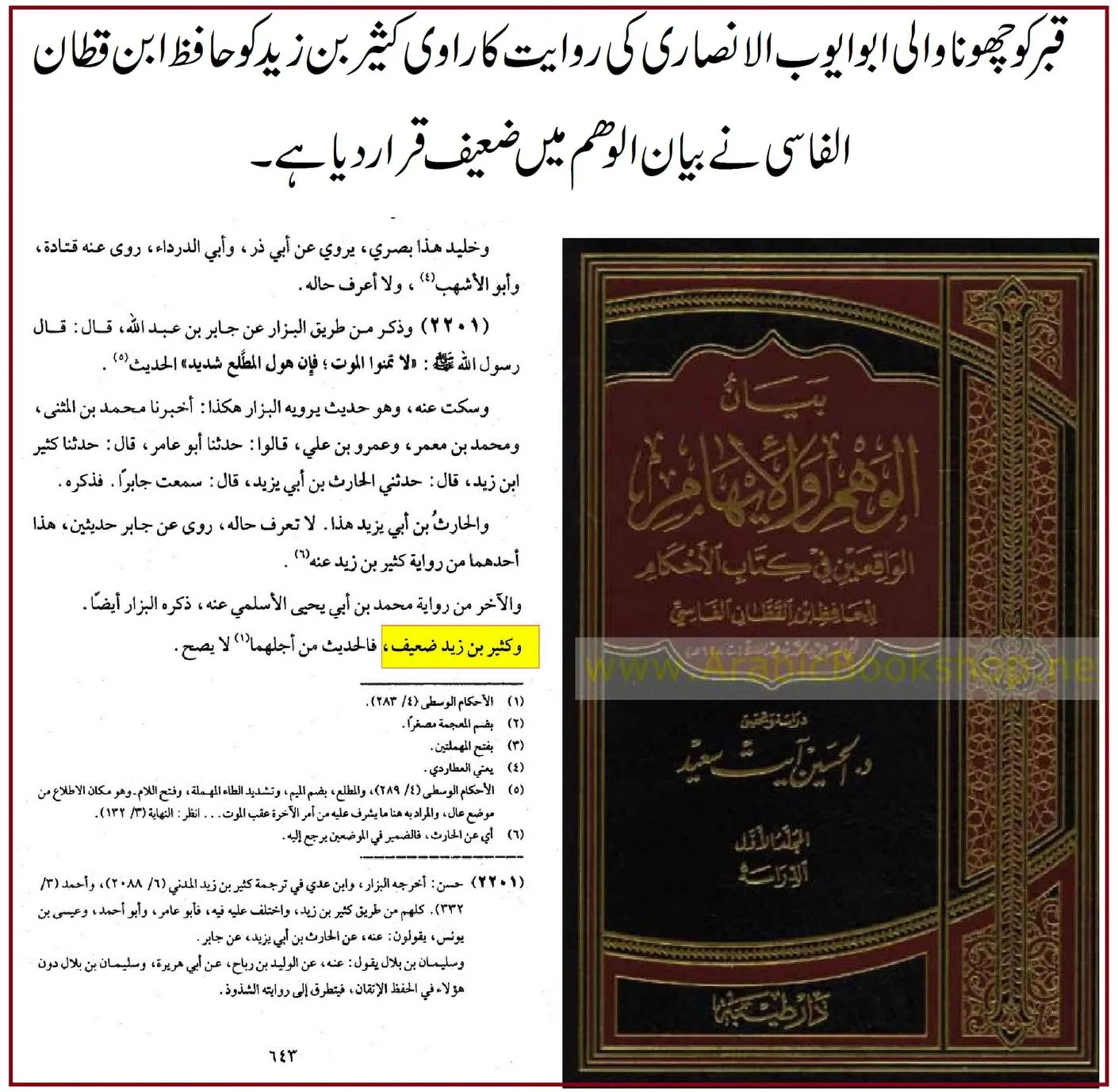
Reported Statement:
Ḥāfiẓ Ibn al-Qaṭṭān declared Kathīr bin Zayd to be weak.
Reference:
(The exact book/page is not specified in the transmitted material.)
Brief Explanation:
Although details are not cited, this attribution aligns with the broader scholarly trend indicating leniency/weakness in this narrator.
Arabic Text:
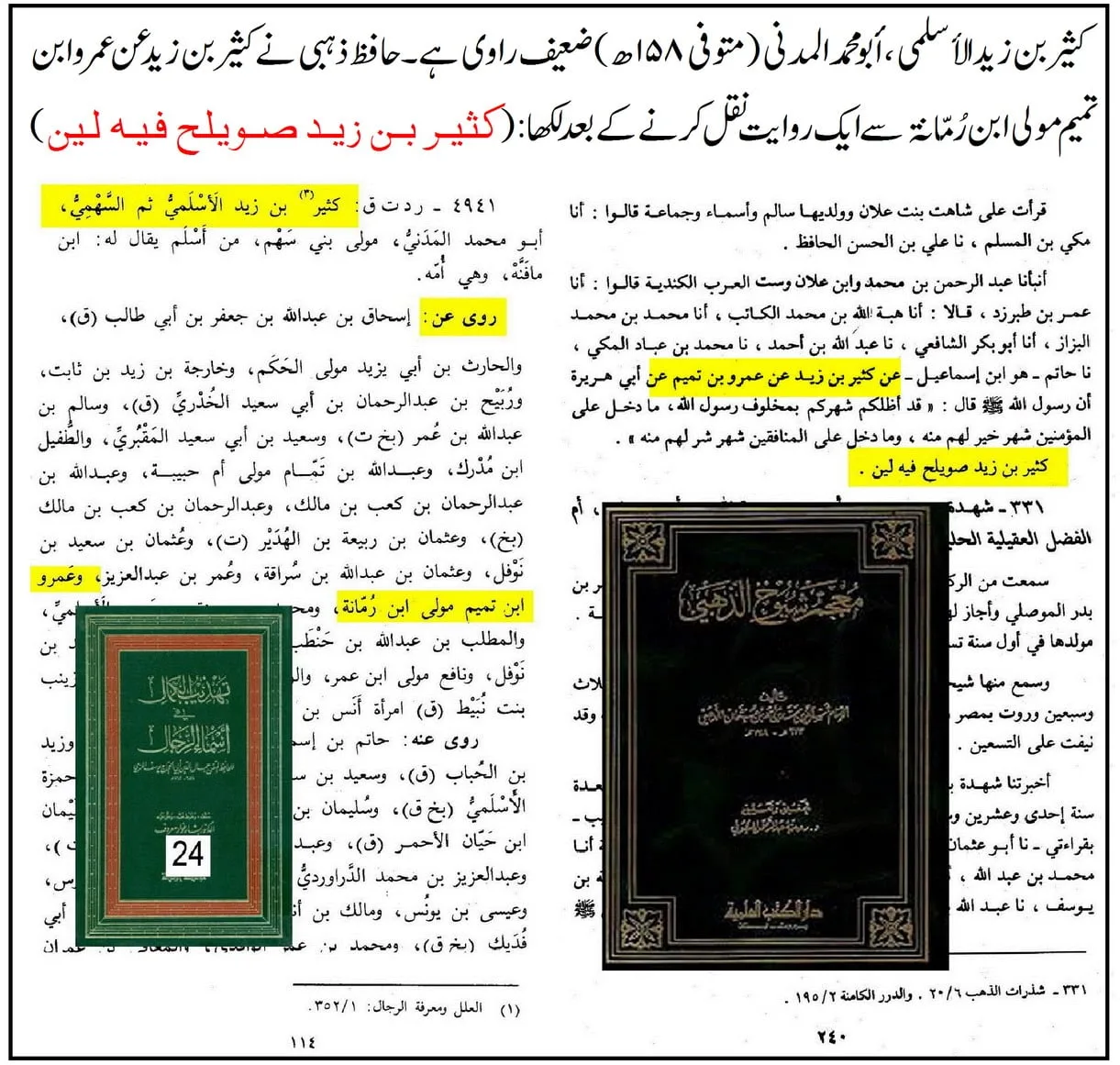
كثير بن زيد صويلح فيه لين
Translation:
Kathīr bin Zayd is “ṣuwailiḥ” (somewhat acceptable), but there is leniency in him.
[Muʿjam Shuyūkh al-Dhahabī]
Brief Explanation:
“Ṣuwailiḥ” indicates he is not completely rejected, yet “fīhi layn” lowers his narration below the level of full reliability.
Arabic Text:
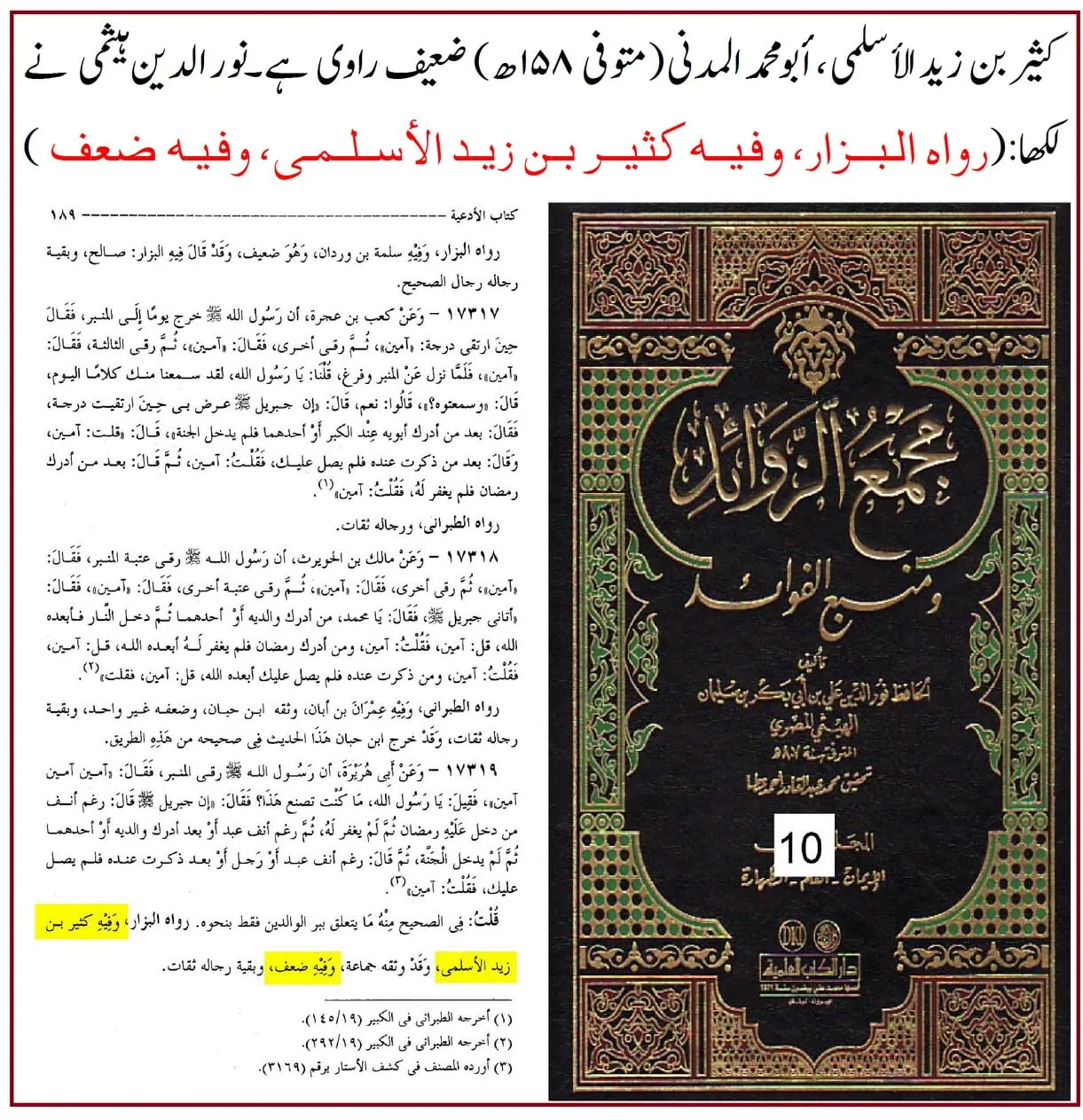
وقد وثقه جماعة وفيه ضعف
Translation:
In this chain is Kathīr bin Zayd al-Aslamī; some have declared him trustworthy, but there is weakness in him.
[Majmaʿ al-Zawāʾid]
Brief Explanation:
This establishes balance: despite some authentication, weakness is explicitly acknowledged, indicating cautious treatment rather than absolute reliance.
Arabic Text:
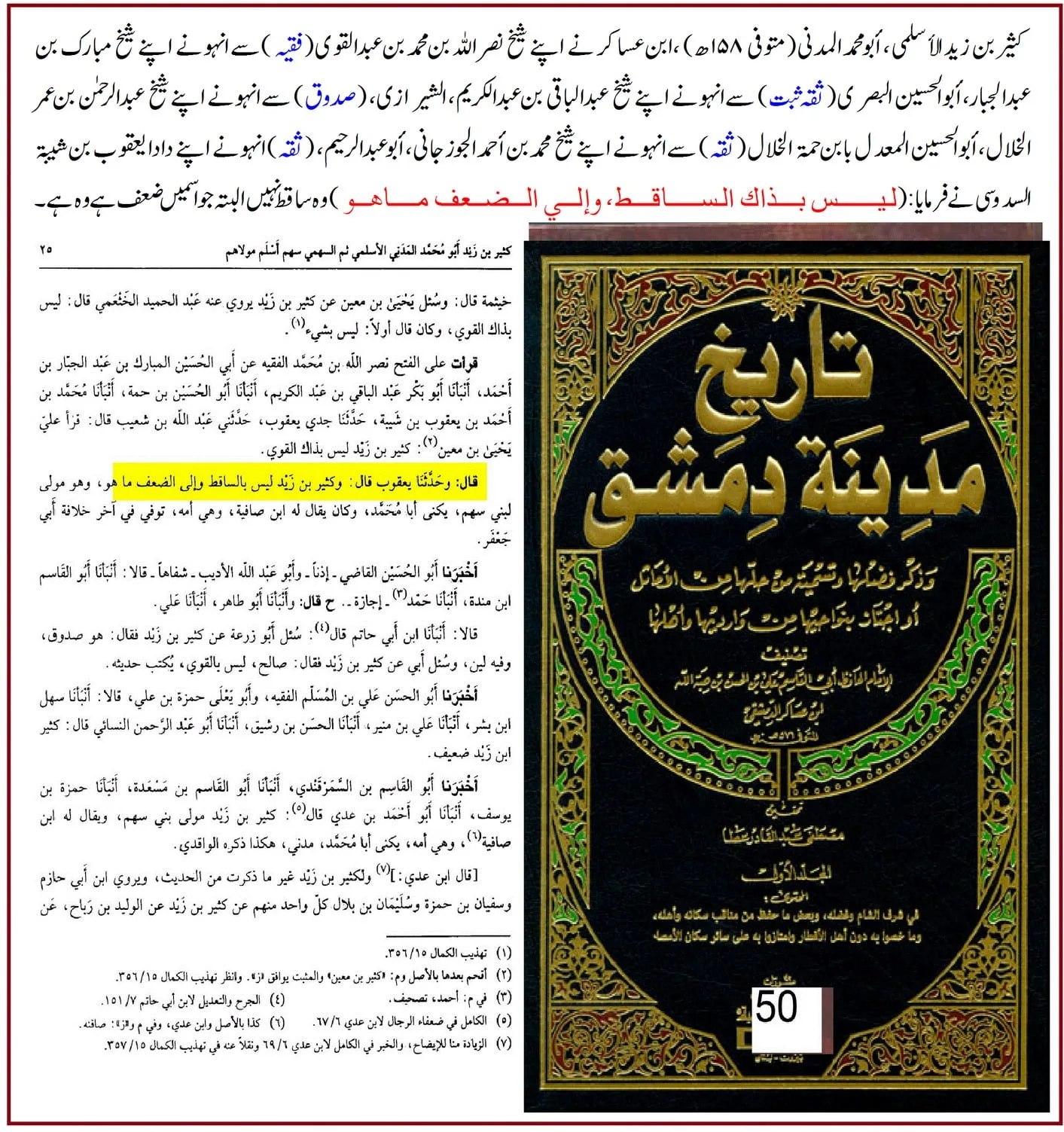
وكثير بن زيد ليس بالساقط وإلى الضعف ما هو
Translation:
Kathīr bin Zayd is not discarded, but he inclines toward weakness.
[Tārīkh Dimashq]
Brief Explanation:
This clarifies his rank: neither completely abandoned nor accepted as strong proof—rather suited for corroborations.
Arabic Text:
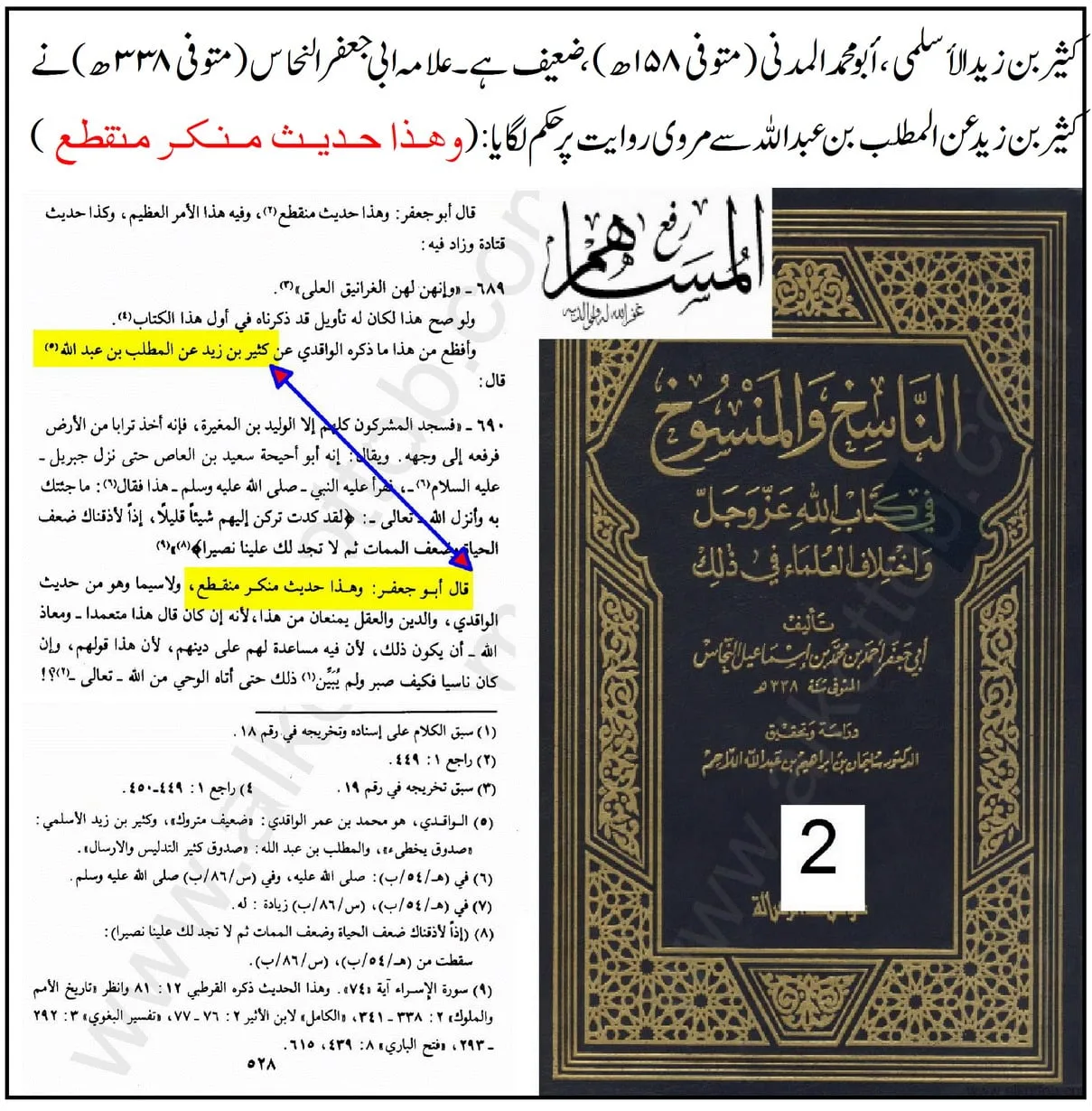
وهذا حديث منكر منقطع
Translation:
This ḥadīth is rejected (munkar) and disconnected (munqaṭiʿ).
[al-Nāsikh wa al-Mansūkh]
Brief Explanation:
Here the ruling concerns a specific narration, showing issues of both connection and reliability in that report.
Arabic Text:
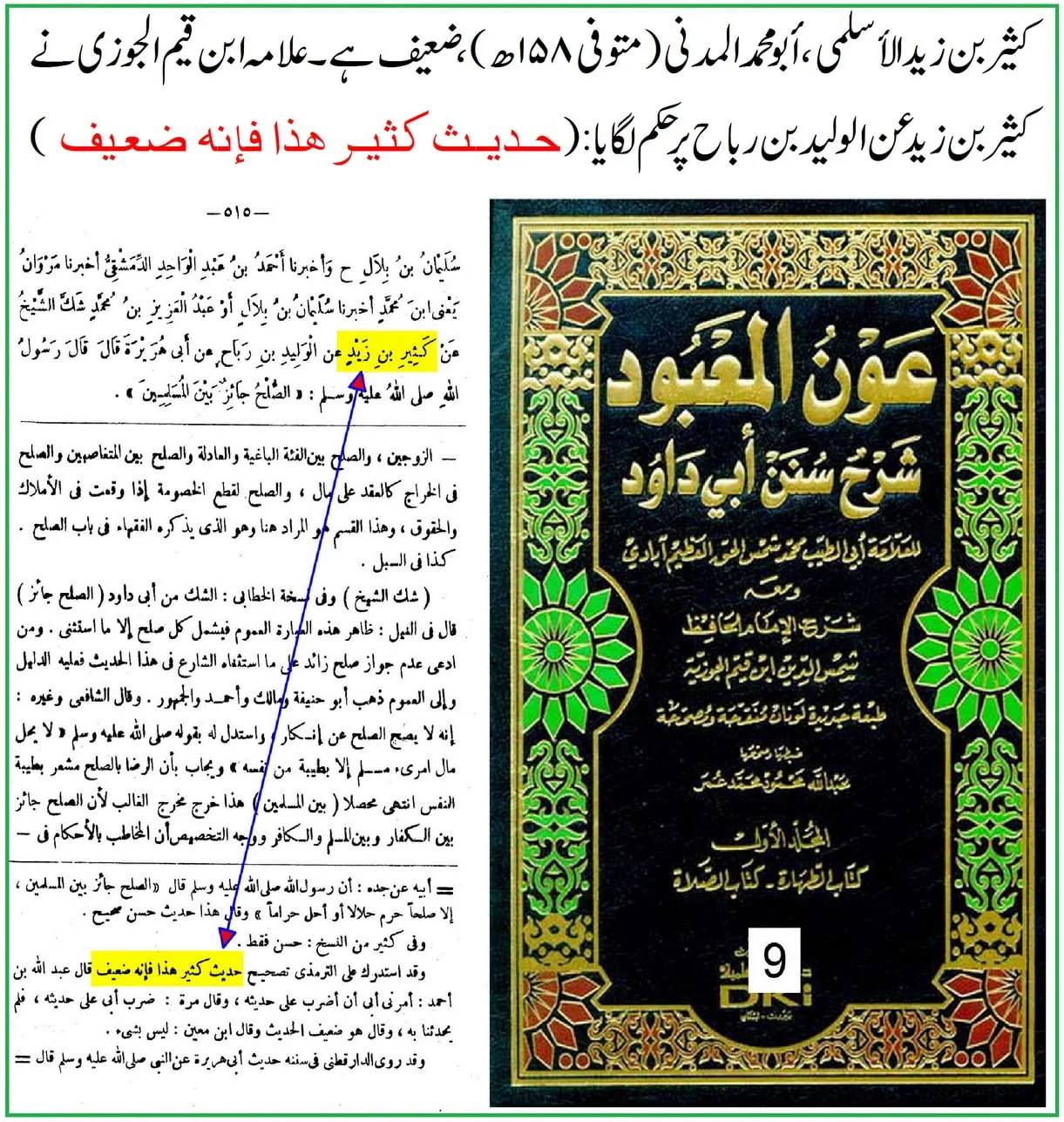
كثير هذا فإنه ضعيف
Translation:
This Kathīr (bin Zayd) is weak.
[ʿAwn al-Maʿbūd with marginal notes of Ibn al-Qayyim]
Brief Explanation:
A brief yet clear declaration that independent reliance upon him is not sound.
Arabic Text:
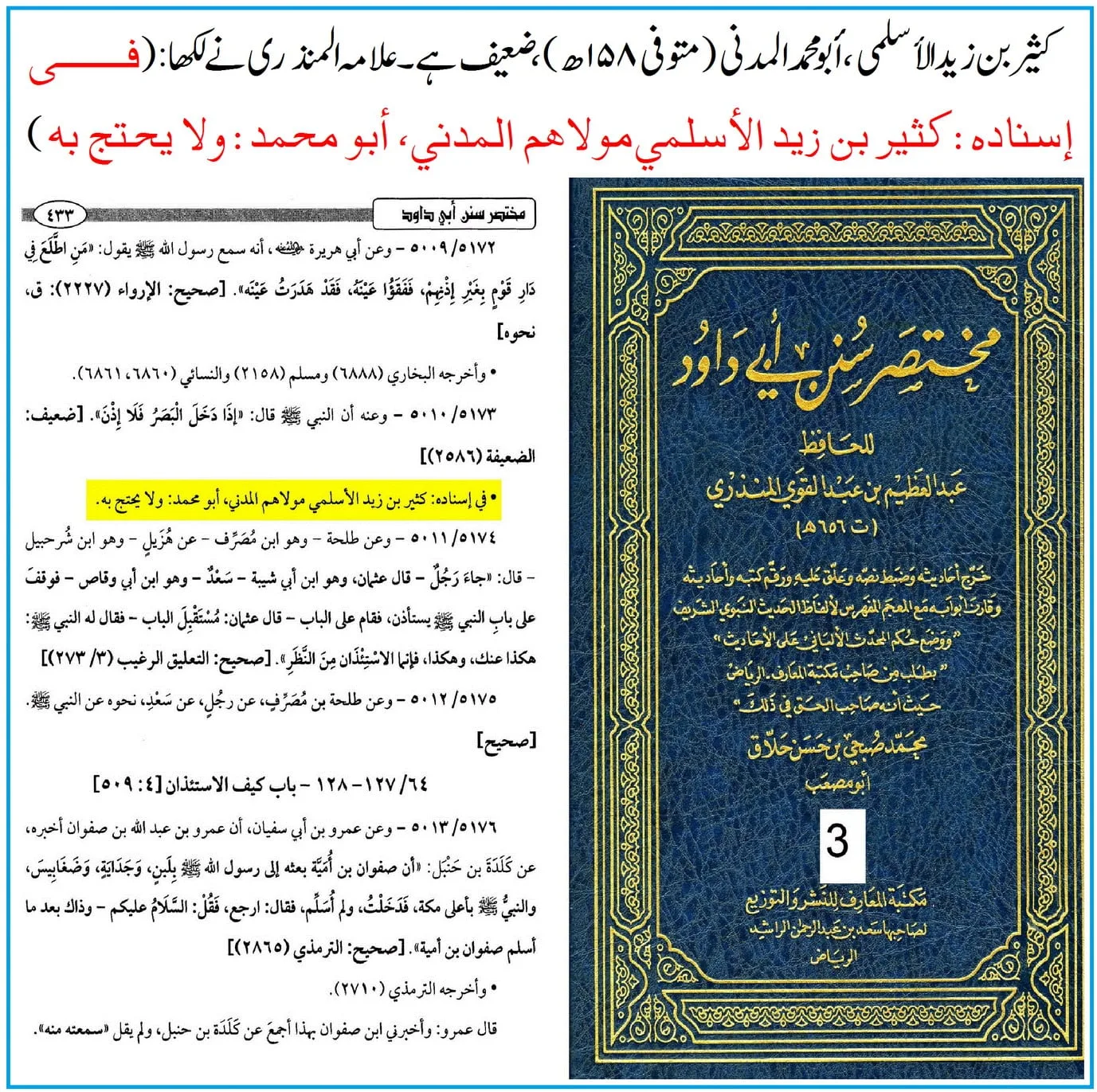
ولا يحتج به
Translation:
He is not used as proof.
[ʿAwn al-Maʿbūd ʿalā Sunan Abī Dāwūd]
Brief Explanation:
This is among the most explicit statements of criticism, especially relevant in cases of solitary narration.
Arabic Text:
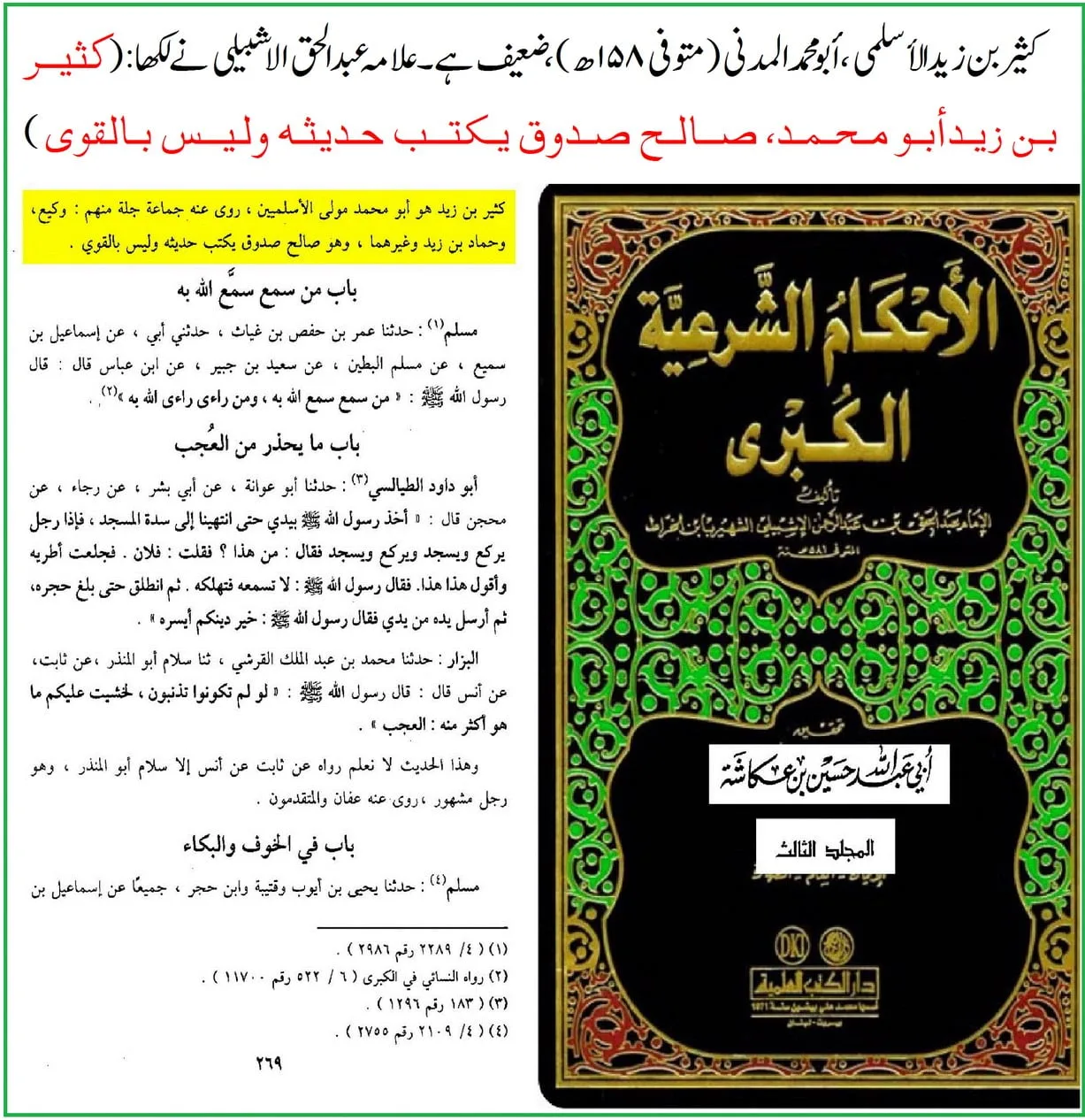
وهو صالح صدوق يكتب حديثه وليس بالقوي
Translation:
He is righteous and truthful; his ḥadīth is written, but he is not strong.
[al-Aḥkām al-Sharʿiyyah al-Kubrā]
Brief Explanation:
This combines praise with limitation, effectively placing his narrations in the category of corroboration.
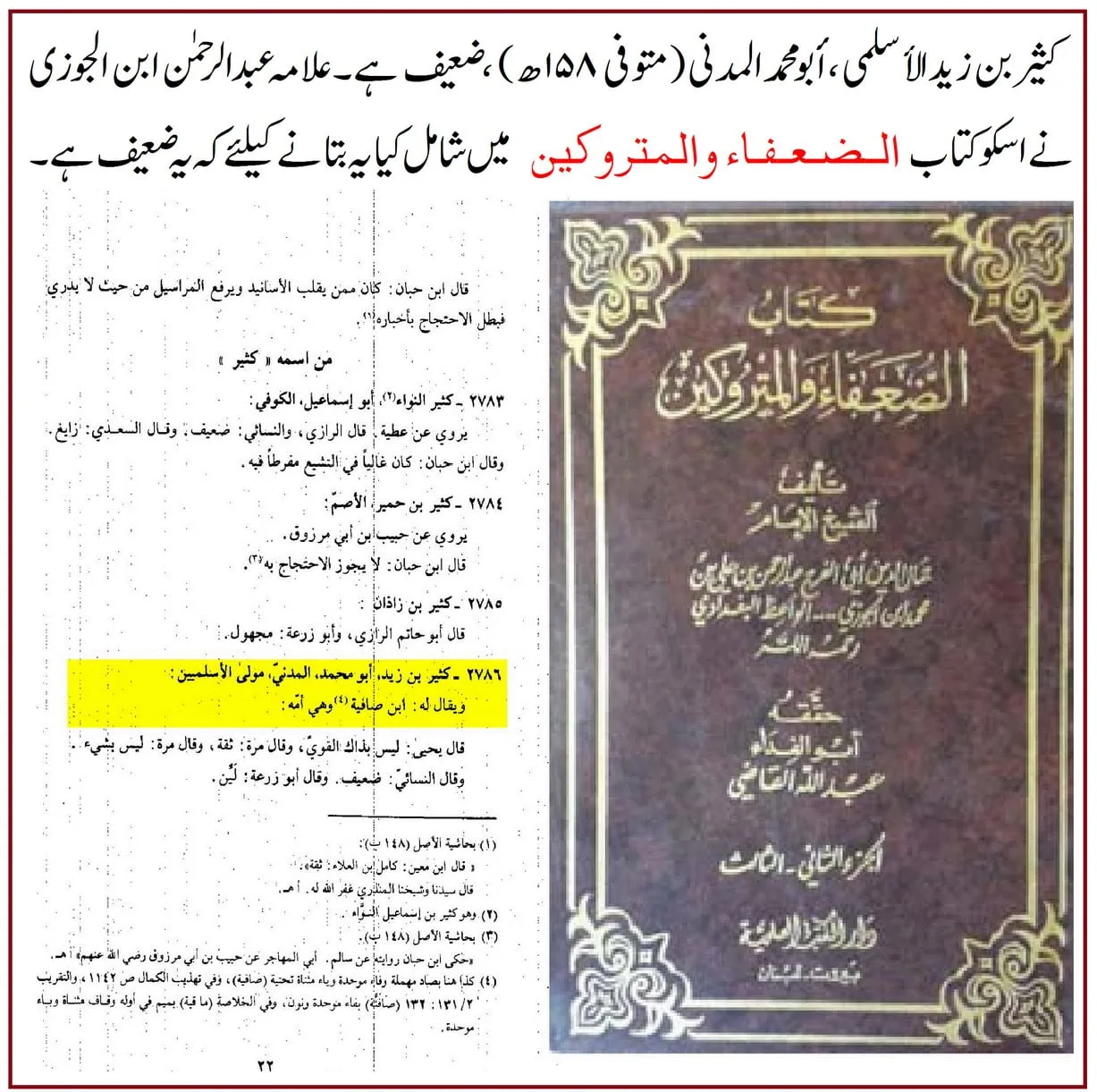
Arabic Text (Summary):
قيل فيه ليس بذاك القوي… وقال النسائي ضعيف… وقال أبو زرعة لين
Translation:
Various statements were cited: “not very strong,” “weak,” and “lenient.”
[al-Ḍuʿafāʾ wa al-Matrūkīn]
Brief Explanation:
The collected opinions collectively indicate insufficient strength, justifying his inclusion among the weak.
Arabic Text:
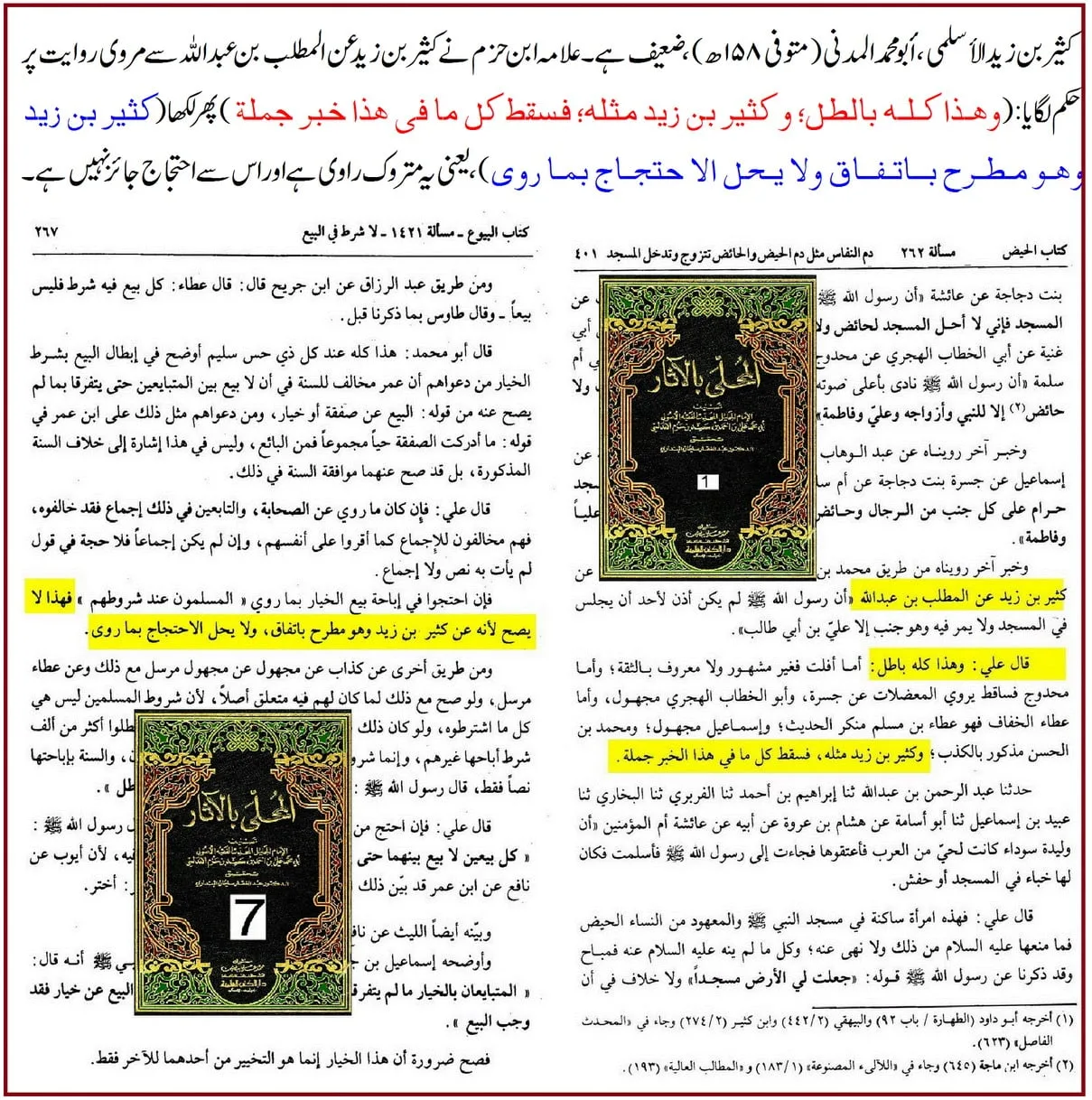
ولا يحل الاحتجاج بما روى
Translation:
It is not lawful to use what he narrated as proof.
[al-Muḥallā bi al-Āthār]
Brief Explanation:
Although Ibn Ḥazm’s criticism is known to be severe, his statement strongly supports the position that independent reliance upon Kathīr bin Zayd is unacceptable.
Arabic Text:
ليس بذاك القوي
Translation:
He is not very strong.
[al-Jarḥ wa al-Taʿdīl]
Brief Explanation:
This reinforces the consistent scholarly trend that he does not reach the level required for independent proof.
✔ ② Those who called him ṣadūq / ṣāliḥ still restricted this with “fīhi layn / laysa bil-qawī.”
✔ ③ Ibn Ḥibbān clearly rejected relying upon him in cases of tafarrud.
✔ ④ Some narrations from him were judged munkar or disconnected.
 (a) The majority of scholars affirm that Kathīr bin Zayd possesses leniency/weakness.
(b) According to many explicit statements, his narration is not used as an independent proof, especially in solitary cases.
(c) The most appropriate and safe position for his narrations is within corroborations and supporting evidences, not as a standalone foundation.
Thus, the intended objective of this article—demonstrating the cautious scholarly approach toward Kathīr bin Zayd based on the majority’s criticism—becomes clear with evidence.
This article systematically presents the statements of Jarḥ wa Taʿdīl by the majority of Hadith scholars regarding Kathīr bin Zayd al-Aslamī al-Madanī (Abū Muḥammad), so that it becomes clear that, according to the critics of Hadith, this narrator possesses weakness / leniency, and especially in the case of tafarrud (solitary narration), relying upon him as proof was not considered appropriate.
The purpose is to bring together before the reader the original Arabic statements, their English translations, references, and brief scholarly analysis, so that it becomes evident that the correct position of Kathīr bin Zayd’s narration is generally in corroborations (mutābaʿāt) and supporting evidences (shawāhid), not as an independent foundation for establishing fundamental or creedal claims.
Introduction to the Narrator and the Subject of Discussion
Name and Lineage: Kathīr bin Zayd al-Aslamī, al-MadanīKunyah: Abū Muḥammad
Fame / Description (as reported): كثير بن زيد الأسلمي، أبو محمد، المدني، السهمي
General Ruling (reported summary): Weak — lā yuḥtajj bihi
(Meaning: he is not relied upon as an independent proof)
In this article, terms such as “ḍaʿīf” (weak), “fīhi layn” (there is leniency in him), “laysa bil-qawī” (not strong), “yuktabu ḥadīthuh” (his ḥadīth is written), and “lā yuḥtajj bihi” (he is not used as proof) are understood according to the technical usage of the Hadith scholars. Along with each statement, its translation and intended meaning are clarified.Statements and Evidence of the Majority of Hadith Scholars
① Abū Ḥātim al-Rāzī رحمه الله
Ruling: “His ḥadīth is written, but he is not strong”Arabic Text:
نا عبد الرحمن قال سئل أبى عن كثير بن زيد فقال صالح (ليس بالقوى) يكتب حديثه
Translation:
ʿAbd al-Raḥmān said: My father (Abū Ḥātim) was asked about Kathīr bin Zayd, and he said: “He is righteous (ṣāliḥ), but not strong; his ḥadīth is written.”
[al-Jarḥ wa al-Taʿdīl]Brief Explanation:
The phrase “laysa bil-qawī” clearly negates strength in precision, while “yuktabu ḥadīthuh” usually indicates that his narration may be considered for corroboration, not that independent proof is established through him.
② Abū Zurʿah al-Rāzī رحمه الله
Ruling: “Truthful, but there is leniency in him”Arabic Text:
عبد الرحمن قال سئل أبو زرعة عن كثير بن زيد فقال هو صدوق فيه لين
Translation:
ʿAbd al-Raḥmān said: Abū Zurʿah was asked about Kathīr bin Zayd, and he said: “He is truthful (ṣadūq), but there is leniency in him.”
[al-Jarḥ wa al-Taʿdīl]Brief Explanation:
“Ṣadūq” indicates he is not accused of lying, but “fīhi layn” shows deficiency in precision. Therefore, his solitary narrations are not used to establish principles or beliefs, and are generally considered among supporting evidences.
③ Ibn Ḥibbān رحمه الله
Severe Criticism: “Frequent mistakes… I do not like using him as proof when he narrates alone”Arabic Text:
كان كثير الخطأ على قلة روايته لا يعجبني الاحتجاج به إذا انفرد
Translation:
Ibn Ḥibbān wrote: Kathīr bin Zayd… despite narrating little, he made many mistakes. I do not like using him as proof when he is alone in narration.
[al-Majrūḥīn min al-Muḥaddithīn]Brief Explanation:
This explicitly clarifies the issue of tafarrud: Ibn Ḥibbān considered his weakness such that his solitary narrations are not suitable for proof.
④ ʿAlī bin al-Madīnī رحمه الله
Ruling: “Righteous, but not strong”Arabic Text:
وسألت عليا عن كثير بن زيد فقال هو صالح وليس بالقوي
Translation:
I asked ʿAlī bin al-Madīnī about Kathīr bin Zayd, and he said: “He is righteous, but not strong.”
[Suʾālāt Muḥammad bin ʿUthmān bin Abī Shaybah]Brief Explanation:
This balanced criticism shows that he is not rejected outright, yet does not meet the standard of strong precision, requiring graded acceptance.
⑤ Imām al-Nasāʾī رحمه الله
Explicit Ruling: “Weak”Arabic Text:
كثير بن زيد ضعيف
Translation:
Kathīr bin Zayd is weak.
[al-Ḍuʿafāʾ wa al-Matrūkīn]Brief Explanation:
The term “ḍaʿīf” is a clear declaration of weakness, generally meaning his narration cannot be taken as independent proof without corroboration.
⑥ Ḥāfiẓ Ibn al-Qaṭṭān رحمه الله
Ruling: WeakReported Statement:
Ḥāfiẓ Ibn al-Qaṭṭān declared Kathīr bin Zayd to be weak.
Reference:
(The exact book/page is not specified in the transmitted material.)
Brief Explanation:
Although details are not cited, this attribution aligns with the broader scholarly trend indicating leniency/weakness in this narrator.
⑦ Ḥāfiẓ al-Dhahabī رحمه الله
Ruling: “Acceptable, but with leniency”Arabic Text:
كثير بن زيد صويلح فيه لين
Translation:
Kathīr bin Zayd is “ṣuwailiḥ” (somewhat acceptable), but there is leniency in him.
[Muʿjam Shuyūkh al-Dhahabī]Brief Explanation:
“Ṣuwailiḥ” indicates he is not completely rejected, yet “fīhi layn” lowers his narration below the level of full reliability.
⑧ Nūr al-Dīn al-Haythamī رحمه الله
Ruling: “Some declared him reliable, but weakness exists”Arabic Text:
وقد وثقه جماعة وفيه ضعف
Translation:
In this chain is Kathīr bin Zayd al-Aslamī; some have declared him trustworthy, but there is weakness in him.
[Majmaʿ al-Zawāʾid]Brief Explanation:
This establishes balance: despite some authentication, weakness is explicitly acknowledged, indicating cautious treatment rather than absolute reliance.
⑨ Yaʿqūb bin Shaybah رحمه الله
Ruling: “Not discarded, but inclined toward weakness”Arabic Text:
وكثير بن زيد ليس بالساقط وإلى الضعف ما هو
Translation:
Kathīr bin Zayd is not discarded, but he inclines toward weakness.
[Tārīkh Dimashq]Brief Explanation:
This clarifies his rank: neither completely abandoned nor accepted as strong proof—rather suited for corroborations.
⑩ Abū Jaʿfar al-Naḥḥās رحمه الله
Ruling on a Specific Ḥadīth: “Munkar and disconnected”Arabic Text:
وهذا حديث منكر منقطع
Translation:
This ḥadīth is rejected (munkar) and disconnected (munqaṭiʿ).
[al-Nāsikh wa al-Mansūkh]Brief Explanation:
Here the ruling concerns a specific narration, showing issues of both connection and reliability in that report.
⑪ Ibn al-Qayyim رحمه الله
Ruling: “This Kathīr is weak”Arabic Text:
كثير هذا فإنه ضعيف
Translation:
This Kathīr (bin Zayd) is weak.
[ʿAwn al-Maʿbūd with marginal notes of Ibn al-Qayyim]Brief Explanation:
A brief yet clear declaration that independent reliance upon him is not sound.
⑫ al-Mundhirī رحمه الله
Explicit Statement: “He is not used as proof”Arabic Text:
ولا يحتج به
Translation:
He is not used as proof.
[ʿAwn al-Maʿbūd ʿalā Sunan Abī Dāwūd]Brief Explanation:
This is among the most explicit statements of criticism, especially relevant in cases of solitary narration.
⑬ ʿAbd al-Ḥaqq al-Ishbīlī رحمه الله
Ruling: “Righteous, truthful… his ḥadīth is written, but not strong”Arabic Text:
وهو صالح صدوق يكتب حديثه وليس بالقوي
Translation:
He is righteous and truthful; his ḥadīth is written, but he is not strong.
[al-Aḥkām al-Sharʿiyyah al-Kubrā]Brief Explanation:
This combines praise with limitation, effectively placing his narrations in the category of corroboration.
⑭ Ibn al-Jawzī رحمه الله
Mentioned among the weak, with multiple opinions citedArabic Text (Summary):
قيل فيه ليس بذاك القوي… وقال النسائي ضعيف… وقال أبو زرعة لين
Translation:
Various statements were cited: “not very strong,” “weak,” and “lenient.”
[al-Ḍuʿafāʾ wa al-Matrūkīn]Brief Explanation:
The collected opinions collectively indicate insufficient strength, justifying his inclusion among the weak.
⑮ Ibn Ḥazm رحمه الله
Very Severe Criticism: “It is not lawful to use his narration as proof”Arabic Text:
ولا يحل الاحتجاج بما روى
Translation:
It is not lawful to use what he narrated as proof.
[al-Muḥallā bi al-Āthār]Brief Explanation:
Although Ibn Ḥazm’s criticism is known to be severe, his statement strongly supports the position that independent reliance upon Kathīr bin Zayd is unacceptable.
⑯ Yaḥyā bin Maʿīn رحمه الله
Ruling: “Not very strong”Arabic Text:
ليس بذاك القوي
Translation:
He is not very strong.
[al-Jarḥ wa al-Taʿdīl]Brief Explanation:
This reinforces the consistent scholarly trend that he does not reach the level required for independent proof.
Overall Summary of the Scholarly Statements
✔ ① Many scholars explicitly declared Kathīr bin Zayd weak.✔ ② Those who called him ṣadūq / ṣāliḥ still restricted this with “fīhi layn / laysa bil-qawī.”
✔ ③ Ibn Ḥibbān clearly rejected relying upon him in cases of tafarrud.
✔ ④ Some narrations from him were judged munkar or disconnected.
Final Conclusion
Based on the transmitted statements: (a) The majority of scholars affirm that Kathīr bin Zayd possesses leniency/weakness. (b) According to many explicit statements, his narration is not used as an independent proof, especially in solitary cases. (c) The most appropriate and safe position for his narrations is within corroborations and supporting evidences, not as a standalone foundation.Thus, the intended objective of this article—demonstrating the cautious scholarly approach toward Kathīr bin Zayd based on the majority’s criticism—becomes clear with evidence.
