
✍ Compiled by: Abu Hamzah Salafi
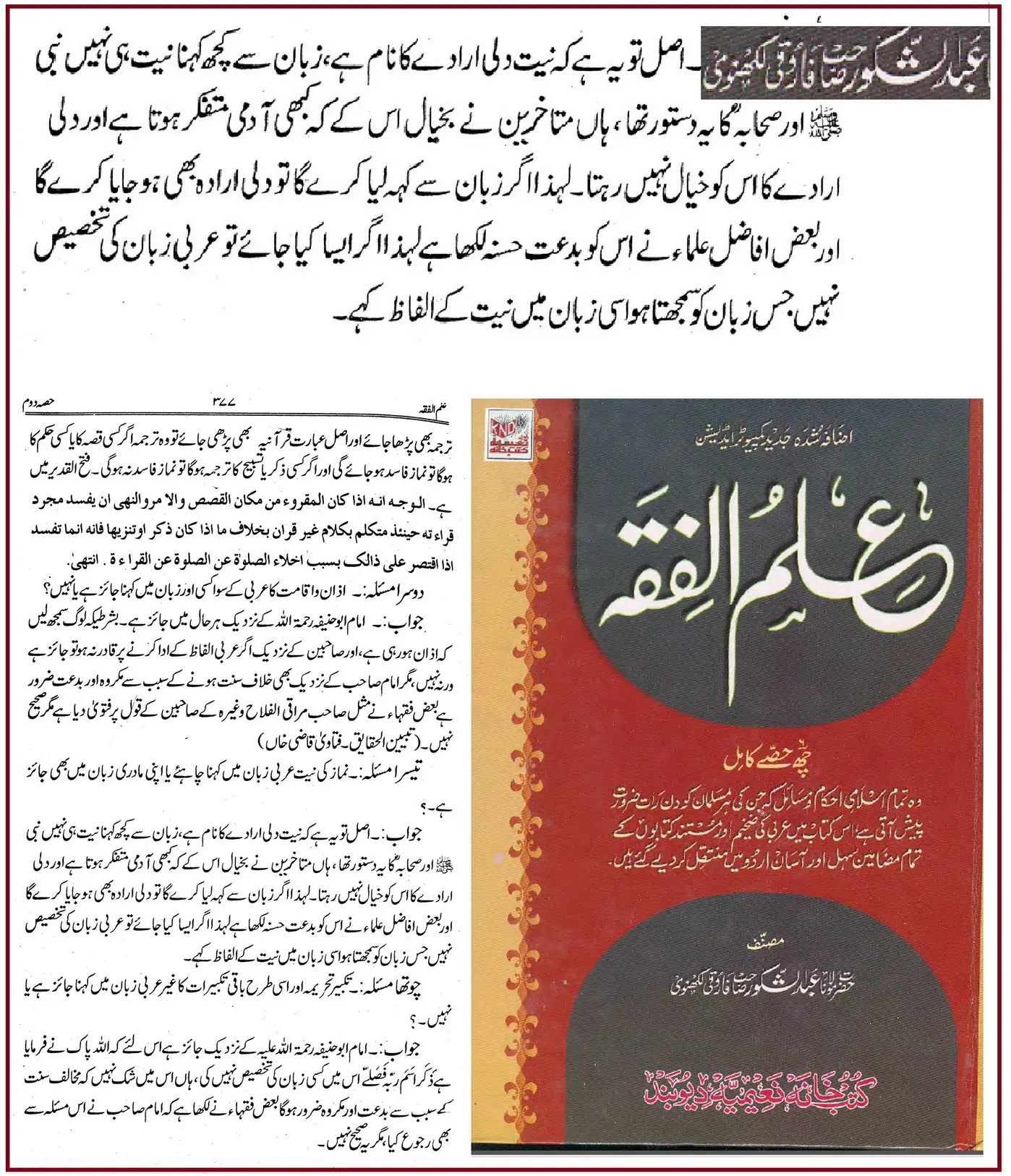
Within the Muslim Ummah, intention (niyyah) for Salah has always been considered an internal act of the heart (قلبی ارادہ). However, followers of the Hanafi school—specifically Barelvis and Deobandis—regard verbal expressions such as “I intend to pray for the sake of Allah” not only as recommended (mustahabb) but, in some books, even as a Sunnah.
In this article, we will refute this innovated view by examining the fatwa of Imam Ahmad Raza Barelvi, and present evidence from authentic Hanafi and Shafi’i sources that verbalizing the intention is neither legislated by Shari‘ah nor practiced by the early generations—but rather, it is a bid‘ah (innovation).
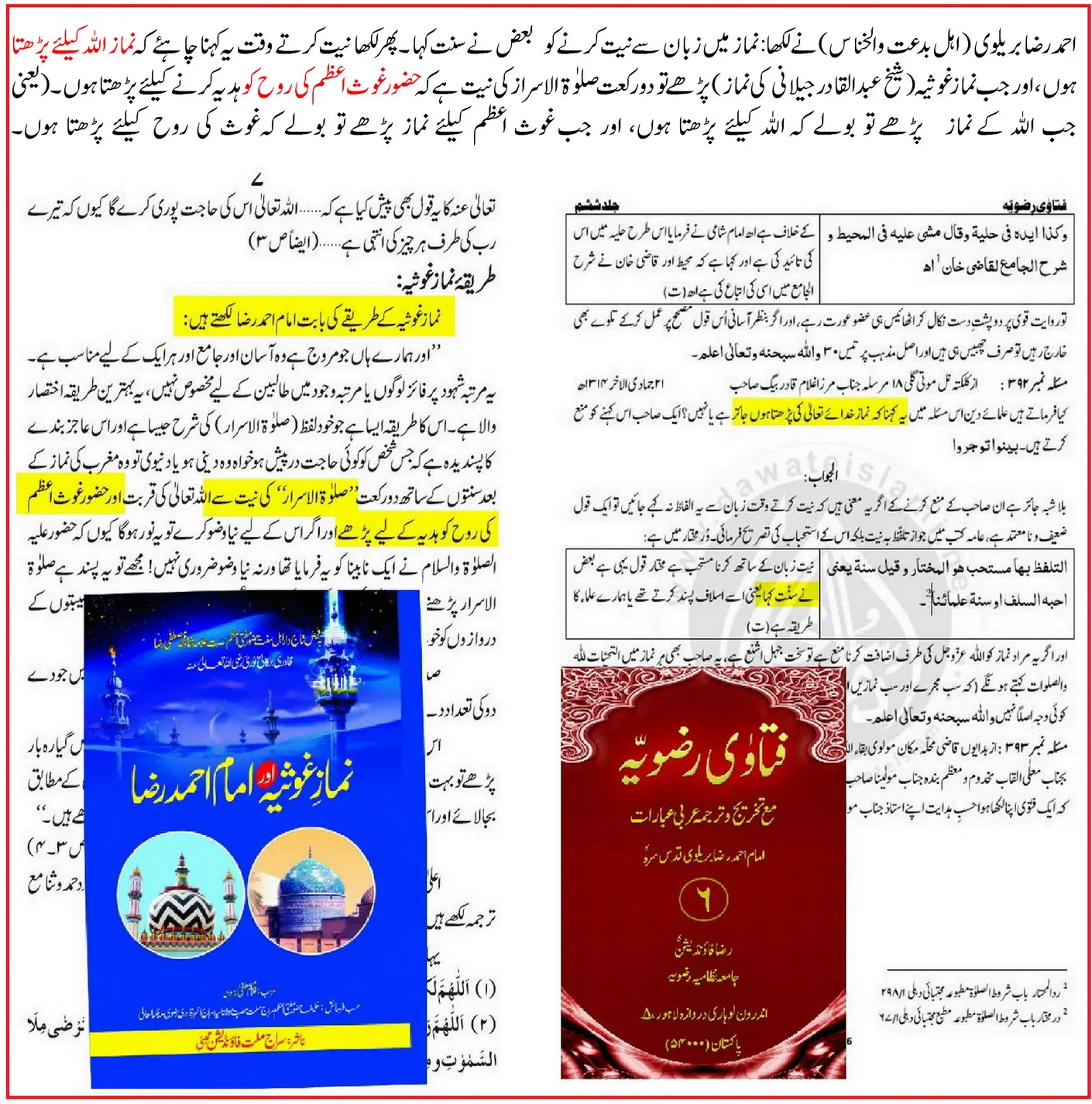
Imam Ahmad Raza Khan Barelvi writes in his book Fatawa Rizwiyah:
“Undoubtedly, saying 'I offer this prayer for the sake of Allah' is permissible… Verbalizing the intention is mustahabb. This is the preferred opinion. Some even called it Sunnah, meaning that the pious predecessors preferred it, or that it is the practice of our scholars.”
 Fatawa Rizwiyah, Vol. 1, p. 67 (quoted from Durr al-Mukhtar)
He further writes:
“If it is claimed that associating the prayer with Allah is forbidden, then that is sheer ignorance… There is absolutely no reason for such prohibition.”
 Note: This is the same Imam who invented the “Salat al-Ghawthiyyah,” a prayer offered in the name of Shaykh ‘Abdul Qadir Jilani رحمه الله. Therefore, saying “I offer this prayer for the sake of Allah” aligns more with his creed than with any authentic Sunnah!
The noble scholars of Ahl al-Sunnah, including senior Hanafi and Shafi‘i authorities, have clearly stated:
✔ The Prophet ﷺ never verbalized his intention—neither through a sound nor weak narration.
✔ No Sahabi or Tabi‘i ever verbalized their niyyah.
✔ Instead, this act has been declared as a bid‘ah (innovation).
"ثم النية بالقلب شرط إجماعاً ولا يشترط النطق بها خلافاً لما في شرح المنية"
Radd al-Muhtār ‘ala al-Durr al-Mukhtār, Vol. 1, p. 84
Translation:
Intention from the heart is a unanimously agreed-upon condition. Verbal expression is not a requirement—contrary to what is mentioned in Sharh al-Munyah.
 Conclusion:
A senior Hanafi authority outright rejected verbal intention and criticized later commentators.
"ولا يشترط في النية النطق بها، لأن محلها القلب"
Al-Baḥr al-Rā’iq Sharḥ Kanz al-Daqā’iq, Vol. 1, p. 11
Translation:
Verbalization is not a condition for intention because its place is the heart.
Conclusion:
Intention requires no speech—heartful resolve suffices.
"النية لغة القصد، وشرعاً: عزم القلب على الفعل عند فعله من غير تردد"
Fatḥ al-Qadīr, Vol. 1, p. 101
Translation:
Niyyah linguistically means ‘resolve’. Islamically, it is the resolve of the heart at the time of action without hesitation.
Conclusion:
No mention of the tongue in the definition of niyyah.
"فالنية متمحضة للقلب فلا اعتبار للسان"
Mirqāt al-Mafātīḥ Sharḥ Mishkāt al-Maṣābīḥ, Vol. 2, p. 241
Translation:
Intention is solely an act of the heart; the tongue has no role.
Conclusion:
Had verbal niyyah been part of worship, the Prophet ﷺ would have taught it.
"القول بأن التلفظ بالنية سنة قول محدث لا يعرف في كلام المتقدمين من أصحابنا"
Al-Āthār al-Marfu‘ah fī al-Akhbār al-Mawḍū‘ah, Vol. 1, p. 50
Translation:
The claim that verbalizing niyyah is Sunnah is a newly invented opinion and is not found among our early scholars.
Conclusion:
That which is not proven from the Prophet ﷺ, the Companions, or early jurists—to label it Sunnah is itself a bid‘ah.
"واعلم أن النية لا يشترط فيها التلفظ بلا خلاف"
Rawḍat al-Ṭālibīn, Vol. 1, p. 71
Translation:
Know that verbal expression is not required for niyyah—there is no disagreement about this.
Note:
Despite the Shafi‘i madhhab emphasizing niyyah more than others, even they declare verbal intention unnecessary.
"ولا يجب التلفظ بالنية باتفاق المسلمين، بل النية محلها القلب باتفاق العلماء"
Majmū‘ al-Fatāwā, Vol. 22, p. 228
Translation:
Verbal intention is not obligatory by consensus of Muslims; rather, niyyah resides in the heart by consensus of scholars.
"وأما التلفظ بالنية فلم يكن من عمل النبي صلى الله عليه وسلم ولا من عمل السلف الصالح، وإنما ابتدعه المتأخرون"
Al-I‘tiṣām, Vol. 1, p. 253
Translation:
Verbal niyyah was not practiced by the Prophet ﷺ or the righteous predecessors—it was an innovation by the later generations.
This matches the definition of bid‘ah:
"Whatever the Prophet ﷺ and his Companions were not upon."
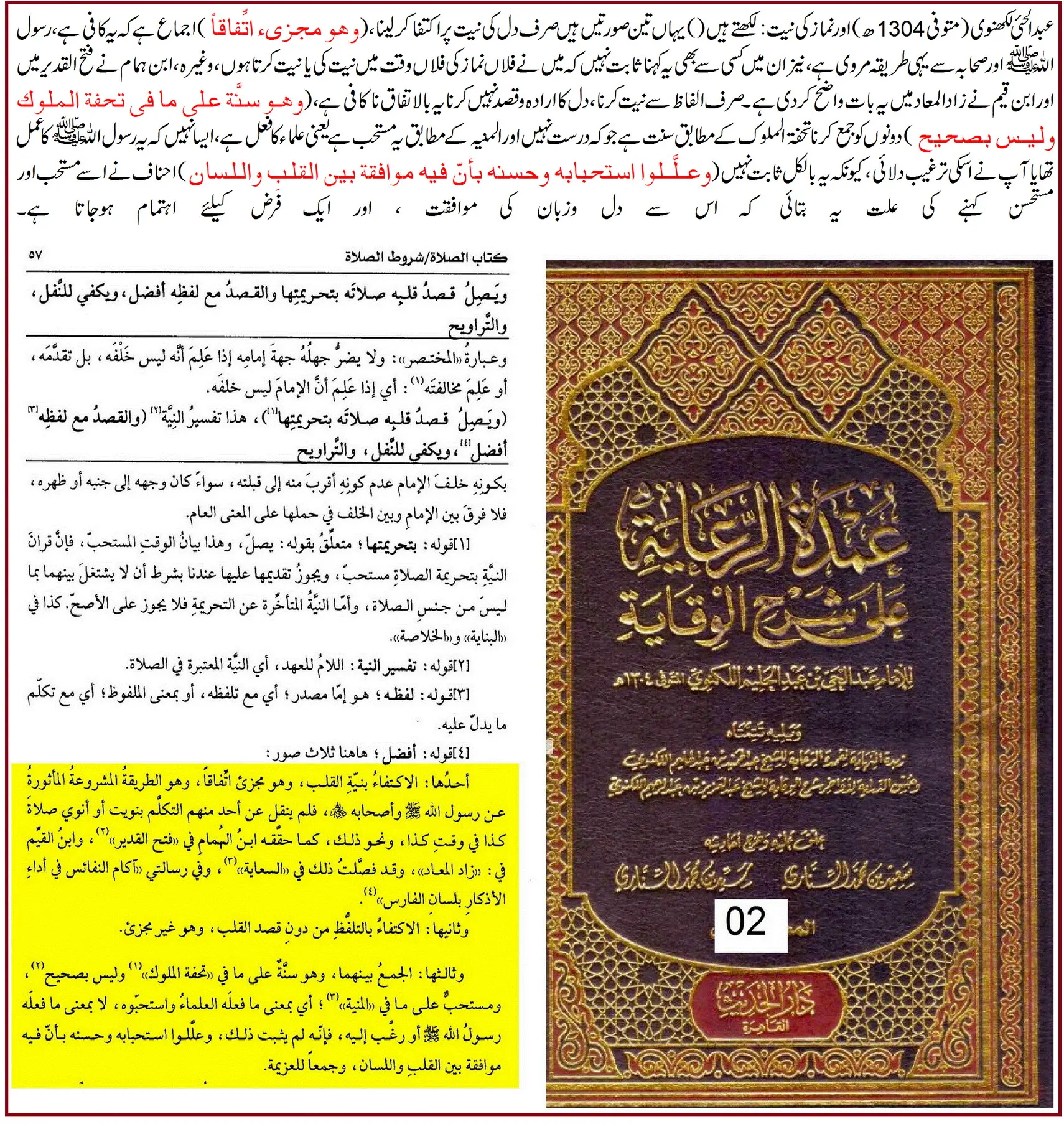
"لم يكن من دأب رسول الله ﷺ ولا أصحابه التكلّم بلفظ نويت أن أُصلّي…"
‘Umdat al-Ri‘āyah, Vol. 1, p. 139
Translation:
Neither the Prophet ﷺ nor his Companions ever uttered “I intend to offer Salah…”
"فمن واظب على فعل لم يفعله الشارع فهو مبتدع… وقيل لا يجوز التلفظ بالنية فإنه بدعة"
Mirqāt al-Mafātīḥ
Translation:
Whoever regularly performs an act not legislated by the Shari‘ah is an innovator… It is also said that verbalizing intention is not permissible—it is a bid‘ah.
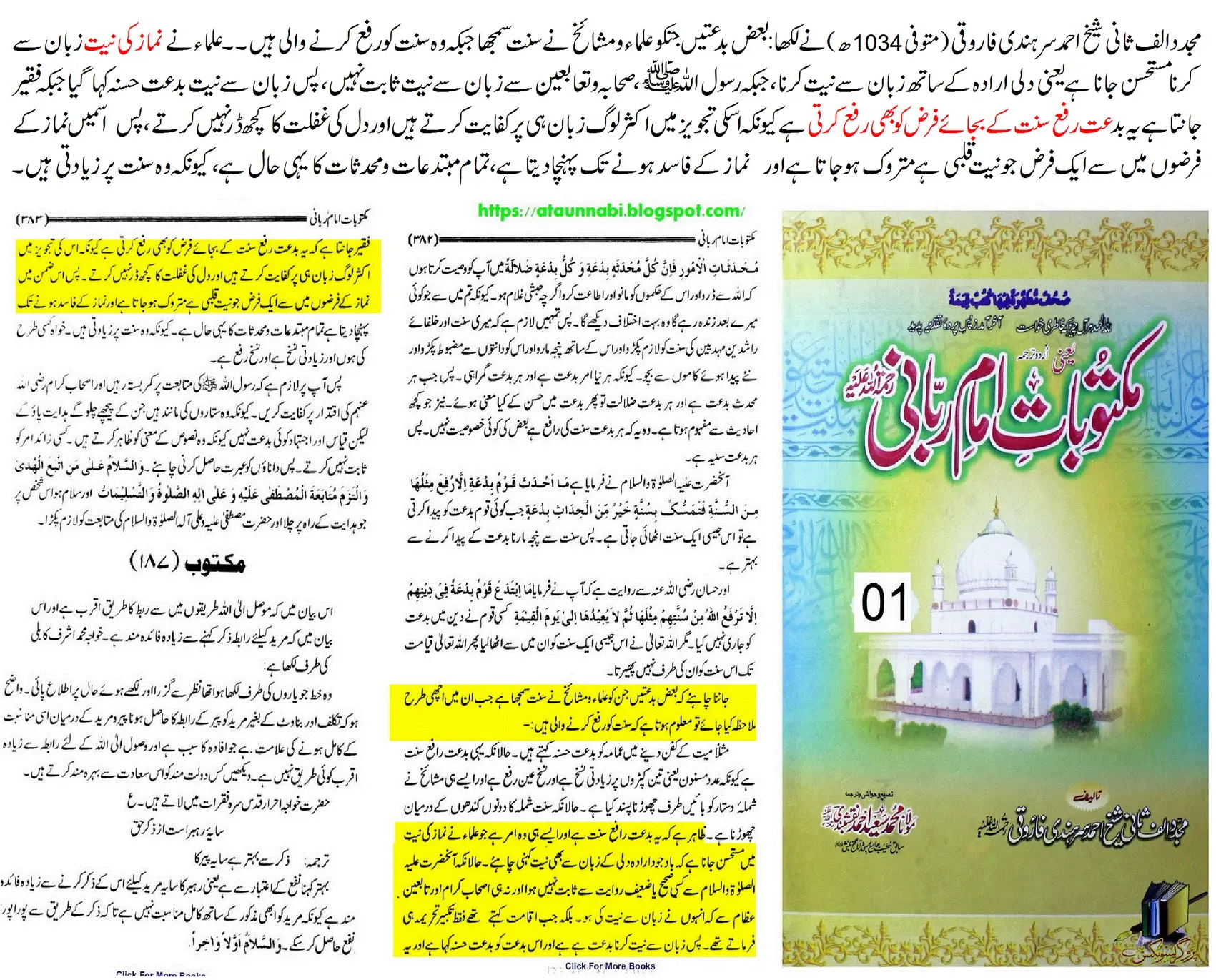
Verbal niyyah, though called a "good innovation" by some, often replaces heartfelt intention, and leads people to neglect the real obligation—thus invalidating the Salah.
Maktūbāt Imām Rabbānī, Volume 2
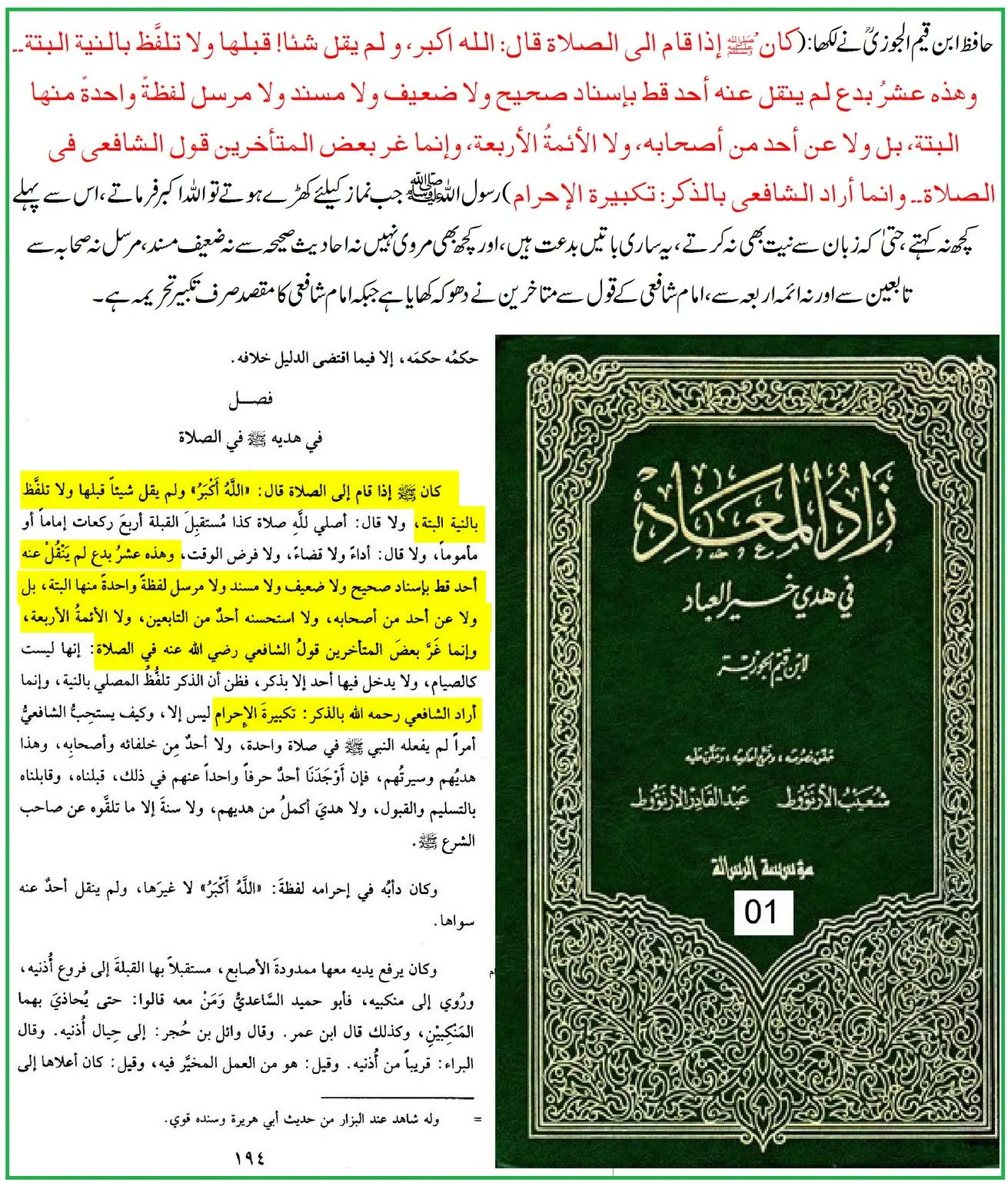
"كان ﷺ إذا قام إلى الصلاة قال: الله أكبر، ولم يقل شيئًا قبلها، ولا تلفظ بالنية البتة…"
Zād al-Ma‘ād, Vol. 1
Translation:
When the Prophet ﷺ would begin Salah, he would say “Allāhu Akbar”—he never said anything before it, nor did he ever verbalize the niyyah.
Summary:
Verbal intention has no basis in sound or weak narrations—nor from the Prophet ﷺ, his Companions, or any of the four Imams.
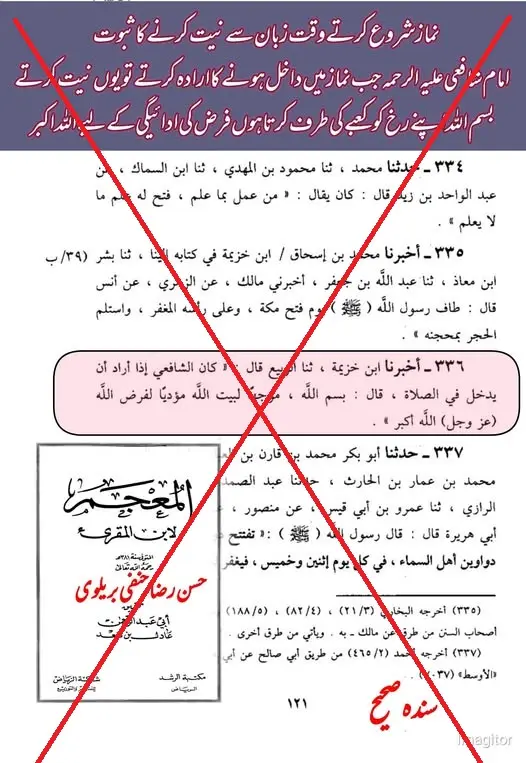
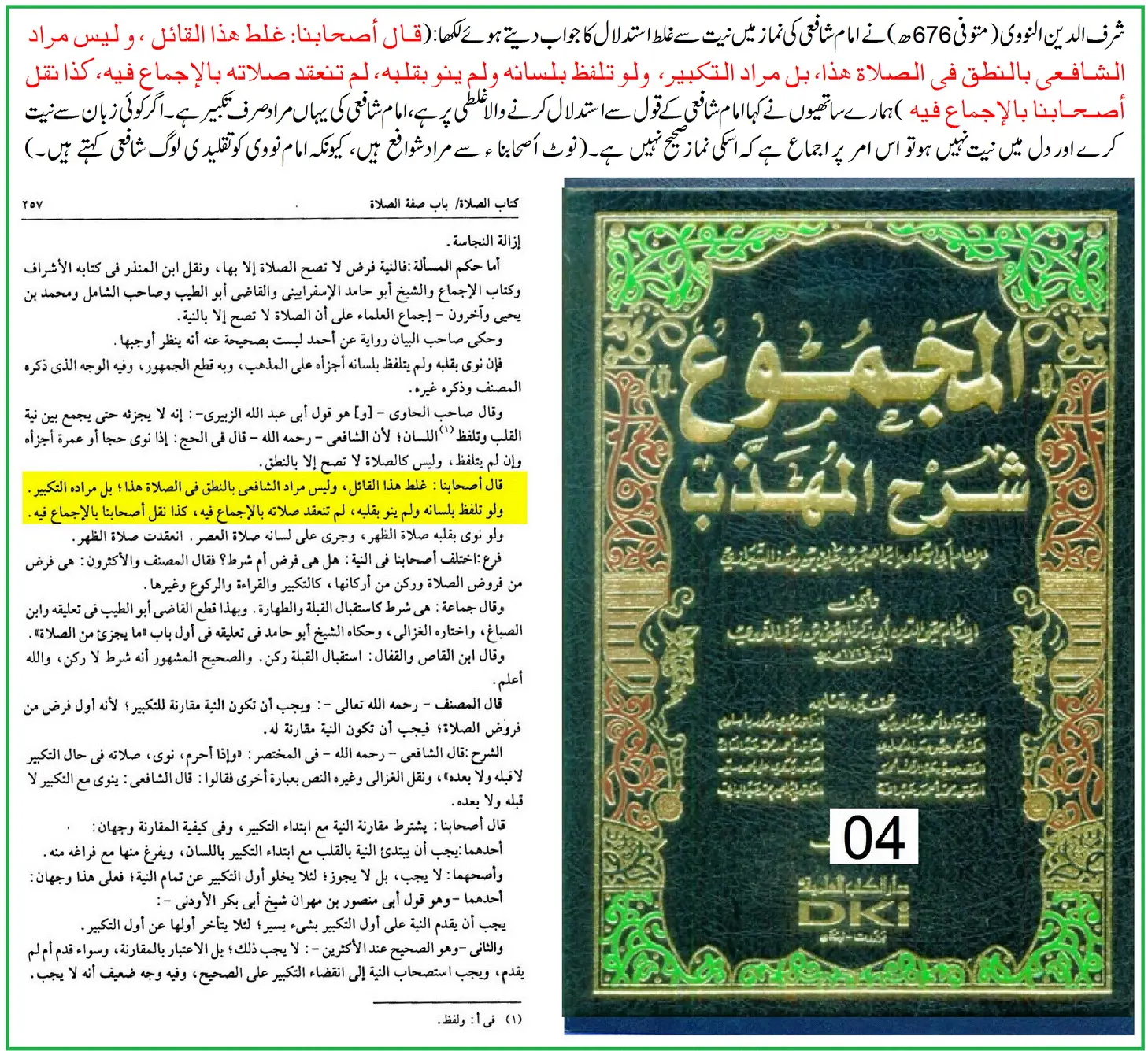
"ليس مراد الشافعي بالنطق النية بل مراده التكبير…"
Al-Majmū‘ Sharḥ al-Muhadhdhab
Translation:
Imam al-Shafi‘i never meant verbal niyyah; he referred to Takbir al-Ihram.
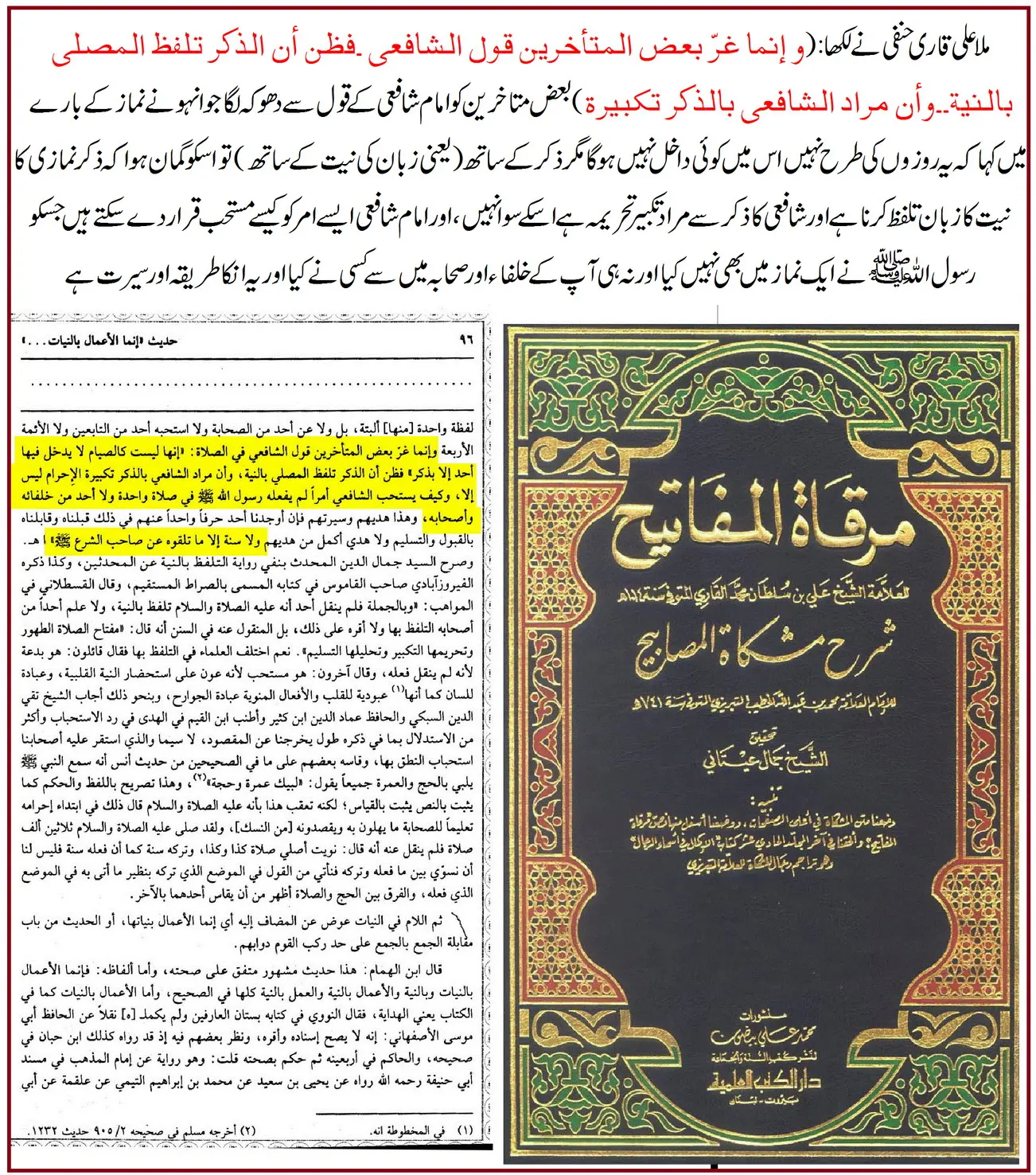
"مراد الشافعي التكبير، لا التلفظ بالنية"
Mirqāt al-Mafātīḥ
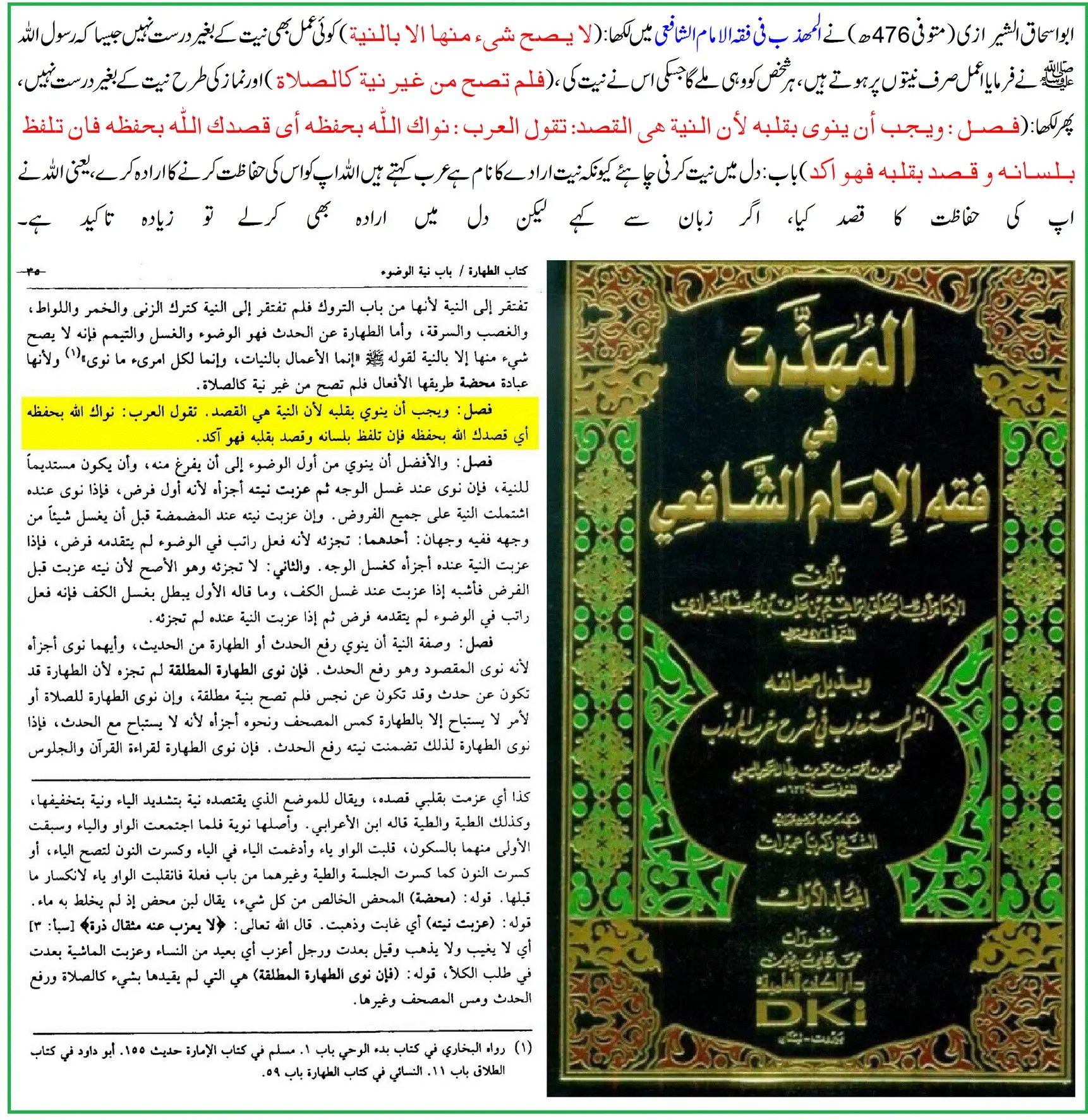
"فإن تلفظ بلسانه وقصد بقلبه فهو آكد"
Al-Muhadhdhab
Translation:
If one verbalizes and also intends in the heart, it may add emphasis—but the actual niyyah is only in the heart.
Verbal niyyah is:
 Not found in any authentic Hadith
Not found from the Companions or Tabi‘in
Not found from any of the Four Imams
And has been declared an innovation
 Intention is a heartfelt action—this is the actual Shar‘i command
Verbal niyyah is a bid‘ah
Without heartfelt niyyah, mere words do not validate Salah
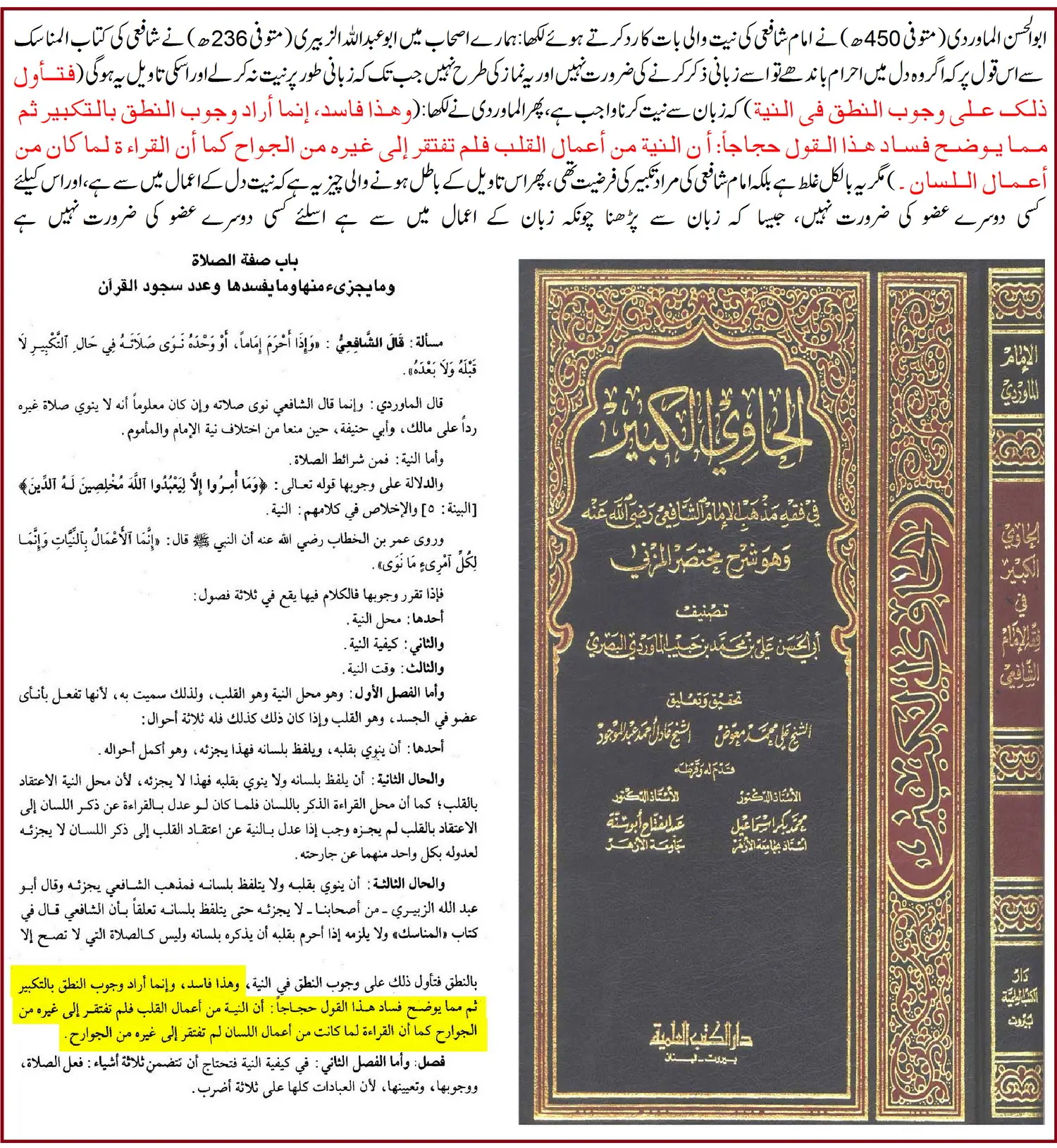
Misattributing this view to Imam al-Shafi‘i has been refuted by his own scholars
That which the Prophet ﷺ and the Companions did not practice is not part of Islam
❖ Introduction
Within the Muslim Ummah, intention (niyyah) for Salah has always been considered an internal act of the heart (قلبی ارادہ). However, followers of the Hanafi school—specifically Barelvis and Deobandis—regard verbal expressions such as “I intend to pray for the sake of Allah” not only as recommended (mustahabb) but, in some books, even as a Sunnah.
In this article, we will refute this innovated view by examining the fatwa of Imam Ahmad Raza Barelvi, and present evidence from authentic Hanafi and Shafi’i sources that verbalizing the intention is neither legislated by Shari‘ah nor practiced by the early generations—but rather, it is a bid‘ah (innovation).
◈ Claim of the Innovators: Fatwa of Ahmad Raza Barelvi
Imam Ahmad Raza Khan Barelvi writes in his book Fatawa Rizwiyah:
“Undoubtedly, saying 'I offer this prayer for the sake of Allah' is permissible… Verbalizing the intention is mustahabb. This is the preferred opinion. Some even called it Sunnah, meaning that the pious predecessors preferred it, or that it is the practice of our scholars.”
Fatawa Rizwiyah, Vol. 1, p. 67 (quoted from Durr al-Mukhtar)He further writes:
“If it is claimed that associating the prayer with Allah is forbidden, then that is sheer ignorance… There is absolutely no reason for such prohibition.”
Note: This is the same Imam who invented the “Salat al-Ghawthiyyah,” a prayer offered in the name of Shaykh ‘Abdul Qadir Jilani رحمه الله. Therefore, saying “I offer this prayer for the sake of Allah” aligns more with his creed than with any authentic Sunnah!❖ The Position of Ahl al-Sunnah wal-Jama‘ah: Verbalizing Intention is a Bid‘ah
The noble scholars of Ahl al-Sunnah, including senior Hanafi and Shafi‘i authorities, have clearly stated:
✔ The Prophet ﷺ never verbalized his intention—neither through a sound nor weak narration.
✔ No Sahabi or Tabi‘i ever verbalized their niyyah.
✔ Instead, this act has been declared as a bid‘ah (innovation).
 Statements of Hanafi Imams Rejecting Verbal Niyyah
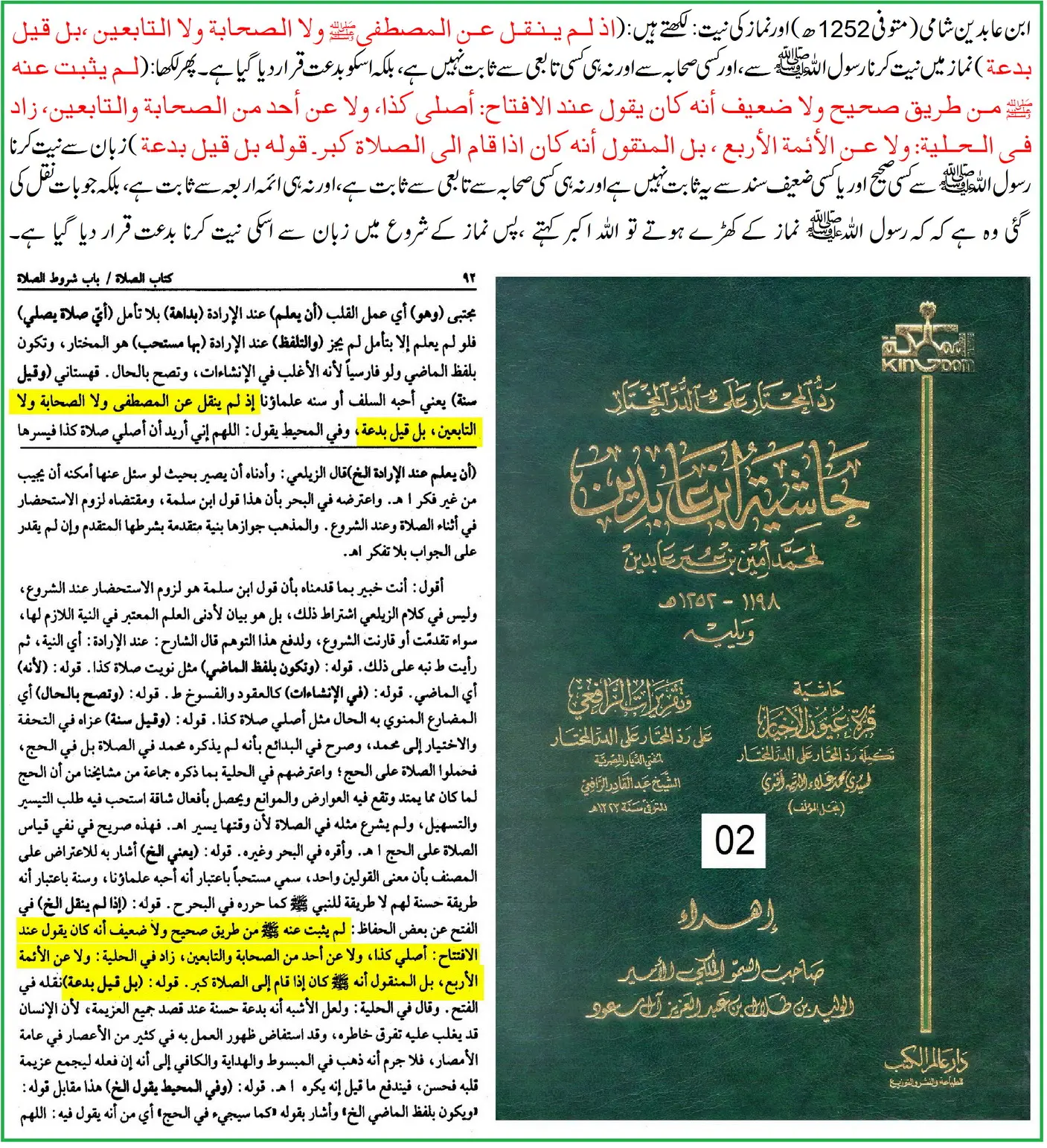
 ① Imām Ibn ‘Ābidīn al-Shāmī (d. 1252 AH):
"ثم النية بالقلب شرط إجماعاً ولا يشترط النطق بها خلافاً لما في شرح المنية"
Radd al-Muhtār ‘ala al-Durr al-Mukhtār, Vol. 1, p. 84Translation:
Intention from the heart is a unanimously agreed-upon condition. Verbal expression is not a requirement—contrary to what is mentioned in Sharh al-Munyah.
Conclusion:A senior Hanafi authority outright rejected verbal intention and criticized later commentators.
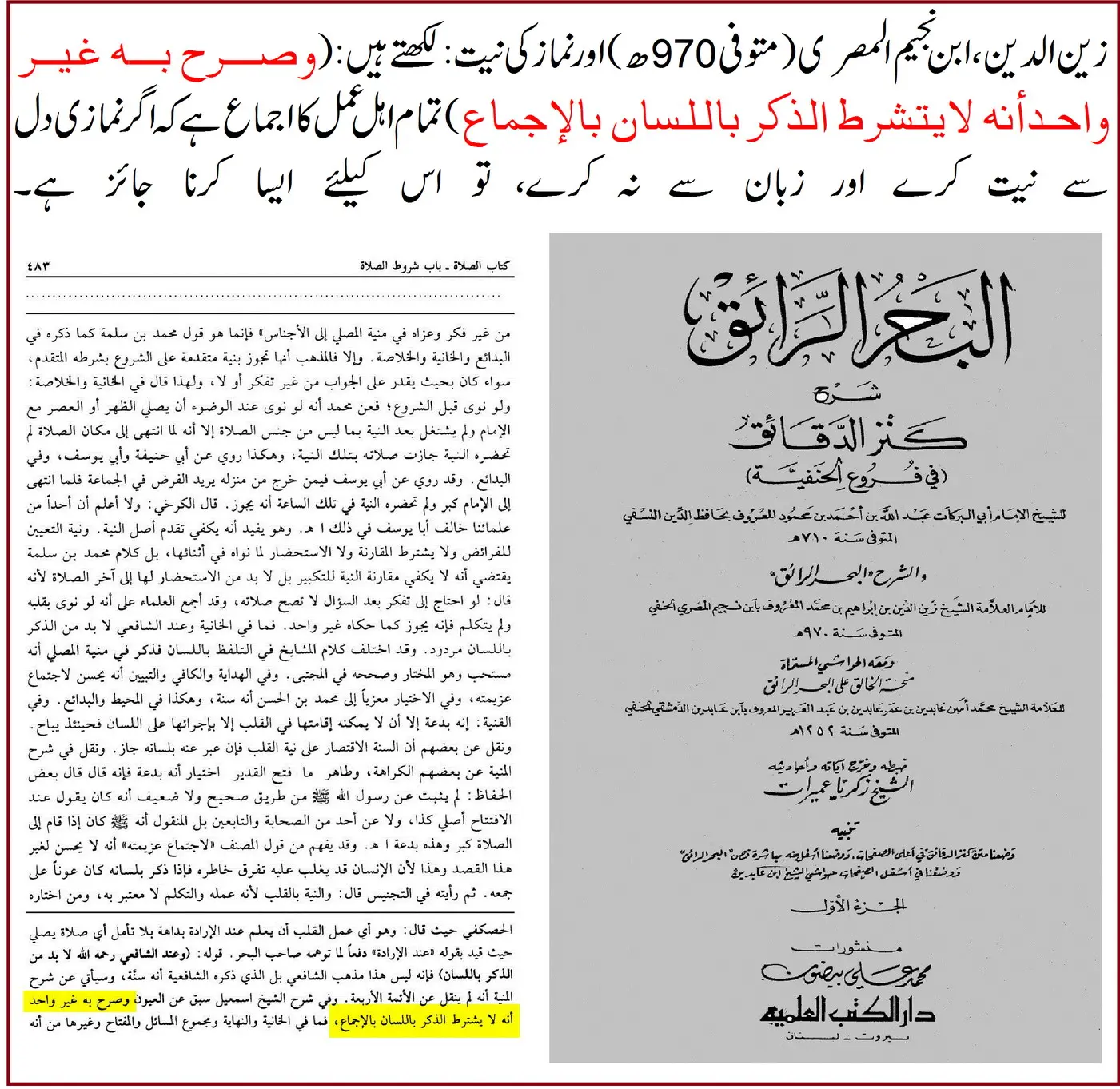
② Imām Ibn Nujaym (d. 970 AH):
"ولا يشترط في النية النطق بها، لأن محلها القلب"
Al-Baḥr al-Rā’iq Sharḥ Kanz al-Daqā’iq, Vol. 1, p. 11Translation:
Verbalization is not a condition for intention because its place is the heart.
Conclusion:Intention requires no speech—heartful resolve suffices.
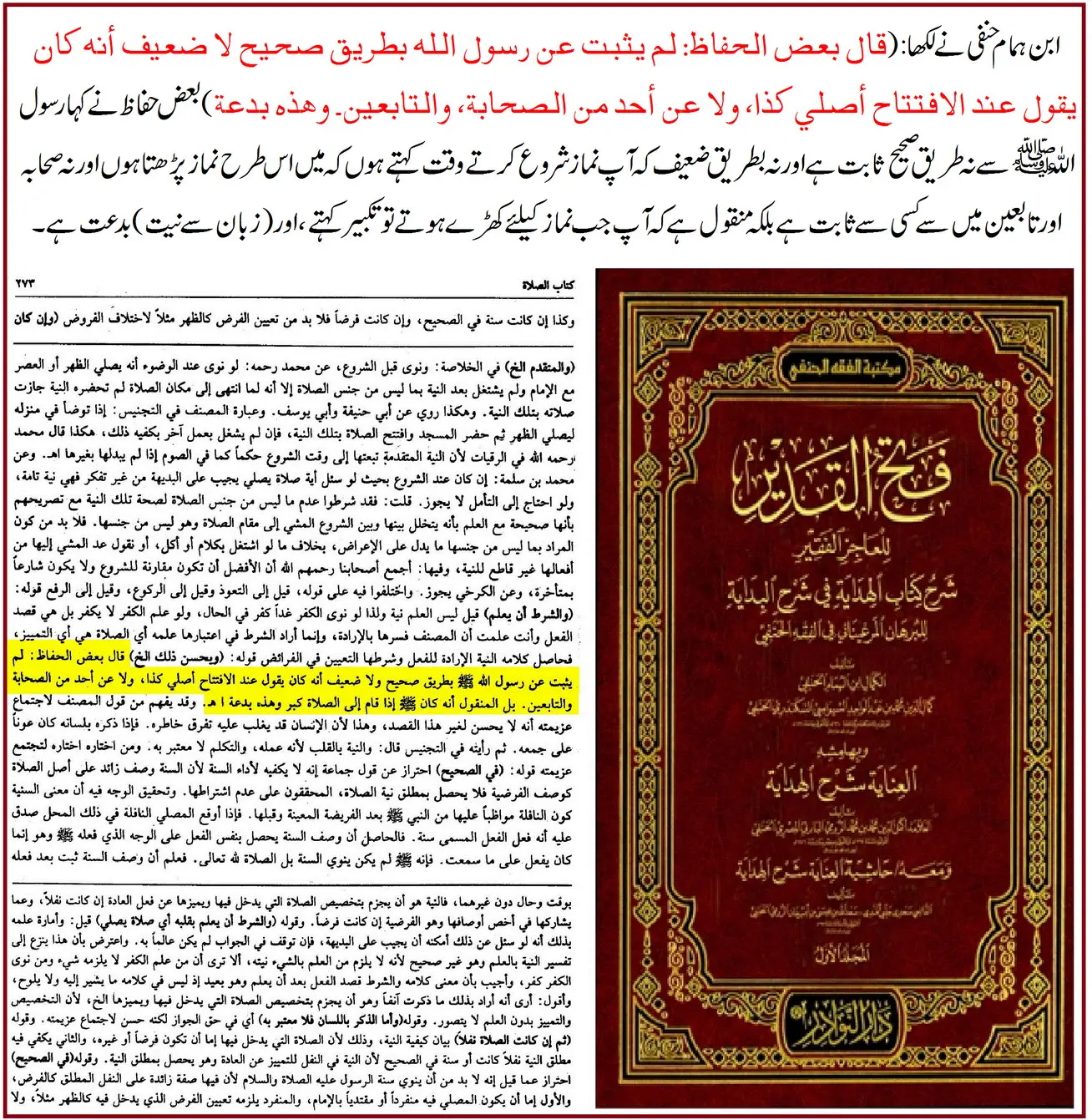
③ Imām Ibn al-Humām (d. 861 AH):
"النية لغة القصد، وشرعاً: عزم القلب على الفعل عند فعله من غير تردد"
Fatḥ al-Qadīr, Vol. 1, p. 101Translation:
Niyyah linguistically means ‘resolve’. Islamically, it is the resolve of the heart at the time of action without hesitation.
Conclusion:No mention of the tongue in the definition of niyyah.
④ Imām Mullā ‘Alī al-Qārī (d. 1014 AH):
"فالنية متمحضة للقلب فلا اعتبار للسان"
Mirqāt al-Mafātīḥ Sharḥ Mishkāt al-Maṣābīḥ, Vol. 2, p. 241Translation:
Intention is solely an act of the heart; the tongue has no role.
Conclusion:Had verbal niyyah been part of worship, the Prophet ﷺ would have taught it.
⑤ ‘Allāmah ‘Abd al-Ḥayy al-Lakhnawī (d. 1304 AH):
"القول بأن التلفظ بالنية سنة قول محدث لا يعرف في كلام المتقدمين من أصحابنا"
Al-Āthār al-Marfu‘ah fī al-Akhbār al-Mawḍū‘ah, Vol. 1, p. 50Translation:
The claim that verbalizing niyyah is Sunnah is a newly invented opinion and is not found among our early scholars.
Conclusion:That which is not proven from the Prophet ﷺ, the Companions, or early jurists—to label it Sunnah is itself a bid‘ah.
Evidences from All Four Madhāhib
⑥ Imām al-Nawawī al-Shāfi‘ī (d. 676 AH):
"واعلم أن النية لا يشترط فيها التلفظ بلا خلاف"
Rawḍat al-Ṭālibīn, Vol. 1, p. 71Translation:
Know that verbal expression is not required for niyyah—there is no disagreement about this.
Note:Despite the Shafi‘i madhhab emphasizing niyyah more than others, even they declare verbal intention unnecessary.
⑦ Shaykh al-Islām Ibn Taymiyyah:
"ولا يجب التلفظ بالنية باتفاق المسلمين، بل النية محلها القلب باتفاق العلماء"
Majmū‘ al-Fatāwā, Vol. 22, p. 228Translation:
Verbal intention is not obligatory by consensus of Muslims; rather, niyyah resides in the heart by consensus of scholars.
⑧ Imām al-Shāṭibī (Mālikī):
"وأما التلفظ بالنية فلم يكن من عمل النبي صلى الله عليه وسلم ولا من عمل السلف الصالح، وإنما ابتدعه المتأخرون"
Al-I‘tiṣām, Vol. 1, p. 253Translation:
Verbal niyyah was not practiced by the Prophet ﷺ or the righteous predecessors—it was an innovation by the later generations.
This matches the definition of bid‘ah:"Whatever the Prophet ﷺ and his Companions were not upon."
❖ The Final Verdict of the Scholars
⑨ ‘Allāmah ‘Abd al-Ḥayy Lakhnawī (Hanafi):
"لم يكن من دأب رسول الله ﷺ ولا أصحابه التكلّم بلفظ نويت أن أُصلّي…"
‘Umdat al-Ri‘āyah, Vol. 1, p. 139Translation:
Neither the Prophet ﷺ nor his Companions ever uttered “I intend to offer Salah…”
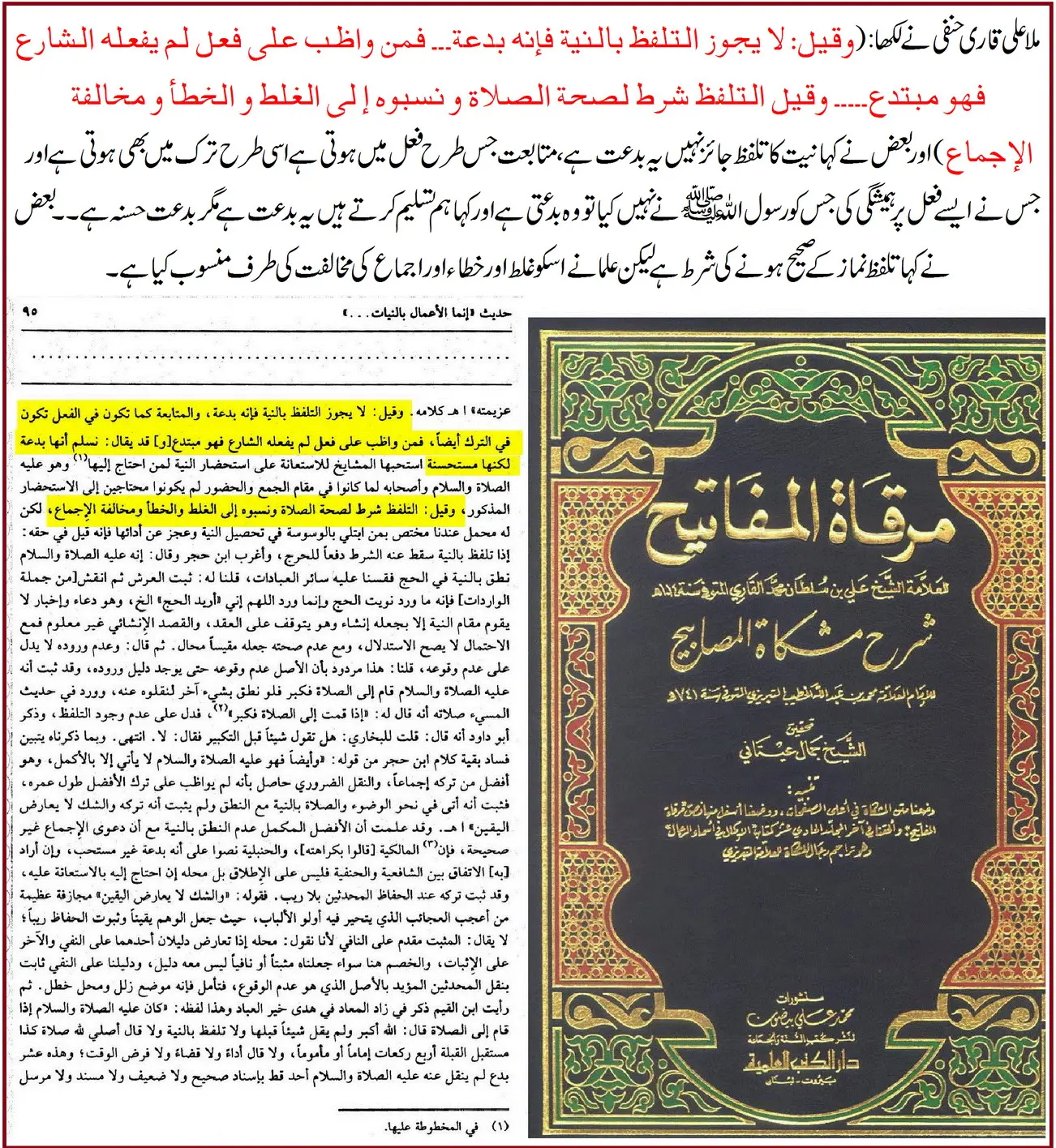
⑩ Mullā ‘Alī al-Qārī (Hanafi):
"فمن واظب على فعل لم يفعله الشارع فهو مبتدع… وقيل لا يجوز التلفظ بالنية فإنه بدعة"
Mirqāt al-MafātīḥTranslation:
Whoever regularly performs an act not legislated by the Shari‘ah is an innovator… It is also said that verbalizing intention is not permissible—it is a bid‘ah.
❖ Scholars Outside the Four Schools
⑪ Mujaddid Alf Thānī Shaykh Aḥmad Sirhindī (d. 1034 AH):
Verbal niyyah, though called a "good innovation" by some, often replaces heartfelt intention, and leads people to neglect the real obligation—thus invalidating the Salah.
Maktūbāt Imām Rabbānī, Volume 2 ⑫ Imām Ibn al-Qayyim:
"كان ﷺ إذا قام إلى الصلاة قال: الله أكبر، ولم يقل شيئًا قبلها، ولا تلفظ بالنية البتة…"
Zād al-Ma‘ād, Vol. 1Translation:
When the Prophet ﷺ would begin Salah, he would say “Allāhu Akbar”—he never said anything before it, nor did he ever verbalize the niyyah.
Summary:Verbal intention has no basis in sound or weak narrations—nor from the Prophet ﷺ, his Companions, or any of the four Imams.
❖ Clarification Regarding Imam al-Shāfi‘ī
⑬ Imām al-Nawawī:
"ليس مراد الشافعي بالنطق النية بل مراده التكبير…"
Al-Majmū‘ Sharḥ al-MuhadhdhabTranslation:
Imam al-Shafi‘i never meant verbal niyyah; he referred to Takbir al-Ihram.
⑭ Mullā ‘Alī al-Qārī:
"مراد الشافعي التكبير، لا التلفظ بالنية"
Mirqāt al-Mafātīḥ ⑮ Imām Abū Isḥāq al-Shīrāzī (Shāfi‘ī):
"فإن تلفظ بلسانه وقصد بقلبه فهو آكد"
Al-MuhadhdhabTranslation:
If one verbalizes and also intends in the heart, it may add emphasis—but the actual niyyah is only in the heart.
⑯ Scholars including Ibn al-Qayyim:
Verbal niyyah is:
Not found in any authentic Hadith Not found from the Companions or Tabi‘in Not found from any of the Four Imams And has been declared an innovation Final Conclusion:
Intention is a heartfelt action—this is the actual Shar‘i command Verbal niyyah is a bid‘ah Without heartfelt niyyah, mere words do not validate Salah Misattributing this view to Imam al-Shafi‘i has been refuted by his own scholars That which the Prophet ﷺ and the Companions did not practice is not part of Islam