


This excerpt is taken from Sheikh Irshad Ullah Maan's book The Search for Truth.
[إن الحمد لله نحمده ونستعينه، ونستغفره، ونعوذ بالله من شرور أنفسنا ومن سيئات أعمالنا، من يهده الله فلا مضل له، ومن يضلل فلا هادي له، وأشهد أن لا إله إلا الله وحده لا شريك له، وأشهد أن محمدا عبده ورسوله، أما بعد! فإن خير الحديث كتاب الله وخير الهدي هدى محمد صلى الله عليه وسلم وشر الأمور محدثاتها وكل محدثة بدعة وكل بدعة ضلالة، الضلالة في النار]
Generally, in the sermon, the words (نؤمن به و تتوكل عليه) are recited, but these are not found in authentic hadiths. In authentic hadiths, (نشهد) is not a plural form but the singular form (أشهد). This sermon is recited on occasions of marriage and Friday sermons, general admonition and guidance, and teaching and instruction. It is called the sermon of need; after reciting it, a person should state their need and requirement.
My brothers! This is the sermon of the Messenger of Allahﷺ. Nowadays, some who recite the Kalima abandon this Sunnah sermon and deliver self-made sermons, as is found in Muhammad Ilyas Qadri Barelvi Sahib's book, "Faizan-e-Sunnat." Remember that just as the person of the Prophet ﷺ is superior and exalted above all elders and Imams on the face of the earth, similarly, his teachings and Sunnah are superior and exalted above all other ways on earth. People enthusiastically praise the Prophet’s ﷺ beauty, morals, chastity, character, trustworthiness, and truthfulness, but in following the Messenger ﷺ, they prefer jurisprudence, analogy, and innovations over his words. They should consider whose character they have adopted, while the religion has been completed and it is not permissible to change even a single word in it.
This world is temporary and then death will come. The life that begins after the Day of Judgment will never end, because on the Day of Judgment death will be slaughtered. Therefore, every person should thoroughly investigate matters of religion and not act blindly. By thoroughly researching religion, one should correct their belief. After the correctness of belief, one should perform good deeds, because if one's belief is not correct, none of their deeds are acceptable:
[وَ مَنۡ یَّکۡفُرۡ بِالۡاِیۡمَانِ فَقَدۡ حَبِطَ عَمَلُہٗ ۫ وَ ہُوَ فِی الۡاٰخِرَۃِ مِنَ الۡخٰسِرِیۡنَ]
And whoever denies faith, indeed, his deeds are worthless, and he will be among the losers in the Hereafter.
Reference: Al-Ma'idah:5
And in the Holy Quran, faith is mentioned first and then deeds, for example:
[اِنَّ الَّذِیۡنَ اٰمَنُوۡا وَ عَمِلُوا الصّٰلِحٰتِ لَہُمۡ جَنّٰتُ النَّعِیۡمِ]،[خٰلِدِیۡنَ فِیۡہَا ؕ وَعۡدَ اللّٰہِ حَقًّا ؕ وَ ہُوَ الۡعَزِیۡزُ الۡحَکِیۡمُ]
Indeed, those who have believed and done righteous deeds - for them are the Gardens of Pleasure, wherein they abide eternally. Allah's promise is true, and He is the Exalted in Might, the Wise.
Reference: Luqman:8-9
And the introduction is on page 2 of Hidayah that until the correct belief is established, bodily actions are in vain. And this is mentioned in the Holy Quran in many places that first comes faith and then deeds:
[اِنَّ الَّذِیۡنَ اٰمَنُوۡا وَ عَمِلُوا الصّٰلِحٰتِ ۙ اُولٰٓئِکَ ہُمۡ خَیۡرُ الۡبَرِیَّۃِ]
Indeed, those who believe and do righteous deeds - those are the best of creatures.
Reference: Al-Bayyina:7
Reference: (For further references see: [Al-Baqarah:25], [At-Tin:6], [Aal Imran:57/56], [An-Nisa:132 to 134]
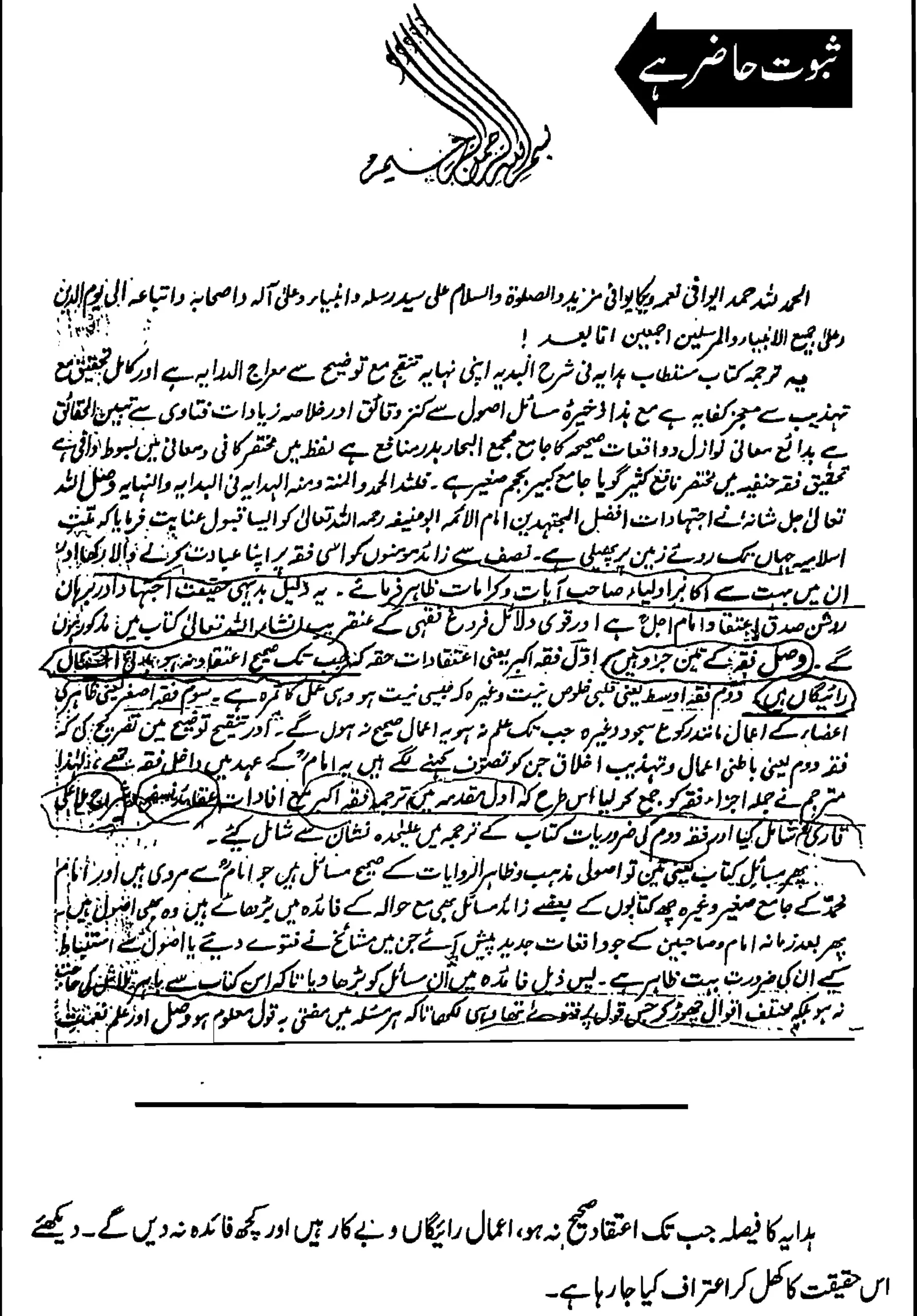
The purpose of authoring the book under study is not to hurt anyone's feelings but it is written regarding the correctness of belief. The aim is the reformation of conditions and the sympathy and well-being of the brothers who recite the Kalima. You may also call it a book of references. In this book, references from the Holy Quran, authentic Hadiths, and Hanafi jurisprudence books have been given. This book discusses the beliefs of all factions of Ahl al-Sunnah wa al-Jama'ah, namely Hanafi Barelvi, Hanafi Deobandi, Ahl al-Hadith, and in addition, the beliefs of Shia and Qadiani persons have been discussed, and the saved sect has been identified, that is, the sect which is saved according to the religion of Allah.
To understand the religion, inquire and research from Barelvi, Deobandi, and Ahl-e-Hadith scholars. If any issue is not clear in your mind, ask those scholars repeatedly in the light of the Quran and Hadith until the matter becomes completely clear in your mind. Do the same for every contentious issue. Do not pay any attention to the words of misguided scholars who say, "Go to so-and-so and do not go to so-and-so," because whoever says not to go to someone is a liar, as this is the behavior of disbelievers. They also used to say, "Do not go to Muhammad ﷺ and his companions, do not listen to them." We should adopt the way of the Muslims. You should definitely research and then do as you wish, because no one can be forced in this matter, and on the Day of Judgment, everyone will be responsible for their own deeds.
List of Books:
Details of the books from which most references in this book have been taken:
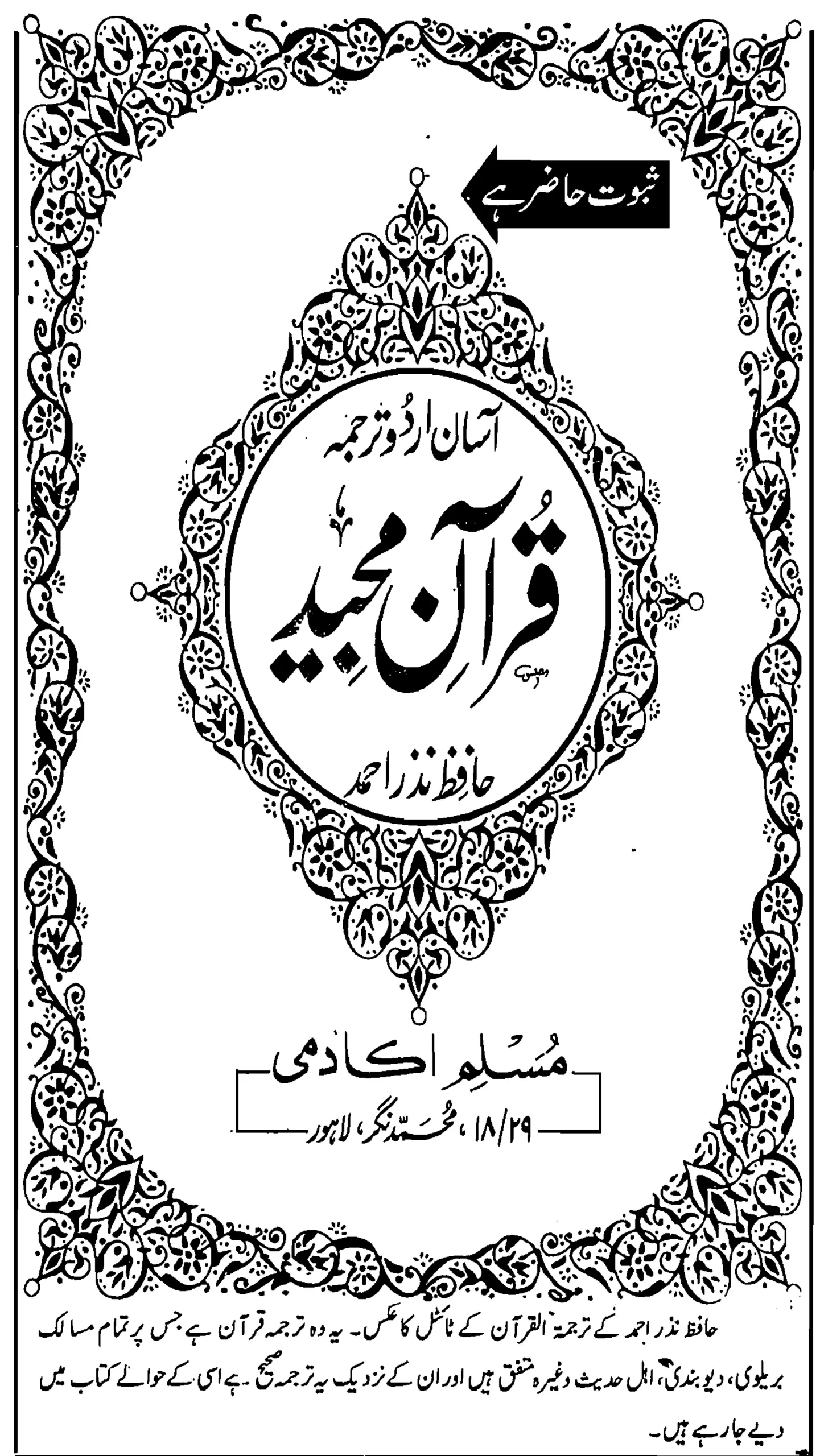
① The Holy Quran with translation and all commentaries: [Ahmad Raza Khan Sahib and Naeemuddin Muradabadi Sahib]. [Ahmad Ali Lahori Sahib]. [Shabbir Ahmad Usmani Sahib]. [Maududi Sahib]. [Ashraf Ali Thanvi Sahib]. [Hafiz Nazar Ahmad Sahib: This is the agreed translation of Barelvi, Deobandi, and Ahl-e-Hadith]. [Janab Nawab Waheed uz Zaman Sahib Hyderabadi]. [Ahsan al-Bayan Maktaba Dar-us-Salam]-
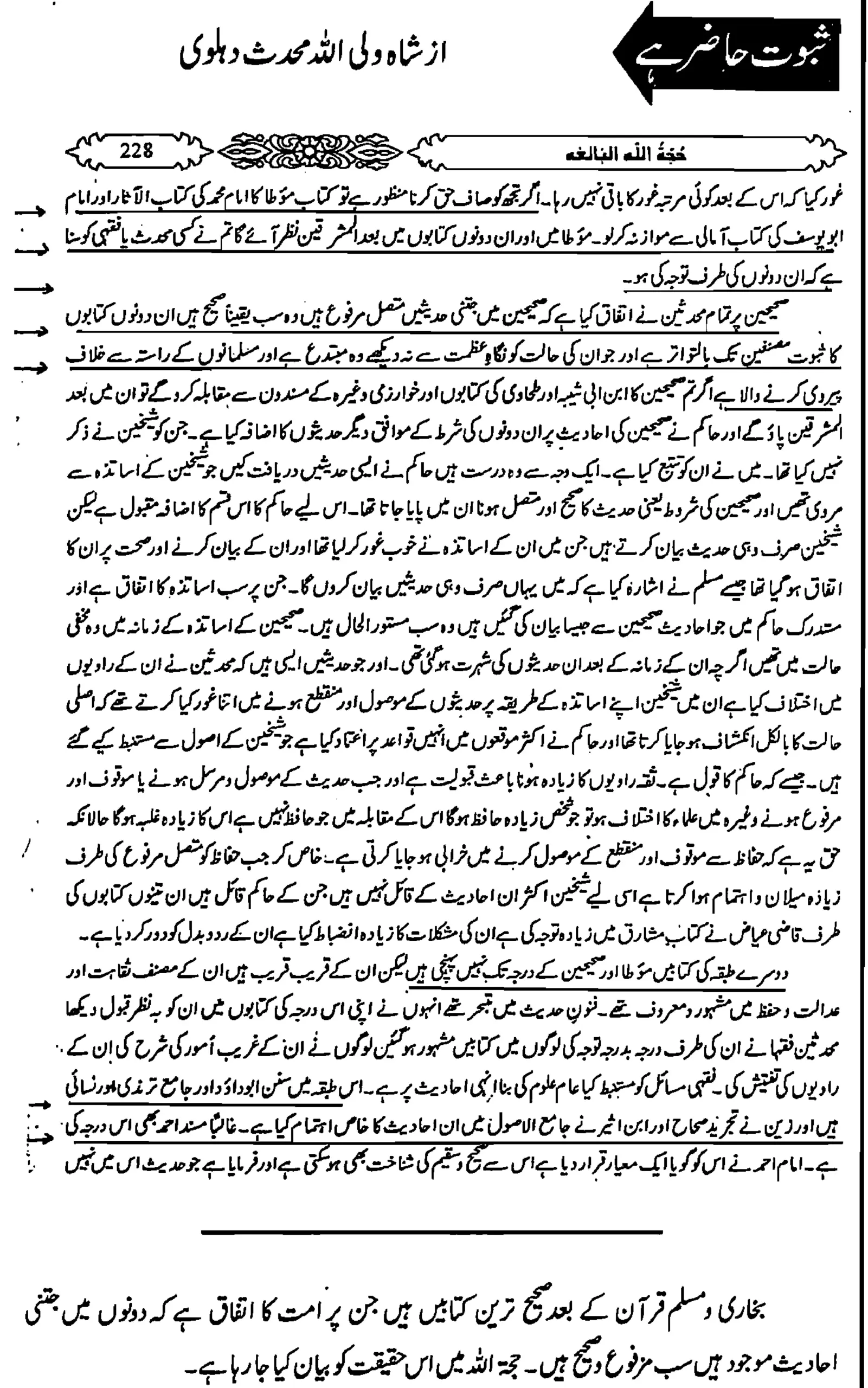
② Al-Lu’lu’ wal-Marjan: The foundation of Islam is the Quran and Hadith. The scholars of Islam have compiled and documented the collection of authentic Hadith in various books. The status that Sahih Bukhari and Sahih Muslim hold among these Hadith books is unmatched by any other book. The Muslim Ummah agrees on the authenticity of the Hadith contained in these two books. Therefore, they are known as the Sahihayn. Every Hadith present in these books is a proof and evidence for us. The book Al-Lu’lu’ wal-Marjan is a collection of the mutually agreed upon Hadith found in both of these sacred books, meaning this book is a compilation of those Hadith whose authenticity is agreed upon by Imam Bukhari and Imam Muslim.
③ Sahih Bukhari, Sahih Muslim: It is a consensus that after the Quran, Bukhari comes first and then Muslim.
Reference: (Muqaddimah Hidayah:1/113), (Sharh wa Qayah: p.5), (Muqaddimah Fatawa Alamgiri:1/2 to 29)
Some people wonder whether Imam Bukhari and Imam Muslim belonged to the Shafi'i school of thought. But the truth is that Imam Bukhari, may Allah have mercy on him, and Imam Muslim, may Allah have mercy on him, were Mujtahids. Allah had granted them great knowledge, and they were the leading hadith scholars of their time. They sifted through the authentic and weak narrations and separated the most authentic ones, compiling Sahih Bukhari and Sahih Muslim. Imam Bukhari, may Allah have mercy on him, spent 16 years on this work. If they found any statement of any Imam to be incorrect, they rejected it. If they found any statement of Imam Abu Hanifa, may Allah have mercy on him, to be wrong, they denied it. If they considered any statement of Imam Shafi'i, may Allah have mercy on him, to be incorrect, they refuted it. This is why in the famous Hanafi jurisprudence books, Sahih Bukhari and Sahih Muslim are referred to as the Sahihain.
③ Mishkat al-Masabih: This Mishkat is an Urdu translation with benefits by Muhammad Sadiq Khalilullah Faisalabadi, consisting of five volumes. In this Mishkat, wherever necessary, the benefit of the hadith is also written below it. That is, the authenticity of the hadith has been commented upon. This book has been written after studying sixty books, as mentioned at the end of volume 5.
⑤ Abu Dawood, Tirmidhi, Nasa'i, Ibn Majah, that is, the remaining four books of the Kutub al-Sittah hadith collections.
References have also been given from the following Hanafi fiqh books.
Available from Maktaba Rehmania Urdu Bazaar Lahore, Urdu translations of all these books have been published. These books belong to both Barelvi and Deobandi schools, because both consider Imam Abu Hanifa as their great Imam:
① Quduri: This book has been printed by Maktaba Sharikah Ilmiya outside Bohar Gate Multan and consists of two volumes.
② Hidayah: This famous Hanafi fiqh book is in Urdu translation consisting of four volumes and has been printed by Maktaba Rehmania Urdu Bazaar Lahore. (The Urdu translation of Hidayah is called Ain al-Hidayah)
③ Kanz al-Daqa’iq: This book of Hanafi fiqh with Urdu translation is available from Maktaba Rahmaniya Urdu Bazaar Lahore.
④ Sharh Waqaya: This book of Hanafi fiqh with Urdu translation has been published by H M Saeed Company Adab Manzil Pakistan Chowk Karachi. This book consists of four volumes.
⑤ Dur Mukhtar: This book of Hanafi fiqh with Urdu translation consists of four volumes and has also been published by H M Saeed Company Karachi.
⑥ Fatawa Alamgiri: This book of Hanafi fiqh with Urdu translation consists of ten volumes and has been published by Maktaba Rahmaniya Lahore. This book was compiled by the Mughal Emperor Aurangzeb Alamgir from five hundred Hanafi scholars.
Reference: Muqaddama Alamgiri:308/1
⑦ Mala Badmana: The original book is in Persian; Maktaba Shirkat Ilmiya outside Bohar Gate Multan has published its Urdu translation.
⑧ Bahishti Zewar: This book of Hanafi fiqh is authored by Janab Ashraf Ali Thanwi and consists of twelve parts in the Urdu language.
All these books belong to the Barelvi and Deobandi fiqh, because both consider Imam Abu Hanifa as their great Imam.
The Importance of Religious Knowledge:
It is absolutely necessary for every person who declares the Kalima to acquire knowledge of the religion. Whoever hears the verses of Allah and does not take heed is a wrongdoer and a criminal; Allah Almighty will take revenge from him:
[وَ مَنۡ اَظۡلَمُ مِمَّنۡ ذُکِّرَ بِاٰیٰتِ رَبِّہٖ ثُمَّ اَعۡرَضَ عَنۡہَا ؕ اِنَّا مِنَ الۡمُجۡرِمِیۡنَ مُنۡتَقِمُوۡنَ]
And who is more unjust than one who is reminded of the verses of his Lord but turns away from them? Indeed, We will take retribution from the criminals.
Reference: As-Sajda:22
Whoever does not take heed of Allah’s guidance will be raised blind on the Day of Resurrection:
[قَالَ اہۡبِطَا مِنۡہَا جَمِیۡعًۢا بَعۡضُکُمۡ لِبَعۡضٍ عَدُوٌّ ۚ فَاِمَّا یَاۡتِیَنَّکُمۡ مِّنِّیۡ ہُدًی ۬ۙ فَمَنِ اتَّبَعَ ہُدَایَ فَلَا یَضِلُّ وَ لَا یَشۡقٰی]،[وَ مَنۡ اَعۡرَضَ عَنۡ ذِکۡرِیۡ فَاِنَّ لَہٗ مَعِیۡشَۃً ضَنۡکًا وَّ نَحۡشُرُہٗ یَوۡمَ الۡقِیٰمَۃِ اَعۡمٰی]،[قَالَ رَبِّ لِمَ حَشَرۡتَنِیۡۤ اَعۡمٰی وَ قَدۡ کُنۡتُ بَصِیۡرًا]،[قَالَ کَذٰلِکَ اَتَتۡکَ اٰیٰتُنَا فَنَسِیۡتَہَا ۚ وَکَذٰلِکَ الۡیَوۡمَ تُنۡسٰی]
[He said, "Both of you get down from here together; some of you are enemies to others. Then if there comes to you guidance from Me, whoever follows My guidance will neither go astray nor suffer hardship."] [And whoever turns away from My reminder - indeed, he will have a depressed life, and We will raise him blind on the Day of Resurrection.] [He will say, "My Lord, why have You raised me blind while I was [once] seeing?"] [He will say, "Thus did Our verses come to you, and you forgot them; and thus will you this Day be forgotten."]
Reference: Surah Taha:123-126
Reference: (For further references see: [Al-Kahf:57], [Al-Baqarah:38,39,130,135,187,198,242,285], [Al-A'raf:3], [Al-An'am:55,57], [Ar-Ra'd:37], [An-Najm:2,5])
Similarly, in Sahih Bukhari, Sahih Muslim, and Mishkat al-Masabih, in the chapter of knowledge, it is stated that every Muslim should acquire religious knowledge and convey it to others, and that the scholar of religion has great superiority over common people. And whoever sets out to acquire religious knowledge, all creation prays for his forgiveness.
Summary:
The conclusion of this discussion is that it is essential for every believer to acquire knowledge of the religion. Every believer should have knowledge of the beliefs of Islam, its commandments, prohibitions, and the likes and dislikes of Allah Almighty and His Messenger ﷺ, so that by performing the correct actions, they may be successful on the Day of Judgment and avoid the punishment of Hellfire by steering clear of wrong beliefs and wrong actions. This is only possible when one has knowledge of the religion. To acquire knowledge of the religion, dedicate one person from the household, because the matter of religion is extremely important; eternal life depends on it, and negligence in this matter is very harmful. Some people say that understanding religion is not within everyone's capacity; this is completely wrong because if understanding religion were difficult, then the very purpose of revealing the religion would be lost. Religion is very easy. Allah Almighty says in the Quran:
[وَ لَقَدۡ یَسَّرۡنَا الۡقُرۡاٰنَ لِلذِّکۡرِ فَہَلۡ مِنۡ مُّدَّکِرٍ]
And indeed, We have made the Qur'an easy to understand and remember. So is there anyone who will take heed?
That is, understanding its meanings and implications, deriving lessons and advice from it, and memorizing it verbally—we have made this easy. Indeed, the fact is that although the Quran is a book of the highest rank in terms of miraculousness and eloquence, if a person pays a little attention, he can easily understand it without studying Arabic grammar and books of meanings and eloquence. In this way, it is the only book in the world that is memorized word for word. Otherwise, memorizing even the smallest book in this manner and retaining it is very difficult. If a person opens the windows and doors of his heart and mind, reads it with the eyes of insight, listens to it with the ears of advice, and reflects on it with a discerning heart, then the doors of success in this world and the Hereafter open for him, and it penetrates the depths of his heart and mind, cleansing all impurities of disbelief and disobedience. Remember:
- The Holy Quran has stated that the Prophet Muhammad ﷺ came to guide the ignorant and the misguided.
- Allah has made the Holy Quran easy and understandable so that everyone can benefit from it.
- The Prophet Muhammad ﷺ said: I have brought an easy religion.
It is proven that whatever Allah and His Messenger ﷺ have said is the truth. If someone says that understanding the Quran and Hadith is difficult, then it is as if he is challenging Allah and His Messenger ﷺ, for which he will be accountable on the Day of Judgment.
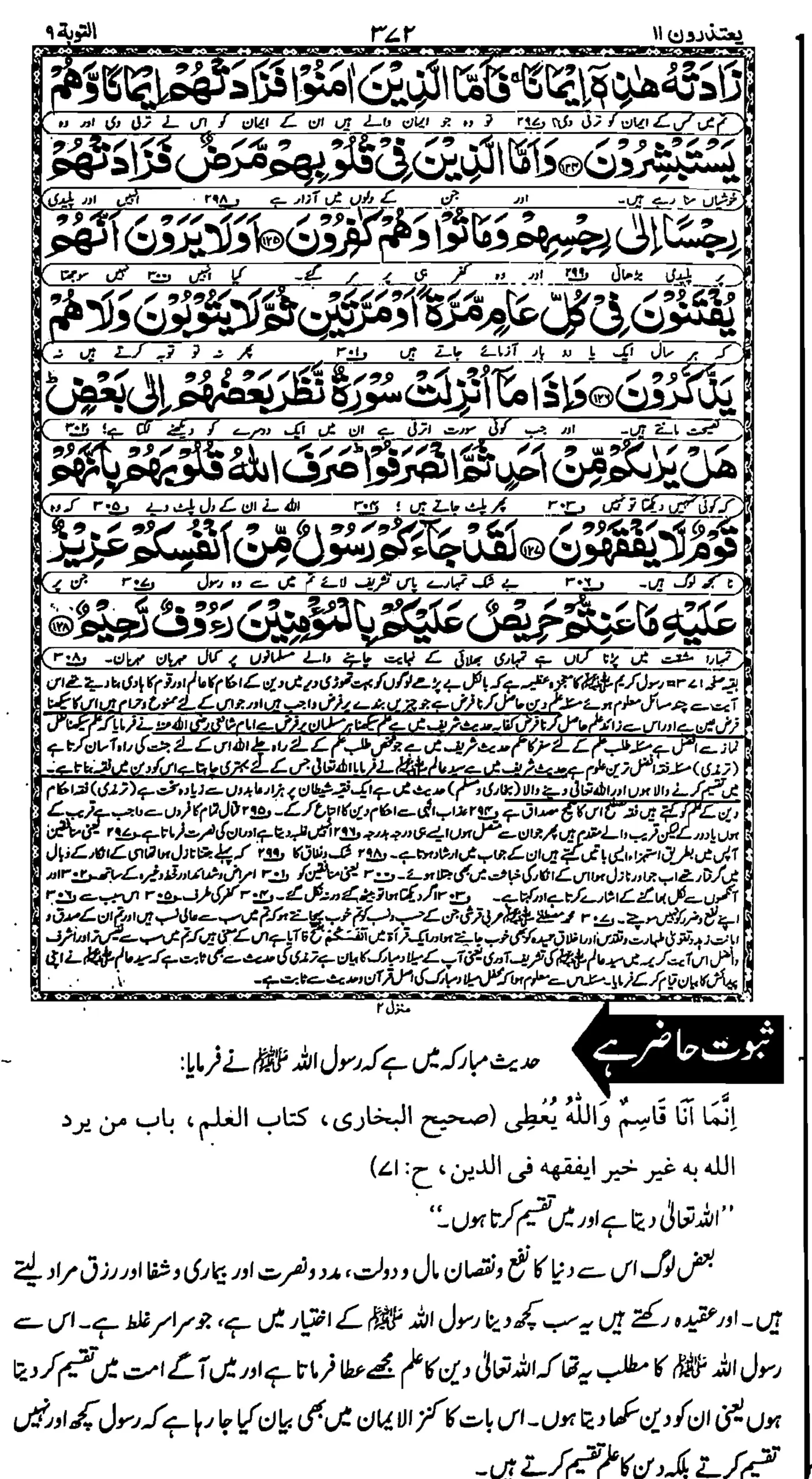
Reference: In Tafsir Muradabadi, it is mentioned in Al-Tawbah (132), Fa (293) that acquiring religious knowledge is obligatory; learning what is obligatory and forbidden for a servant is a personal duty. Acquiring knowledge is obligatory upon every Muslim. The Prophet Muhammad ﷺ said: I am the distributor of religious knowledge, and Allah is the giver of religion.
This hadith is about the distribution of religious knowledge, but some word-reciting brothers have started saying that this hadith indicates that the Messenger of Allah ﷺ has the treasures of Allah and that he is distributing those treasures, whereas in the Qur'an it is stated: (O Prophet!) Say, "I do not have the treasures of Allah."
Our attitude towards religion ،،سمعنا واطعنا،، should be "We have heard and we obey," not oppositional and argumentative (i.e., quarrelsome) like ،،سمعنا وعصينا،، "We have heard and we do not obey":
[اِنَّمَا کَانَ قَوۡلَ الۡمُؤۡمِنِیۡنَ اِذَا دُعُوۡۤا اِلَی اللّٰہِ وَ رَسُوۡلِہٖ لِیَحۡکُمَ بَیۡنَہُمۡ اَنۡ یَّقُوۡلُوۡا سَمِعۡنَا وَ اَطَعۡنَا ؕ وَ اُولٰٓئِکَ ہُمُ الۡمُفۡلِحُوۡنَ]
The statement of the believers, when they are called to Allah and His Messenger to judge between them, is nothing except that they say, "We have heard and we obey." And those are the successful.
It is necessary for every one who recites the Kalima to believe in the revealed religion, as it is stated in
Hearing this made me very sad; whatever Allah Almighty has revealed is necessary for every Kalima reciter to believe in.
And We have made this Quran easy, so is there anyone who will take admonition from it?
If not, then what could be a greater deprivation than this!
The condition of people is such that they eagerly wait to read the newspaper as soon as they wake up in the morning, they read magazines with enthusiasm, they sit with the journals of their respective sects, they make time to read books from all over the world, but they have no time to read the Book of Allah? Whereas the revelation of the Quran began with the command to read ،،اقرأ،،.
It was revealed not only for recitation but to read with understanding and to gain guidance.
It was not sent to save men only but to open the path of salvation for the living.
It invites man to ponder and reflect so that his thoughts may be refined and life may be beautified.
It demands that the journey of life be traveled in its light.
Will these objectives be fulfilled by writing this book on the walls, which is a lesson in revolution? Or will the problems be solved just by calling this book a complete code of life? Or can these objectives be fulfilled without studying the Quran? How many people are there who have at least once in their life read the Quran with understanding? Come! Let us tear apart this veil of negligence and popularize the understanding of the Quran:
[اَفَلَا یَتَدَبَّرُوۡنَ الۡقُرۡاٰنَ اَمۡ عَلٰی قُلُوۡبٍ اَقۡفَالُہَا] What is wrong with you that you do not reflect upon the Quran? Or are there locks upon your hearts?
The characteristics of the Holy Quran as described by Allah Almighty are:
① There is no doubt in the Quran; it is a guidance for the believers.
② No one can produce the like of the Quran.
③ The verses of the Quran are clear and explicit; only the disobedient deny them.
④ Divine guidance is the true guidance; turning away from it is dangerous.
⑤ The purpose of sending down divine guidance is that Allah's blessing may be complete, people may come to guidance, and they may be informed of those matters of Shariah which they do not know.
⑥ The Quran is guidance for the people and a distinction between right and wrong.
⑦ It is necessary for the Prophet and the believers to have faith in the revelation and to adopt the attitude of ،،سمعنا واطعنا،، meaning "We hear and we obey."
⑧ The Quran is easy to understand.
⑨ The words of Allah Almighty are true.
⑩ There is no contradiction in it.
⑪ The Quran is a blow of truth against falsehood.
⑫ Allah Almighty Himself has taken the responsibility of protecting the Quran.
⑬ Those who do not judge according to the revelation are disbelievers, oppressors, and disobedient.
⑭ From the Quran, one can distinguish between the guided and the criminals.
⑮ The words of Allah cause the hairs of those who fear Allah to stand on end.
The permissibility of Hadith is established from the Quran; for this, see the questions and answers on page .......... Along with the Holy Quran, it is also necessary to act upon the blessed Hadith, because in the Holy Quran, Allah Almighty has commanded prayer, fasting, Hajj, Zakat, sacrifice, etc., and the Messenger of Allah ﷺ fully practiced these and explained in detail how to implement these commands. Without the blessed Hadith, it is impossible to act upon the Quran. Allah Almighty has commanded obedience to the Messenger of Allah ﷺ along with His own obedience thirty-one times in the Holy Quran, the details of which are in the discussions of Tawheed fi al-Hukm and Shirk fi al-Hukm in this book, as well as in the discussion of Sunnah and Bid'ah. Authentic Hadiths can be found in Sahih Bukhari, Sahih Muslim, Al-Lu'lu' wal-Marjan, Mishkat al-Masabih, and others, as well as in the book As-Silsilah as-Sahihah by Allama Albani.
Regarding the importance of the blessed Hadith, we will suffice with just one Hadith which is sufficient for the believers:
It is narrated from Sayyiduna Abdullah bin Mas'ud (may Allah be pleased with him): Allah has cursed those who tattoo and those who get tattooed, those who pluck facial hair and those who have it plucked, those who widen their teeth for beauty, and those who alter the creation of Allah. Then this news reached a woman from Bani Asad named Umm Ya'qub, who used to recite the Quran. She came to Sayyiduna Abdullah bin Mas'ud (may Allah be pleased with him) and said: I have heard that you have cursed those who tattoo and get tattooed, those who pluck facial hair and have it plucked, those who widen their teeth, and those who alter the creation of Allah. Sayyiduna Abdullah (may Allah be pleased with him) said: Why should I not curse them when the Messenger of Allah ﷺ cursed them, and this is mentioned in the Book of Allah. The woman said: I have recited as much Quran as was in the two tablets, but I did not find this. Sayyiduna Abdullah (may Allah be pleased with him) said: If you had recited, you would have found it. Allah Almighty says: Hold firmly to what the Messenger gives you and refrain from what he forbids you.
Now we
Remember, this book is about fabricated hadiths, and it has been published with Urdu translation by Muhammad Saeed & Sons Karachi:
(1) Abu Hanifa is the lamp of my Ummah. (This hadith is unanimously fabricated by the muhaddithin.
(2) Khidr (peace be upon him) and Ilyas (peace be upon him) meet every year during the Hajj season. (Hafiz Asqalani says: Nothing authentic is established regarding this.
(3) The parents of the Messenger of Allah ﷺ being alive. (This hadith is fabricated.
(4) The disagreement of my Ummah is also a mercy. (This hadith has no authentic origin.
(5) When love becomes true, the conditions of etiquette end. (This is not a hadith.
(6) Four things are never satisfied by four things: the earth by rain, a woman by a man, the eye by seeing, and a scholar by knowledge. (This hadith is fabricated.
(7) The best decision-maker among you is Ali, may Allah be pleased with him. (This hadith is not established as marfu‘.
(8) O Allah! Support Islam with one of its two lifetimes. (There is no original source for these words.
(9) The leader of the honey bees is Sayyiduna Ali رضي الله عنه. (There is no original source for this.
(10) I am the city of knowledge and Ali is its gate. (This hadith is rejected.
(11) I am from Allah and the believer is from me. (This is not a hadith.
(12) Bilal used to change the "sh" sound in the adhan to "s". (There is no mention of this in the books of hadith.
(13) The dead see people in their house for seven days. (This is false.
(14) Love of the world is the root of every sin. (Some muhaddithin consider this fabricated.
(15) Attending the gathering of a scholar is better than a thousand rak'ahs of prayer. (This is fabricated.
(16) Sayyiduna Ali رضي الله عنه lifted the gate of Khyber. (This is incorrect.
(17) The chief of the Arabs is Sayyiduna Ali رضي الله عنه. (This is weak.
(18) (صدق رسول الله) (There is no original source for this.
(19) Praying behind a scholar grants the reward of forty thousand four hundred and forty prayers. (This is false.
(20) Praying after using a miswak is better than seventy prayers without using a miswak. (This hadith is false.
(21) The scholars of my Ummah are like the prophets of Bani Israel. (There is no original source for this.
(22) The strangers are the inheritors of the prophets. (This hadith is false.
(23) The heart is the house of Allah. (There is no original marfu‘ hadith for this.
(24) I was a prophet even when Adam was between clay and water. There is no hadith with these words.
(25) When the Prophet Muhammad ﷺ was given a bath, the water rose to the sockets of his eyes. When Sayyiduna Ali رضي الله عنه drank it, he was given the knowledge of the first and the last. (This is the claim of the Rafidah.
(26) All hadiths related to rice are fabricated. (
(27) On the Day of Judgment, Sayyiduna Ali رضي الله عنه will carry the flag. (This is fabricated.
(28) No short stature is devoid of wisdom, and no tall stature is devoid of foolishness. (Sakhawi says I am not aware of this.
(29) Whoever was made a prophet was made so at the age of forty. (This hadith is fabricated.
(30) Wiping the neck is protection from the collar. (This hadith is fabricated.
(31) At the time of the call to prayer, kissing the fingertips of both index fingers on the name of the Messenger of Allah ﷺ and then wiping the eyes. This is not authentic.
(32) Whoever says ،،لا الہ الا اللہ،، upon entering the market, Allah Almighty writes one hundred thousand good deeds for him and erases one hundred thousand sins. (This is rejected.
(33) My successor among my household, the best among the people after me, is Sayyiduna Ali, may Allah be pleased with him. This hadith is fabricated.
(34) There is no youth except Sayyiduna Ali, may Allah be pleased with him, and no sword except Dhu al-Fiqar. (It has no authentic origin.
(35) Regarding the meetings of the Imams with each other, and similarly those writings that were written about the graves of great people, all of these are false. (
(36) Similarly, all those traditions in which a small good deed is attributed with great reward, they also have no basis.
(37) Whoever prays six rak'ahs after Maghrib prayer will receive the reward equivalent to twelve years of worship. (This hadith is rejected.
(38) All the traditions regarding intellect are not authentic. (
(39) All the hadiths that mention the life of Sayyidna Khidr (peace be upon him) are false. (
(40) An important principle is that any hadith that is explicitly contrary to the Quran is not authentic. (
(41) Any hadith that resembles the belief of the Christians is not authentic. (
(42) All the prayers of day and night, for example on Sunday, Monday, Tuesday, etc., and the prayers of those nights, even the prayers of the entire week, all of these are fabricated. (
(43) The prayers of the fifteenth night of Sha'ban are not established. (
(44) None of the traditions about pigeons are authentic. (
(45) All the traditions related to Ashura are not authentic. (
(46) Such traditions that describe the virtues and rewards of Surahs are not authentic, except those in Bukhari, Muslim, Tirmidhi, etc. (
Below we mention those ahadith which are called fabricated and weak ahadith, due to which the Ummah has suffered irreparable loss.
① A book by Allama Nasiruddin al-Albani is available in the market with Urdu translation, in which (100) fabricated ahadith are given. The name of the book is "Collection of Fabricated and Weak Ahadith."
From which the Muslim Ummah has suffered irreparable loss. These (100) fabricated ahadith are as follows:
Hadith 1: Islam is according to reason, and whoever does not enter Islam has no reason. (This hadith is false)
Hadith 2: Whoever is not prevented by his prayer from indecency and evil deeds becomes more distant from Allah Almighty. (This hadith is false)
Hadith 3: The courage of people can move mountains from their place. (This is not a Hadith of the Prophet)
Hadith 4: Talking in the mosque wastes good deeds just as livestock eat grass. There is no authenticity to this Hadith with these words.
Hadith 5: Whoever abandons an act solely for the pleasure of Allah, Allah will reward him with something better in this world and the Hereafter. (This Hadith is fabricated with these words)
Hadith 6: Stay away from dust because dust causes respiratory diseases. (The authenticity of this Hadith is unknown)
Hadith 7: Do not approach two things: associating partners with Allah and harming people. (There is no authenticity to this Hadith)
Hadith 8: Act in this world as if you will live forever, and act for the Hereafter as if you will die tomorrow. (There is no authenticity to this Hadith)
Hadith 9: I am the center of happiness for all the pious. (Also)
Hadith 10: Indeed, Allah the Exalted knows that He sees His servant tired in seeking what is lawful. (This hadith is fabricated)
Hadith 11: I have been sent as a teacher. (This hadith is weak)
Hadith 12: Allah revealed to the world: You be His servant who is My servant. (This hadith is fabricated)
Hadith 13: The people of Sham are His representatives on the earth of Allah. (This hadith is weak)
Hadith 14: Protect yourselves outwardly from the greenery. (This is a very weak narration)
Hadith 15: The land of Sham is My quiver. (The original of this hadith is not proven as Marfu’)
Hadith 16: In My Ummah, there are two types of people such that when they are correct, the people will also be correct, and they are the rulers and the jurists. (This hadith is fabricated)
Hadith 17: Whoever sins while laughing will enter Hell crying. (This hadith is fabricated)
Hadith 18: Keep trained pigeons so that they keep the jinn away from your children in negligence. (Also)
Hadith 19: Adorn the gatherings of your women with a spinning wheel. (This hadith is fabricated)
Hadith 20: Decorate the dining spread with vegetables. (This hadith is fabricated)
Hadith 21: It suffices me to ask that He knows my condition. (This hadith is fabricated)
Hadith 22: You should seek my position as a means; indeed, my position is great with Allah. (This hadith is baseless)
Hadith 23: Allah Almighty is the One who gives life and causes death, and He will always remain alive. (O Allah) forgive my mother Fatimah bint Asad. (This hadith is fabricated)
Hadith 24: Whoever goes out from home to pray and says: O Allah! I ask You through those beggars who ask You. (This hadith is weak)
Hadith 25: When Adam committed a mistake, he prayed: O Lord my Sustainer! I ask You through Muhammad ﷺ. (This hadith is fabricated)
Hadith 26: Quick temper is a characteristic of the best people of my Ummah. (This hadith is weak)
Hadith 27: Quick temper is found among the bearers of the Holy Quran because the greatness of the Quran resides in their hearts. (This hadith is fabricated)
Hadith 28: Quick temper will only be found among the righteous and pious of my Ummah, and then the quick temper ends. (This hadith is fabricated)
Hadith 29: The best people of my Ummah are those with quick temper. (This hadith is completely false)
Hadith 30: There is blessing in me and my Ummah for the Day of Judgment. (This hadith has no authenticity)
Hadith 31: The world is the path for Muslims. (This hadith has no authenticity)
Hadith 32: The world is forbidden for the people of the Hereafter, and the Hereafter is forbidden for the people of the world, and both the world and the Hereafter are forbidden for the people of Allah. (This hadith is not proven)
Hadith 33: The world is the dwelling place of the Hereafter. (This hadith is fabricated)
Hadith 34: Keep away from the world because the world is a greater magician than Harut and Marut. (This hadith is rejected and has no authenticity)
Hadith 35: Whoever calls the Adhan should say Takbeer. (This hadith is weak)
Hadith 36: Love of homeland is part of faith. (This hadith is fabricated)
Hadith 37: A time will come upon the people when they will be like wolves, and whoever is not a wolf will be devoured by the wolves. (This hadith is very weak)
Hadith 38: Whoever adopts sincerity for the pleasure of Allah for forty days, springs of wisdom will flow from his tongue. (This hadith is weak)
Hadith 39: Whoever sleeps after Asr prayer and loses his intellect, let him only blame himself. (This hadith is weak)
Hadith 40: Use pumpkin; eating it strengthens the brain. (This hadith is fabricated)
Hadith 41: Whoever accumulates unlawful wealth, Allah takes his wealth through unlawful means. (This hadith is not authentic)
Hadith 42: The Prophets, peace be upon them, are leaders, and the jurists are chiefs. (This hadith is fabricated)
Hadith 43: The month of Ramadan hangs suspended between the heavens and the earth. (This hadith is weak)
Hadith 44: Whoever is without ablution and does not perform ablution has wronged me. (This hadith is fabricated)
Hadith 45: Whoever performs Hajj to the House of Allah and does not visit my grave has wronged me. (This hadith is fabricated)
Hadith 46: Whoever visits me and my father Ibrahim in the same year will enter Paradise. (This hadith is fabricated)
Hadith 47: Whoever performs Hajj and visits my grave after my death is like the one who visited me during my lifetime. (This hadith is fabricated)
Hadith 48: A boy follows in the footsteps of his father. (This hadith is baseless)
Hadith 49: Whoever visits the graves of both parents or either one of them every Friday, his sins are forgiven. (This hadith is fabricated)
Hadith 50: Whoever visits the graves of his parents every Friday and recites Surah Yaseen near their graves. (This hadith is fabricated)
Hadith 51: Indeed, Allah Almighty loves this believing servant. (This hadith is weak)
Hadith 52: When none of you has a four-legged animal forbidden to him. (This hadith is weak)
Hadith 53: Adopt the manners and religion of old women. (It has no basis)
Hadith 54: When the Day of Judgment is near and there will be disagreement in desires, we will have to adopt the manners of people living in the forests and women. (This hadith is fabricated)
Hadith 55: Speediness destroys the dignity of a believer. (This hadith is extremely rejected)
Hadith 56: If there were no women, the worship of Allah would be perfect. (This hadith is fabricated)
Hadith 57: The disagreement of my Ummah is a cause of mercy. (This hadith has no basis)
Hadith 58: My companions are like stars. (This hadith is fabricated and baseless)
Hadith 59: Remain steadfast on what Allah's Book has been given to you. (This hadith is fabricated)
Hadith 60: I asked my Lord about these matters, and the disagreement of my companions is a cause of mercy for you. (This hadith is fabricated)
Hadith 61: Undoubtedly, my companions are like stars. (This hadith is fabricated)
Hadith 62: My Ahl al-Bayt are like stars. (This hadith is fabricated)
Hadith 63: Undoubtedly, the Awliya are neither food nor drink. (This hadith is rejected)
Hadith 64: An animal with one tooth is a good sacrifice.
Hadith 65: A one-year-old lamb is permissible for sacrifice. (This hadith is weak)
Hadith 66: Whoever recognizes himself has recognized his Lord. (This hadith has no basis)
Hadith 67: Whoever recites ،،الم نشرح،، and ،،الم ترکیف،، in the Fajr prayer will not have pain in his eyes. (Also)
Hadith 68: After performing ablution, recite Surah ،،انا انزلنا،،. (Also)
Hadith 69: Wiping the neck during ablution is a means of protection from the collar on the Day of Judgment. (This hadith is fabricated)
Hadith 70: Whoever feeds his brother bread until he is full. (This hadith is fabricated)
Hadith 71: Do not prolong the recitation of Allahu Akbar. (It has no basis)
Hadith 72: My Lord has honored me with good manners and treated me well. (This hadith is weak)
Hadith 73: When the Mu'adhdhin says ،،اشهد ان محمد الرسول الله،،, wipe the eyes with the tips of the index fingers of both hands. (Not authentic)
Hadith 74: Honor the sacrifices because your sacrifices will be your mounts on the Sirat Bridge. (No basis at all)
Hadith 75: Hurry to perform prayer before it is missed and hurry to repent before death. (This hadith is fabricated)
Hadith 76: All people except the scholars are dead. (This hadith is fabricated)
Hadith 77: Jesus is the Mahdi. (This hadith is rejected)
Hadith 78: The leftover water of a believer is a cure. (This hadith has no basis)
Hadith 79: A sign of humility is that a person drinks the false water of his believing brother. (This hadith is fabricated)
Hadith 80: The Mahdi is from the children of my uncle Abbas. (This hadith is fabricated)
Hadith 81: O Abbas, indeed Allah began the religion with me and will end it with a young man from your offspring. (Also fabricated)
Hadith 82: Beware! O Abu al-Fadl, I give you glad tidings. (Also fabricated)
Hadith 83: Mentioning Allah on the beads of Tasbih is the best way. (Also)
Hadith 84: You are the best of all. (This hadith is weak)
Hadith 85: Three people will be killed because of your treasure, and all three will be sons of the Caliph. (This hadith is rejected)
Hadith 86: The plague is a punishment from your ,,brothers,,. (There is nothing authentic with these words)
Hadith 87: When the preacher goes up to the pulpit, then there is neither prayer nor conversation. (False)
Hadith 88: The farmer has hunted, even though he has forcibly occupied the land. (False)
Hadith 89: The owner of something has more right to pick it up. (This hadith is fabricated)
Hadith 90: Wear woolen clothes, you will find the sweetness of faith in your hearts because of it. (Also)
Hadith 91: I prefer to swear falsely by Allah than to swear truthfully by the name of anyone other than Allah. (Also)
Hadith 92: In the person who has three qualities, Allah inclines His side towards him. (Also)
Hadith 93: On the Day of Judgment, people will be lined up in rows. (This hadith is weak)
Hadith 94: The fundamental matters of Islam and the religion of Islam are three. (Also weak)
Hadith 95: The one who repents is beloved to Allah. (Not authentic with these exact words)
Hadith 96: Indeed, Allah loves those servants who repent after being afflicted by trials. (This hadith is fabricated)
Hadith 97: Undoubtedly, Allah loves the young person who repents. (This hadith is weak)
Hadith 98: Surely Allah Almighty loves the young person whose youth was spent in obedience to Allah Almighty. (This hadith is fabricated)
Hadith 99: Undoubtedly, Allah Almighty loves the person who is worshipful and lives in cleanliness. (Also weak)
Hadith 100: The good deeds of the righteous are evil compared to the near ones (in terms of relationship). (This hadith is false)
الحمد لله رب العلمين والصلوة والسلام على رسوله الأمين أما بعد! Some people present literal and semantic distortions in the Quran and Sunnah for their false beliefs, along with some fabricated and weak narrations. Therefore, in this brief article, comments and research are presented on a few such narrations which pose a risk of causing doubt among the general public. وما توفیقی الا بالله!
① من صلى على عند قبري سمعته... الخ
Whoever hears about me at a distance near my grave.
The main narrator of this hadith is Muhammad bin Marwan al-Suddi. (Bayhaqi, Mizan al-I'tidal, etc.)
Abdullah ibn Numayr, may Allah have mercy on him, and Jarir bin Abdul Hamid, may Allah have mercy on him, said: "Liar" (meaning this is false). Imam Salih Jazari said: ،،كان ضعيفا و كان يضع،، He (Muhammad bin Marwan) was weak (in fact) he fabricated false hadiths.
Reference: (Bukhari and Muslim)
This hadith is about the distribution of religious knowledge, but some word-reciting brothers have started saying that this hadith indicates that the Messenger of Allah ﷺ has the treasures of Allah and that he is distributing those treasures, whereas in the Qur'an it is stated: (O Prophet!) Say, "I do not have the treasures of Allah."
Reference: Al-An'am:50
Our attitude towards religion:
Our attitude towards religion ،،سمعنا واطعنا،، should be "We have heard and we obey," not oppositional and argumentative (i.e., quarrelsome) like ،،سمعنا وعصينا،، "We have heard and we do not obey":
[اِنَّمَا کَانَ قَوۡلَ الۡمُؤۡمِنِیۡنَ اِذَا دُعُوۡۤا اِلَی اللّٰہِ وَ رَسُوۡلِہٖ لِیَحۡکُمَ بَیۡنَہُمۡ اَنۡ یَّقُوۡلُوۡا سَمِعۡنَا وَ اَطَعۡنَا ؕ وَ اُولٰٓئِکَ ہُمُ الۡمُفۡلِحُوۡنَ]
The statement of the believers, when they are called to Allah and His Messenger to judge between them, is nothing except that they say, "We have heard and we obey." And those are the successful.
Reference: An-Nur:51
It is necessary for every one who recites the Kalima to believe in the revealed religion, as it is stated in
Reference: (Surah Al-Baqarah (285)
that the Messenger of Allahﷺ believed in the revealed religion and the believers also believed, and they said ،،سمعنا وأطعنا،،. I met a person who recites the Kalima; he came to my house to take my book. I told him that in Naeem Murad Abadi's Tafsir, it is written that calling the Prophets human beings is the way of the disbelievers. That person said that this statement is correctly written. I said that Allah Almighty has said in many places in the Quran that the Prophets were human beings, and Allah Almighty has made our Messengerﷺ declare in many places in the Quran, saying, "Say, I am a human being." He said that it is true that Allah Almighty called the Messenger of Allahﷺ a human being in the Quran and the Messenger of Allahﷺ also declared his humanity: but show me where in the Quran it is written that you should also call the Messenger of Allahﷺ a human being, and he got up and left without listening further.
Hearing this made me very sad; whatever Allah Almighty has revealed is necessary for every Kalima reciter to believe in.
Reference: (Al-Baqarah: 285)
and to adopt the attitude of ،،سمعنا واطعنا،، and not to deny what Allah Almighty has revealed, because one who denies it does not remain a Muslim and his forgiveness is impossible.
Reference: Al-A'raf: 37 to 41
and not to dislike what Allah Almighty has revealed, because those who do so have all their deeds ruined.
Reference: Muhammad: 1 to 9
Every Kalima reciter should sincerely affirm the religion revealed by Allah Almighty in their heart and confess it with their tongue, confession by the tongue and affirmation by the heart, because when the command of Allah and His Messenger ﷺ comes, no Muslim man or Muslim woman has any choice, and whoever does not obey the command has clearly gone astray.
Reference: Al-Ahzab: 36
Read the Holy Quran with Translation:
And We have made this Quran easy, so is there anyone who will take admonition from it?
Reference: Al-Qamar: 17
Open the Holy Quran and read it with translation.Have you studied the Quran?
If not, then what could be a greater deprivation than this!
The condition of people is such that they eagerly wait to read the newspaper as soon as they wake up in the morning, they read magazines with enthusiasm, they sit with the journals of their respective sects, they make time to read books from all over the world, but they have no time to read the Book of Allah? Whereas the revelation of the Quran began with the command to read ،،اقرأ،،.
It was revealed not only for recitation but to read with understanding and to gain guidance.
It was not sent to save men only but to open the path of salvation for the living.
It invites man to ponder and reflect so that his thoughts may be refined and life may be beautified.
It demands that the journey of life be traveled in its light.
Will these objectives be fulfilled by writing this book on the walls, which is a lesson in revolution? Or will the problems be solved just by calling this book a complete code of life? Or can these objectives be fulfilled without studying the Quran? How many people are there who have at least once in their life read the Quran with understanding? Come! Let us tear apart this veil of negligence and popularize the understanding of the Quran:
[اَفَلَا یَتَدَبَّرُوۡنَ الۡقُرۡاٰنَ اَمۡ عَلٰی قُلُوۡبٍ اَقۡفَالُہَا] What is wrong with you that you do not reflect upon the Quran? Or are there locks upon your hearts?
Reference: Muhammad:24
The Holy Quran:
The characteristics of the Holy Quran as described by Allah Almighty are:
① There is no doubt in the Quran; it is a guidance for the believers.
Reference: Al-Baqarah:2
② No one can produce the like of the Quran.
Reference: Al-Baqarah:23-24
③ The verses of the Quran are clear and explicit; only the disobedient deny them.
Reference: Al-Baqarah:99
④ Divine guidance is the true guidance; turning away from it is dangerous.
Reference: Al-Baqarah:137/135/120
⑤ The purpose of sending down divine guidance is that Allah's blessing may be complete, people may come to guidance, and they may be informed of those matters of Shariah which they do not know.
Reference: Al-Baqarah:151/150
⑥ The Quran is guidance for the people and a distinction between right and wrong.
Reference: Al-Baqarah:185
⑦ It is necessary for the Prophet and the believers to have faith in the revelation and to adopt the attitude of ،،سمعنا واطعنا،، meaning "We hear and we obey."
Reference: Al-Baqarah:285
⑧ The Quran is easy to understand.
Reference: Al-Qamar:40/32/22/17
⑨ The words of Allah Almighty are true.
Reference: An-Nisa:122/87
⑩ There is no contradiction in it.
Reference: An-Nisa:82
⑪ The Quran is a blow of truth against falsehood.
Reference: Al-Anbiya:18, Al-Furqan:33
⑫ Allah Almighty Himself has taken the responsibility of protecting the Quran.
Reference: Al-Hijr:9
⑬ Those who do not judge according to the revelation are disbelievers, oppressors, and disobedient.
Reference: Al-Ma'idah:47/45/44
⑭ From the Quran, one can distinguish between the guided and the criminals.
Reference: Al-Baqarah:2 to 5, 39/38
⑮ The words of Allah cause the hairs of those who fear Allah to stand on end.
Reference: Az-Zumar:23
Hadith Mubarak:
The permissibility of Hadith is established from the Quran; for this, see the questions and answers on page .......... Along with the Holy Quran, it is also necessary to act upon the blessed Hadith, because in the Holy Quran, Allah Almighty has commanded prayer, fasting, Hajj, Zakat, sacrifice, etc., and the Messenger of Allah ﷺ fully practiced these and explained in detail how to implement these commands. Without the blessed Hadith, it is impossible to act upon the Quran. Allah Almighty has commanded obedience to the Messenger of Allah ﷺ along with His own obedience thirty-one times in the Holy Quran, the details of which are in the discussions of Tawheed fi al-Hukm and Shirk fi al-Hukm in this book, as well as in the discussion of Sunnah and Bid'ah. Authentic Hadiths can be found in Sahih Bukhari, Sahih Muslim, Al-Lu'lu' wal-Marjan, Mishkat al-Masabih, and others, as well as in the book As-Silsilah as-Sahihah by Allama Albani.
Regarding the importance of the blessed Hadith, we will suffice with just one Hadith which is sufficient for the believers:
It is narrated from Sayyiduna Abdullah bin Mas'ud (may Allah be pleased with him): Allah has cursed those who tattoo and those who get tattooed, those who pluck facial hair and those who have it plucked, those who widen their teeth for beauty, and those who alter the creation of Allah. Then this news reached a woman from Bani Asad named Umm Ya'qub, who used to recite the Quran. She came to Sayyiduna Abdullah bin Mas'ud (may Allah be pleased with him) and said: I have heard that you have cursed those who tattoo and get tattooed, those who pluck facial hair and have it plucked, those who widen their teeth, and those who alter the creation of Allah. Sayyiduna Abdullah (may Allah be pleased with him) said: Why should I not curse them when the Messenger of Allah ﷺ cursed them, and this is mentioned in the Book of Allah. The woman said: I have recited as much Quran as was in the two tablets, but I did not find this. Sayyiduna Abdullah (may Allah be pleased with him) said: If you had recited, you would have found it. Allah Almighty says: Hold firmly to what the Messenger gives you and refrain from what he forbids you.
Reference: Al-Hashr:7
The woman said: Some of these acts are also done by your wife. Sayyiduna Abdullah (may Allah be pleased with him) said: Go and see for yourself. She went to his wife but found nothing, then returned and said: I did not see any of these in her. Sayyiduna Abdullah bin Mas'ud (may Allah be pleased with him) said: If she did such things, we would not associate with her.
Reference: Sahih Muslim, Book of Clothing and Adornment, Chapter on the Prohibition of Tattooing, Plucking, and Widening Teeth, etc.: 2125], [also see pages 124 to 137 for questions and answers]
Now we
will present some references from Mulla Ali Qari Hanafi's book Mawaḍiʿ Kabīr
Remember, this book is about fabricated hadiths, and it has been published with Urdu translation by Muhammad Saeed & Sons Karachi:
(1) Abu Hanifa is the lamp of my Ummah. (This hadith is unanimously fabricated by the muhaddithin.
Reference: p.91
)(2) Khidr (peace be upon him) and Ilyas (peace be upon him) meet every year during the Hajj season. (Hafiz Asqalani says: Nothing authentic is established regarding this.
Reference: p.96
)(3) The parents of the Messenger of Allah ﷺ being alive. (This hadith is fabricated.
Reference: p.98
)(4) The disagreement of my Ummah is also a mercy. (This hadith has no authentic origin.
Reference: p.98
)(5) When love becomes true, the conditions of etiquette end. (This is not a hadith.
Reference: p.107
)(6) Four things are never satisfied by four things: the earth by rain, a woman by a man, the eye by seeing, and a scholar by knowledge. (This hadith is fabricated.
Reference: p.109
)(7) The best decision-maker among you is Ali, may Allah be pleased with him. (This hadith is not established as marfu‘.
Reference: p.122
)(8) O Allah! Support Islam with one of its two lifetimes. (There is no original source for these words.
Reference: p.128
)(9) The leader of the honey bees is Sayyiduna Ali رضي الله عنه. (There is no original source for this.
Reference: p.132
)(10) I am the city of knowledge and Ali is its gate. (This hadith is rejected.
Reference: p.134
)(11) I am from Allah and the believer is from me. (This is not a hadith.
Reference: p.136
)(12) Bilal used to change the "sh" sound in the adhan to "s". (There is no mention of this in the books of hadith.
Reference: p.137
)(13) The dead see people in their house for seven days. (This is false.
Reference: p.149
)(14) Love of the world is the root of every sin. (Some muhaddithin consider this fabricated.
Reference: p.191
)(15) Attending the gathering of a scholar is better than a thousand rak'ahs of prayer. (This is fabricated.
Reference: p.202
)(16) Sayyiduna Ali رضي الله عنه lifted the gate of Khyber. (This is incorrect.
Reference: p.203
)(17) The chief of the Arabs is Sayyiduna Ali رضي الله عنه. (This is weak.
Reference: p.238
)(18) (صدق رسول الله) (There is no original source for this.
Reference: p.251
)(19) Praying behind a scholar grants the reward of forty thousand four hundred and forty prayers. (This is false.
Reference: p.253
)(20) Praying after using a miswak is better than seventy prayers without using a miswak. (This hadith is false.
Reference: p.255
)(21) The scholars of my Ummah are like the prophets of Bani Israel. (There is no original source for this.
Reference: p.298
)(22) The strangers are the inheritors of the prophets. (This hadith is false.
Reference: p.273
)(23) The heart is the house of Allah. (There is no original marfu‘ hadith for this.
Reference: p.284
)(24) I was a prophet even when Adam was between clay and water. There is no hadith with these words.
Reference: p.297
)(25) When the Prophet Muhammad ﷺ was given a bath, the water rose to the sockets of his eyes. When Sayyiduna Ali رضي الله عنه drank it, he was given the knowledge of the first and the last. (This is the claim of the Rafidah.
Reference: p.315
)(26) All hadiths related to rice are fabricated. (
Reference: p.324
)(27) On the Day of Judgment, Sayyiduna Ali رضي الله عنه will carry the flag. (This is fabricated.
Reference: p.327
)(28) No short stature is devoid of wisdom, and no tall stature is devoid of foolishness. (Sakhawi says I am not aware of this.
Reference: p.336
)(29) Whoever was made a prophet was made so at the age of forty. (This hadith is fabricated.
Reference: p.341
)(30) Wiping the neck is protection from the collar. (This hadith is fabricated.
Reference: p.347
)(31) At the time of the call to prayer, kissing the fingertips of both index fingers on the name of the Messenger of Allah ﷺ and then wiping the eyes. This is not authentic.
Reference: p.348
)(32) Whoever says ،،لا الہ الا اللہ،، upon entering the market, Allah Almighty writes one hundred thousand good deeds for him and erases one hundred thousand sins. (This is rejected.
Reference: p.350
)(33) My successor among my household, the best among the people after me, is Sayyiduna Ali, may Allah be pleased with him. This hadith is fabricated.
Reference: p.425
)(34) There is no youth except Sayyiduna Ali, may Allah be pleased with him, and no sword except Dhu al-Fiqar. (It has no authentic origin.
Reference: p.434
)(35) Regarding the meetings of the Imams with each other, and similarly those writings that were written about the graves of great people, all of these are false. (
Reference: p454
)(36) Similarly, all those traditions in which a small good deed is attributed with great reward, they also have no basis.
(37) Whoever prays six rak'ahs after Maghrib prayer will receive the reward equivalent to twelve years of worship. (This hadith is rejected.
Reference: p486
)(38) All the traditions regarding intellect are not authentic. (
Reference: p515
)(39) All the hadiths that mention the life of Sayyidna Khidr (peace be upon him) are false. (
Reference: p515
)(40) An important principle is that any hadith that is explicitly contrary to the Quran is not authentic. (
Reference: p525
)(41) Any hadith that resembles the belief of the Christians is not authentic. (
Reference: p525
)(42) All the prayers of day and night, for example on Sunday, Monday, Tuesday, etc., and the prayers of those nights, even the prayers of the entire week, all of these are fabricated. (
Reference: p541
)(43) The prayers of the fifteenth night of Sha'ban are not established. (
Reference: p560
)(44) None of the traditions about pigeons are authentic. (
Reference: p.552
)(45) All the traditions related to Ashura are not authentic. (
Reference: p.560
)(46) Such traditions that describe the virtues and rewards of Surahs are not authentic, except those in Bukhari, Muslim, Tirmidhi, etc. (
Reference: p.562
)Collection of Fabricated and Weak Ahadith and the Great Loss to the Ummah:
Below we mention those ahadith which are called fabricated and weak ahadith, due to which the Ummah has suffered irreparable loss.
① A book by Allama Nasiruddin al-Albani is available in the market with Urdu translation, in which (100) fabricated ahadith are given. The name of the book is "Collection of Fabricated and Weak Ahadith."
From which the Muslim Ummah has suffered irreparable loss. These (100) fabricated ahadith are as follows:
Hadith 1: Islam is according to reason, and whoever does not enter Islam has no reason. (This hadith is false)
Hadith 2: Whoever is not prevented by his prayer from indecency and evil deeds becomes more distant from Allah Almighty. (This hadith is false)
Hadith 3: The courage of people can move mountains from their place. (This is not a Hadith of the Prophet)
Hadith 4: Talking in the mosque wastes good deeds just as livestock eat grass. There is no authenticity to this Hadith with these words.
Hadith 5: Whoever abandons an act solely for the pleasure of Allah, Allah will reward him with something better in this world and the Hereafter. (This Hadith is fabricated with these words)
Hadith 6: Stay away from dust because dust causes respiratory diseases. (The authenticity of this Hadith is unknown)
Hadith 7: Do not approach two things: associating partners with Allah and harming people. (There is no authenticity to this Hadith)
Hadith 8: Act in this world as if you will live forever, and act for the Hereafter as if you will die tomorrow. (There is no authenticity to this Hadith)
Hadith 9: I am the center of happiness for all the pious. (Also)
Hadith 10: Indeed, Allah the Exalted knows that He sees His servant tired in seeking what is lawful. (This hadith is fabricated)
Hadith 11: I have been sent as a teacher. (This hadith is weak)
Hadith 12: Allah revealed to the world: You be His servant who is My servant. (This hadith is fabricated)
Hadith 13: The people of Sham are His representatives on the earth of Allah. (This hadith is weak)
Hadith 14: Protect yourselves outwardly from the greenery. (This is a very weak narration)
Hadith 15: The land of Sham is My quiver. (The original of this hadith is not proven as Marfu’)
Hadith 16: In My Ummah, there are two types of people such that when they are correct, the people will also be correct, and they are the rulers and the jurists. (This hadith is fabricated)
Hadith 17: Whoever sins while laughing will enter Hell crying. (This hadith is fabricated)
Hadith 18: Keep trained pigeons so that they keep the jinn away from your children in negligence. (Also)
Hadith 19: Adorn the gatherings of your women with a spinning wheel. (This hadith is fabricated)
Hadith 20: Decorate the dining spread with vegetables. (This hadith is fabricated)
Hadith 21: It suffices me to ask that He knows my condition. (This hadith is fabricated)
Hadith 22: You should seek my position as a means; indeed, my position is great with Allah. (This hadith is baseless)
Hadith 23: Allah Almighty is the One who gives life and causes death, and He will always remain alive. (O Allah) forgive my mother Fatimah bint Asad. (This hadith is fabricated)
Hadith 24: Whoever goes out from home to pray and says: O Allah! I ask You through those beggars who ask You. (This hadith is weak)
Hadith 25: When Adam committed a mistake, he prayed: O Lord my Sustainer! I ask You through Muhammad ﷺ. (This hadith is fabricated)
Hadith 26: Quick temper is a characteristic of the best people of my Ummah. (This hadith is weak)
Hadith 27: Quick temper is found among the bearers of the Holy Quran because the greatness of the Quran resides in their hearts. (This hadith is fabricated)
Hadith 28: Quick temper will only be found among the righteous and pious of my Ummah, and then the quick temper ends. (This hadith is fabricated)
Hadith 29: The best people of my Ummah are those with quick temper. (This hadith is completely false)
Hadith 30: There is blessing in me and my Ummah for the Day of Judgment. (This hadith has no authenticity)
Hadith 31: The world is the path for Muslims. (This hadith has no authenticity)
Hadith 32: The world is forbidden for the people of the Hereafter, and the Hereafter is forbidden for the people of the world, and both the world and the Hereafter are forbidden for the people of Allah. (This hadith is not proven)
Hadith 33: The world is the dwelling place of the Hereafter. (This hadith is fabricated)
Hadith 34: Keep away from the world because the world is a greater magician than Harut and Marut. (This hadith is rejected and has no authenticity)
Hadith 35: Whoever calls the Adhan should say Takbeer. (This hadith is weak)
Hadith 36: Love of homeland is part of faith. (This hadith is fabricated)
Hadith 37: A time will come upon the people when they will be like wolves, and whoever is not a wolf will be devoured by the wolves. (This hadith is very weak)
Hadith 38: Whoever adopts sincerity for the pleasure of Allah for forty days, springs of wisdom will flow from his tongue. (This hadith is weak)
Hadith 39: Whoever sleeps after Asr prayer and loses his intellect, let him only blame himself. (This hadith is weak)
Hadith 40: Use pumpkin; eating it strengthens the brain. (This hadith is fabricated)
Hadith 41: Whoever accumulates unlawful wealth, Allah takes his wealth through unlawful means. (This hadith is not authentic)
Hadith 42: The Prophets, peace be upon them, are leaders, and the jurists are chiefs. (This hadith is fabricated)
Hadith 43: The month of Ramadan hangs suspended between the heavens and the earth. (This hadith is weak)
Hadith 44: Whoever is without ablution and does not perform ablution has wronged me. (This hadith is fabricated)
Hadith 45: Whoever performs Hajj to the House of Allah and does not visit my grave has wronged me. (This hadith is fabricated)
Hadith 46: Whoever visits me and my father Ibrahim in the same year will enter Paradise. (This hadith is fabricated)
Hadith 47: Whoever performs Hajj and visits my grave after my death is like the one who visited me during my lifetime. (This hadith is fabricated)
Hadith 48: A boy follows in the footsteps of his father. (This hadith is baseless)
Hadith 49: Whoever visits the graves of both parents or either one of them every Friday, his sins are forgiven. (This hadith is fabricated)
Hadith 50: Whoever visits the graves of his parents every Friday and recites Surah Yaseen near their graves. (This hadith is fabricated)
Hadith 51: Indeed, Allah Almighty loves this believing servant. (This hadith is weak)
Hadith 52: When none of you has a four-legged animal forbidden to him. (This hadith is weak)
Hadith 53: Adopt the manners and religion of old women. (It has no basis)
Hadith 54: When the Day of Judgment is near and there will be disagreement in desires, we will have to adopt the manners of people living in the forests and women. (This hadith is fabricated)
Hadith 55: Speediness destroys the dignity of a believer. (This hadith is extremely rejected)
Hadith 56: If there were no women, the worship of Allah would be perfect. (This hadith is fabricated)
Hadith 57: The disagreement of my Ummah is a cause of mercy. (This hadith has no basis)
Hadith 58: My companions are like stars. (This hadith is fabricated and baseless)
Hadith 59: Remain steadfast on what Allah's Book has been given to you. (This hadith is fabricated)
Hadith 60: I asked my Lord about these matters, and the disagreement of my companions is a cause of mercy for you. (This hadith is fabricated)
Hadith 61: Undoubtedly, my companions are like stars. (This hadith is fabricated)
Hadith 62: My Ahl al-Bayt are like stars. (This hadith is fabricated)
Hadith 63: Undoubtedly, the Awliya are neither food nor drink. (This hadith is rejected)
Hadith 64: An animal with one tooth is a good sacrifice.
Hadith 65: A one-year-old lamb is permissible for sacrifice. (This hadith is weak)
Hadith 66: Whoever recognizes himself has recognized his Lord. (This hadith has no basis)
Hadith 67: Whoever recites ،،الم نشرح،، and ،،الم ترکیف،، in the Fajr prayer will not have pain in his eyes. (Also)
Hadith 68: After performing ablution, recite Surah ،،انا انزلنا،،. (Also)
Hadith 69: Wiping the neck during ablution is a means of protection from the collar on the Day of Judgment. (This hadith is fabricated)
Hadith 70: Whoever feeds his brother bread until he is full. (This hadith is fabricated)
Hadith 71: Do not prolong the recitation of Allahu Akbar. (It has no basis)
Hadith 72: My Lord has honored me with good manners and treated me well. (This hadith is weak)
Hadith 73: When the Mu'adhdhin says ،،اشهد ان محمد الرسول الله،،, wipe the eyes with the tips of the index fingers of both hands. (Not authentic)
Hadith 74: Honor the sacrifices because your sacrifices will be your mounts on the Sirat Bridge. (No basis at all)
Hadith 75: Hurry to perform prayer before it is missed and hurry to repent before death. (This hadith is fabricated)
Hadith 76: All people except the scholars are dead. (This hadith is fabricated)
Hadith 77: Jesus is the Mahdi. (This hadith is rejected)
Hadith 78: The leftover water of a believer is a cure. (This hadith has no basis)
Hadith 79: A sign of humility is that a person drinks the false water of his believing brother. (This hadith is fabricated)
Hadith 80: The Mahdi is from the children of my uncle Abbas. (This hadith is fabricated)
Hadith 81: O Abbas, indeed Allah began the religion with me and will end it with a young man from your offspring. (Also fabricated)
Hadith 82: Beware! O Abu al-Fadl, I give you glad tidings. (Also fabricated)
Hadith 83: Mentioning Allah on the beads of Tasbih is the best way. (Also)
Hadith 84: You are the best of all. (This hadith is weak)
Hadith 85: Three people will be killed because of your treasure, and all three will be sons of the Caliph. (This hadith is rejected)
Hadith 86: The plague is a punishment from your ,,brothers,,. (There is nothing authentic with these words)
Hadith 87: When the preacher goes up to the pulpit, then there is neither prayer nor conversation. (False)
Hadith 88: The farmer has hunted, even though he has forcibly occupied the land. (False)
Hadith 89: The owner of something has more right to pick it up. (This hadith is fabricated)
Hadith 90: Wear woolen clothes, you will find the sweetness of faith in your hearts because of it. (Also)
Hadith 91: I prefer to swear falsely by Allah than to swear truthfully by the name of anyone other than Allah. (Also)
Hadith 92: In the person who has three qualities, Allah inclines His side towards him. (Also)
Hadith 93: On the Day of Judgment, people will be lined up in rows. (This hadith is weak)
Hadith 94: The fundamental matters of Islam and the religion of Islam are three. (Also weak)
Hadith 95: The one who repents is beloved to Allah. (Not authentic with these exact words)
Hadith 96: Indeed, Allah loves those servants who repent after being afflicted by trials. (This hadith is fabricated)
Hadith 97: Undoubtedly, Allah loves the young person who repents. (This hadith is weak)
Hadith 98: Surely Allah Almighty loves the young person whose youth was spent in obedience to Allah Almighty. (This hadith is fabricated)
Hadith 99: Undoubtedly, Allah Almighty loves the person who is worshipful and lives in cleanliness. (Also weak)
Hadith 100: The good deeds of the righteous are evil compared to the near ones (in terms of relationship). (This hadith is false)
Comments and research on some more fabricated and weak hadiths (Abu Tahir Hafiz Zubair Ali Zai Hazro Attock):
الحمد لله رب العلمين والصلوة والسلام على رسوله الأمين أما بعد! Some people present literal and semantic distortions in the Quran and Sunnah for their false beliefs, along with some fabricated and weak narrations. Therefore, in this brief article, comments and research are presented on a few such narrations which pose a risk of causing doubt among the general public. وما توفیقی الا بالله!
① من صلى على عند قبري سمعته... الخ
Whoever hears about me at a distance near my grave.
Reference: (Shu'ab al-Iman, Bayhaqi: 318/3, Hadith: 1583, Virtues of Hajj: p.901 Hanafi Beheshti Zewar, by Alam Faqri Barelvi p.490 and others)
The main narrator of this hadith is Muhammad bin Marwan al-Suddi. (Bayhaqi, Mizan al-I'tidal, etc.)
Abdullah ibn Numayr, may Allah have mercy on him, and Jarir bin Abdul Hamid, may Allah have mercy on him, said: "Liar" (meaning this is false). Imam Salih Jazari said: ،،كان ضعيفا و كان يضع،، He (Muhammad bin Marwan) was weak (in fact) he fabricated false hadiths.
Reference: (Tahdhib al-Tahdhib: 387/9)
Hafiz Burhan al-Din al-Halabi mentioned him in
Reference: Al-Kashf al-Hatith 'an man Rama bi Wad' al-Hadith
(p.404)
Some people have searched for another chain of narration of this hadith from a book of Abu al-Sheikh al-Asbahani.
Reference: (See Aina-e-Taskeen al-Sudoor: 327, 326)
However, this hadith is also false. The integrity of Abu al-Sheikh’s teacher, Abdul Rahman bin Ahmad al-Araj, is unknown.
Reference: (See Aina-e-Taskeen al-Sudoor: 113)
Both of these chains include al-A’mash, who is unanimously considered a mudallis (one who conceals defects in the chain).
Reference: (Aina-e-Taskeen al-Sudoor: 131)
A hadith narrated by a mudallis from the beginning is weak.
Reference: (Kitab al-Risala by al-Shafi’i, common books of Usool al-Hadith, Khaza’in al-Sunan: 1), (Fatawa Razawiyya: 5, 266/245 and others)
② اختلاف أمتي رحمة:
The difference of my Ummah is a mercy.
Reference: (Al-Jami’ al-Saghir, etc.)
To our knowledge, there is no chain of narration of this in any book. Allama Subki, may Allah have mercy on him, says: I found neither an authentic chain nor a weak one nor a fabricated one.
Reference: (Fayz al-Qadr by al-Munawi)
Allama Ibn Hazm, may Allah have mercy on him, says: "False and fabricated," meaning this hadith is false and fabricated.
Reference: (Al-Ahkam)
③ لولاك لما خلقت الأفلاك:
If you were not, I would not have created the universe.
Reference: (Fabricated Sayings of San’ani)
We have no knowledge of any chain of narration for this. Imam San'ani, may Allah have mercy on him, has declared it fabricated. This narration (verbatim and in meaning) is also not found in Imam Daylami's, may Allah have mercy on him, book Al-Firdaws, which is a treasury of fabricated narrations. The narration of Ibn Asakir, may Allah have mercy on him, has been declared fabricated by both Ibn Jauzi, may Allah have mercy on him, and Suyuti, may Allah have mercy on him.
④ يا سارية الجبل:
O Sariyah, take position behind the mountain.
Reference: (Al-Asabah etc.)
It is narrated from Sayyidna Ibn Umar, may Allah be pleased with him, that Sayyidna Umar, may Allah be pleased with him, sent an army and appointed a man named Sariyah as its commander. You were delivering a sermon when you called out: Sariyah, hold fast to the mountain. A messenger came from the army and said: O Commander of the Faithful! When we met the enemy, we were defeated, then someone shouted: O Sariyah, hold fast to the mountain. We turned our backs towards the mountain, so Allah granted them victory.
Reference: This was narrated by Al-Bayhaqi in Dala'il al-Nubuwwah.
The narrator of the main chain of this narration, Muhammad bin Ajlan, is a mudallis (a narrator who practices tadlis) (Tabaqat al-Mudallisīn by Ibn Hajar, may Allah have mercy on him, etc.) and he is narrating from ‘An. All other supporting narrations are weak. For a detailed discussion, see
Reference: (Qabr Parasti: A Realistic Review, 2nd Edition, p. 155 by the author)
.⑤ الأبدال يكونون بالشام:
The Abdal will be in Sham (Greater Syria).
Reference: (Musnad Ahmad: 112/1)
It is narrated from Shurayh bin Ubaid that the people of Sham were mentioned to Sayyiduna Ali, may Allah be pleased with him, and it was said: O Commander of the Faithful! Curse them. He, may Allah be pleased with him, said: No, I heard the Messenger of Allah ﷺ say: The Abdal will be from the people of Sham; they are forty men. Whenever one of them dies, Allah replaces him with another man. Through their blessings, rain falls; through their prayers, victory is granted over enemies; and because of them, punishment is averted from the people of Sham.
Its chain of narration is weak due to discontinuity.
Reference: (Musnad Ahmad, edited by Ahmad Muhammad Shakir 171/20, Hadith 896)
And it is not established that Shurayh bin Ubaid met Sayyiduna Ali رضي الله عنه.⑥ There is a narration that when Sayyiduna Abdullah bin Umar رضي الله عنهما’s foot became numb, he said (O) Muhammad... etc.
Reference: (Al-Adab Al-Mufrad by Bukhari: Hadith 250:964, in its version: Hadith 324:967)
In this narration, two narrators, Sufyan al-Thawri رحمه الله and Abu Ishaq (al-Subayi’i) narrate from him, and both are mudallis (those who practice concealment in narration).
Reference: (Kutub al-Mudallisīn)
⑦ يا جابر أول ما خلق الله نور نبيك:
O Jabir! Allah first created the light of your Prophet.
Reference: (Zarqani. Nashr al-Tayyib wa Ghairah)
This narration is neither present in the works of Abdul Razzaq nor in the Tafsir of Abdul Razzaq; rather, despite extensive searching, no chain of narration for it was found. It is also against authentic narrations. See the book of respected Dr. Abu Jaber Abdullah Damanwi
Reference: , "Aqeedah Noor Min Noor Allah,"
its Shariah status (in the light of Quran and Hadith)
Reference: pp. 40 to 48
. A brief narration of this meaning is narrated from the Rafidis
Reference: Usool al-Kafi (442/1) No. 10:
from Abu Ja'far (Muhammad bin Ali bin Al-Husayn Al-Baqir). However, this chain of narration is considered fabricated by both Ahl al-Sunnah and the Rafidis. Besides Muhammad bin Sinan and Jabir Al-Ja'fi, the chain includes Al-Mufassal bin Salih Abu Jameelah Al-Asadi, whom Ibn Al-Fusayri (a Rafidi) and others have declared ،،كذاب يضع الحديث،،.
Reference: (Tanzeeh al-Maqal by Al-Mamaqani Al-Rafidi: 238/237/3)
Moreover, Hashim Ma'roof (a Rafidi) wrote: ،،اتفق المؤلفون في أحوال الرجال أنه كان كذابا يضع الحديث،،
Reference: (Al-Mawdoo'at: 230, with reference to Rijal al-Shi'ah fi al-Meezan: p. 119, Kuwait)
(meaning) among the names of narrators, the Rafidi authors agree that this person was a liar and fabricated hadiths.⑧ It is narrated from Saeed bin Abdul Aziz that when the incident of Harrah occurred, the call to prayer (Adhan) and the Iqamah were not pronounced in the Prophet's Mosque for three days, and Saeed bin Musayyib did not know the prayer times, but they would hear in a low voice from inside the chamber that the blessed grave of the Prophet ﷺ was there.
Reference: (Sunan al-Darimi:44/1, Hadith 94)
One of the narrators of this report, Saeed bin Abdul Aziz, is trustworthy, but he suffered from confusion in his old age.
Reference: (Taqreeb al-Tahdheeb wa 'Aam Kutub al-Rijal, Kutub al-Mukhtaliteen - Talkhees al-Habeer:180/3)
There is no evidence that Marwan bin Muhammad narrated this before Saeed's confusion. Secondly, Saeed did not explicitly state that this incident of Saeed bin Musayyib was known to him through any chain of narration.⑨ Abu al-Jawza narrates that there was a severe famine in Medina, so he complained to Sayyida Aisha Siddiqah رضي الله عنهما. Sayyida Aisha Siddiqah رضي الله عنهما said: Build a skylight between the Prophet’s grave and the sky, so that there is no barrier between the grave and the sky. People did as Sayyida Aisha Siddiqah رضي الله عنهما instructed. Then very heavy rain fell until grass grew, camels became fat and burst from the fat, and that year was named Fataq.
Some researchers have authenticated Amr ibn Malik’s narration, but Imam Bukhari رحمه الله declared it weak.
Reference: (Tahdhib:336/1)
There is a difference regarding Abu al-Jawza Aws ibn Abdullah’s meeting with Umm al-Mu'minin Sayyida Aisha Siddiqah رضي الله عنهما. In this narration, even if authentic, he did not mention from which source he learned this narration. It is a highly blameworthy act to base grave worship on such a suspicious and disconnected narration. اعاذنا الله منه!⑩ A summary of a narration is that Adam (peace be upon him) prayed through the intercession of the Prophet ﷺ.
Reference: (Al-Mustadrak Al-Hakim:6180/2)
Hafiz Zahabi declared it fabricated and false.
Reference: (Al-Mizan, etc.)
Regarding one of its narrators, Abdul Rahman ibn Zaid ibn Aslam, the author of Al-Mustadrak Imam Hakim says: ،،روی عن أبيه أحاديث موضوعة،، Al-Kh
Reference: (Al-Madkhal ila Al-Sahih:154)
meaning he narrated fabricated reports from his father (for which he is blamed). His student Abdullah Majhool or in Mu'jam Al-Sagheer, with other unknown narrators, has another chain which is evidently fabricated.
Reference: (See Majma' Al-Zawa'id:253/8, etc.)
May Allah, the Exalted, keep us steadfast on the Book and Sunnah and make our end according to (من أحب لله و أبغض لله و أعطى لله و منع لله فقد استكمل الإيمان). Ameen!
Most Important Request:
Whoever recites the pure declaration of faith (Kalima Tayyiba) is obligated to:
① Hold the belief in the Oneness of Allah and avoid polytheism.
② Hold the belief in faith and avoid disbelief.
③ Hold sincere belief and avoid hypocrisy.
④ Hold the belief in the Sunnah and avoid innovation.
Because Tawheed, Iman, Ikhlas, and Sunnah are such things that a person who believes in them and acts upon them, being a Kalima reciter, will enter Paradise according to Allah's promise. And Shirk, Kufr, Nifaq, and Bid'ah are such dangerous things that a person who believes in them and acts upon them will be in severe danger on the Day of Judgment, and will be treated like the criminals. This is Allah's promise because first comes Iman, that is belief, and then action:
[وَ مَنۡ یَّکۡفُرۡ بِالۡاِیۡمَانِ فَقَدۡ حَبِطَ عَمَلُہٗ ۫ وَ ہُوَ فِی الۡاٰخِرَۃِ مِنَ الۡخٰسِرِیۡنَ]
And whoever denies faith - his deeds have become worthless, and he, in the Hereafter, will be among the losers.
Reference: Al-Ma'idah:5
[ہَلۡ اَتٰىکَ حَدِیۡثُ الۡغَاشِیَۃِ]،[وُجُوۡہٌ یَّوۡمَئِذٍ خَاشِعَۃٌ]،[عَامِلَۃٌ نَّاصِبَۃٌ]،[تَصۡلٰی نَارًا حَامِیَۃً]
[Has there reached you the report of the Overwhelming (Event)?] [Some faces, that Day, will be humbled], [Laboring (hard) and exhausted], [Entering into burning fire].
Reference: Surah Al-Ghashiyah:1-4
Further references
Reference: At-Tawbah:18/17
, [Muqaddimah Hidayah:2/1[/ref] state that until the correct belief is established, bodily deeds are in vain.The same is written in Muradabadi's Tafsir that for the acceptance of good deeds, correct beliefs are necessary. See Ahmad Raza Sahib's translation with Tafsir
Reference: Al-Baqarah:17, p311
, [An-Nahl:97, p230[/ref], [Bani Isra'il:19, p52[/ref], [Taha:112, p170[/ref]Must Read
This book contains many excerpts from Kanz-ul-Iman and Hafiz Nazar Ahmad's Quranic translations.
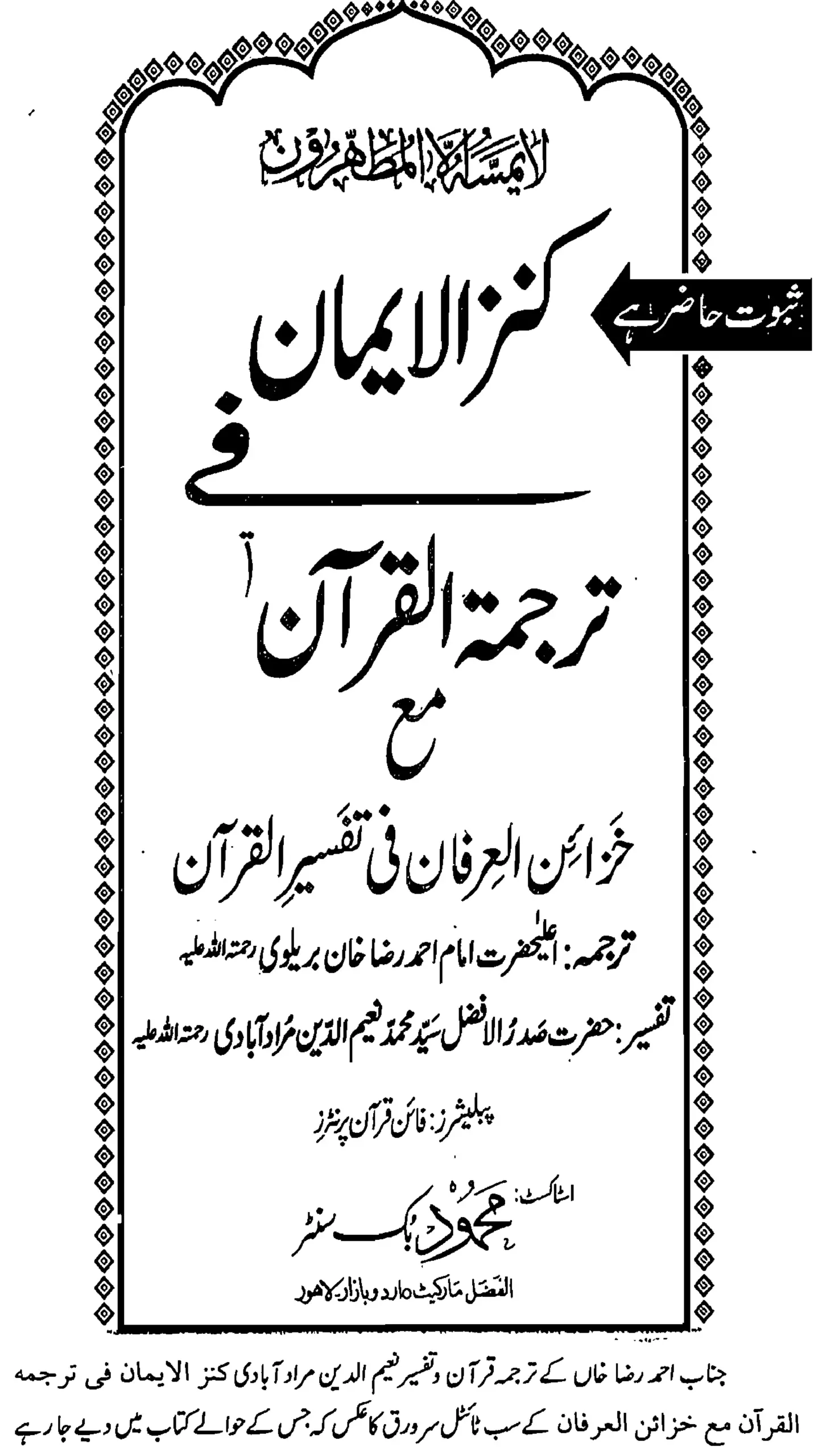
Kanz al-Iman, which is the Quranic translation of Ahmad Raza Khan Sahib, and the Quranic Tafsir of Naeemuddin Muradabadi. Its identification is that the translation is written below the Arabic, and a separate Tafsir is written below that. That is, the Arabic Quran, Urdu translation below it, and a separate Urdu Tafsir written below. See:
Reference: This book pp. (143-144)(188 to 191)(107 to 109)(198 to 211)(229 to 231)(251 to 259)(578, 577)
etc.Hafiz Nazar Ahmad's is only a Quranic translation; it does not contain Tafsir. This is a consensus translation of two Barelvi scholars Mufti Muhammad Hussain Naeemi and Muhammad Sarfaraz Sahib Naeemi, two Deobandi scholars Abdul Rauf Malik Sahib and Saeedur Rahman Alvi, and two Ahl-e-Hadith scholars Aziz Zubaidi Sahib and Professor Mazamil Ahsan Sahib. It consists of 1300 pages. See:
Reference: This book pp. (242 to 250)(590 to 592)(599/598)

