

Compiled by: Abu Hamzah Salafi
الحمد لله وحده، والصلوٰة والسلام على من لا نبي بعده۔
All praise is for Allah alone, and peace and blessings be upon the one after whom there is no Prophet.
However, it is also an undeniable fact that Hanafi scholars themselves have made severe criticisms against al-Khatib al-Baghdadi, leveling various accusations against him. Some described him as biased, others labeled him as frequently mistaken, some accused him of bad character and injustice, and others even cast allegations upon his personal integrity.
❖ The purpose of this article is to establish that if any Hanafi today presents a statement or verdict of al-Khatib al-Baghdadi as evidence, then it is obligatory upon him to first answer the statements of numerous Hanafi كبار (leading scholars) who themselves declared al-Khatib unreliable and biased.
If all these criticisms and allegations against al-Khatib are true, then presenting any of his statements as proof is open hypocrisy. And if these allegations are false, then the statements of those Hanafi كبار must be rejected.
In any case, this double standard—declaring him biased when he criticizes Abu Ḥanīfah, yet using his words as proof when they are favorable—is contrary to scholarly integrity.
والجواب الثالث: أن رواية من كان كثير الغلط والزلل وإن كان ورعاً غير مقبولة، والخطيب بهذه المثابة.»
— al-Khwarizmi, Jāmiʿ al-Masānīd
— Ibn ʿĀbidīn, Radd al-Muḥtār ʿalā al-Durr al-Mukhtār
Al-Ḥāfiẓ al-Khwarizmi arranged Musnad Imam Abu Ḥanīfah according to juridical chapters and answered the objections raised against the Imam by certain individuals, especially al-Khatib al-Baghdadi. Al-Khatib was biased and hostile against Imam Abu Ḥanīfah. In mentioning alleged faults of the Imam, he contradicted himself, and his speech is disordered.
— Sibt Ibn al-Jawzi, Mir’āt al-Zamān
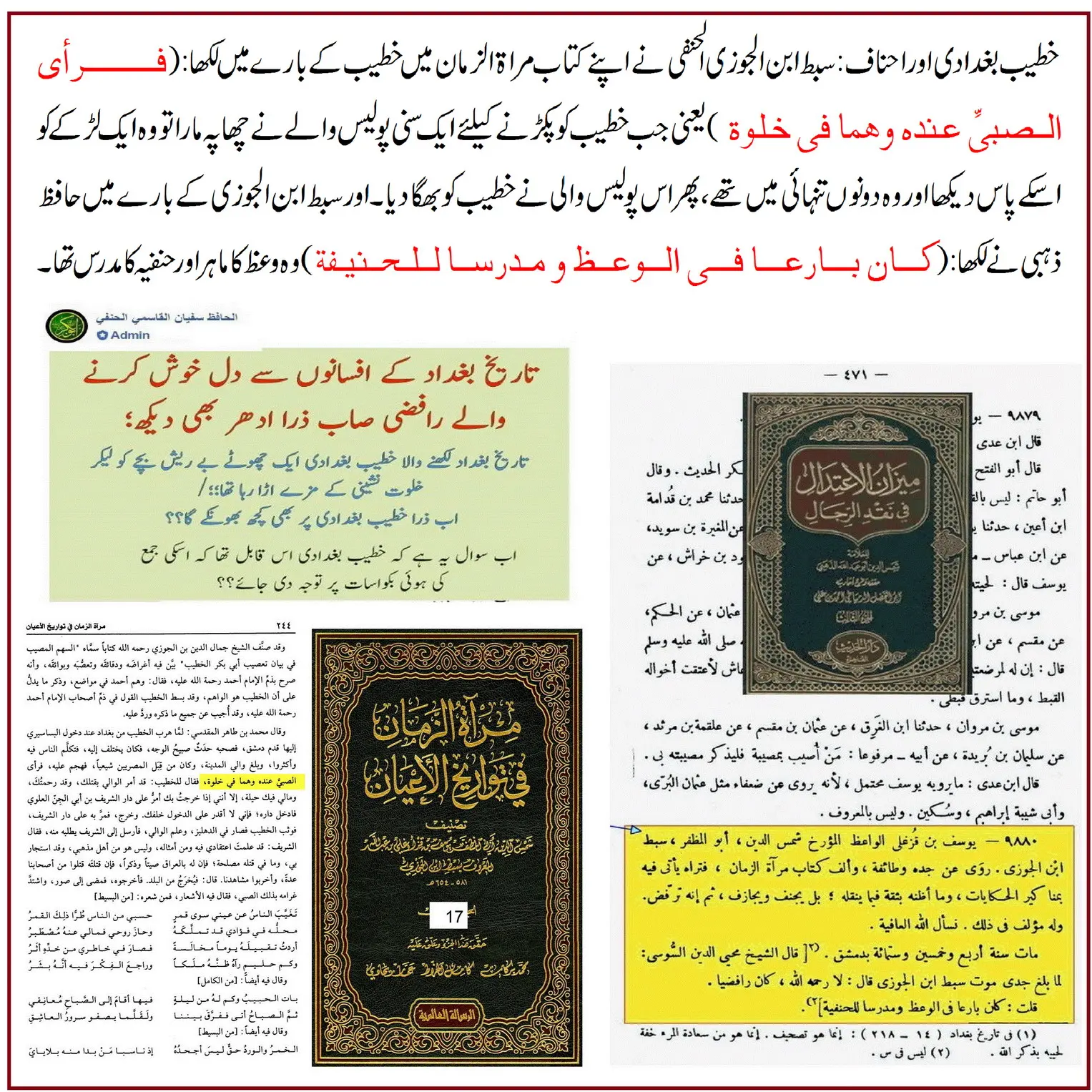
(Hafiz al-Dhahabi said regarding Sibt Ibn al-Jawzi: «كان واعظاً ومدرّساً للحنفية» — Mīzān al-Iʿtidāl, no. 9880)
— al-Laknawi, al-Rafʿ wa al-Takmīl fī al-Jarḥ wa al-Taʿdīl
— al-Kawthari, Ta’nīb al-Khatib, p. 49
He further stated:
— al-Kawthari, Ta’nīb al-Khatib, p. 62
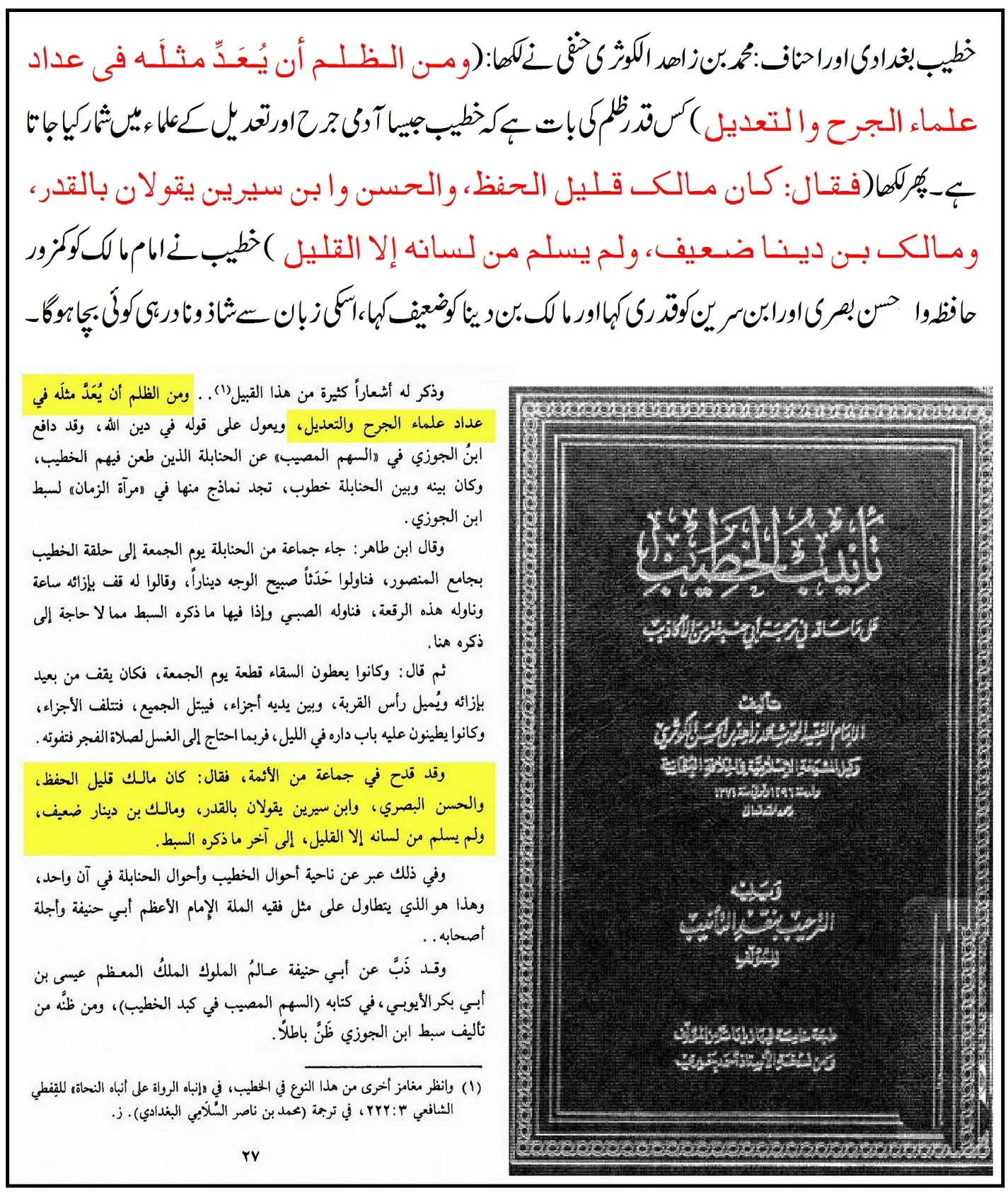
 According to al-Kawthari, al-Khatib was both overly strict and overly lenient in criticism; therefore, counting him among the Imams of Jarḥ wa Taʿdīl is injustice.
— Ibn Taghri Bardi, al-Nujūm al-Zāhirah (6/15)
— Ibn Khallikan, Wafayāt al-Aʿyān (3/125); al-Laknawi, al-Fawā’id al-Bahiyyah, p. 62
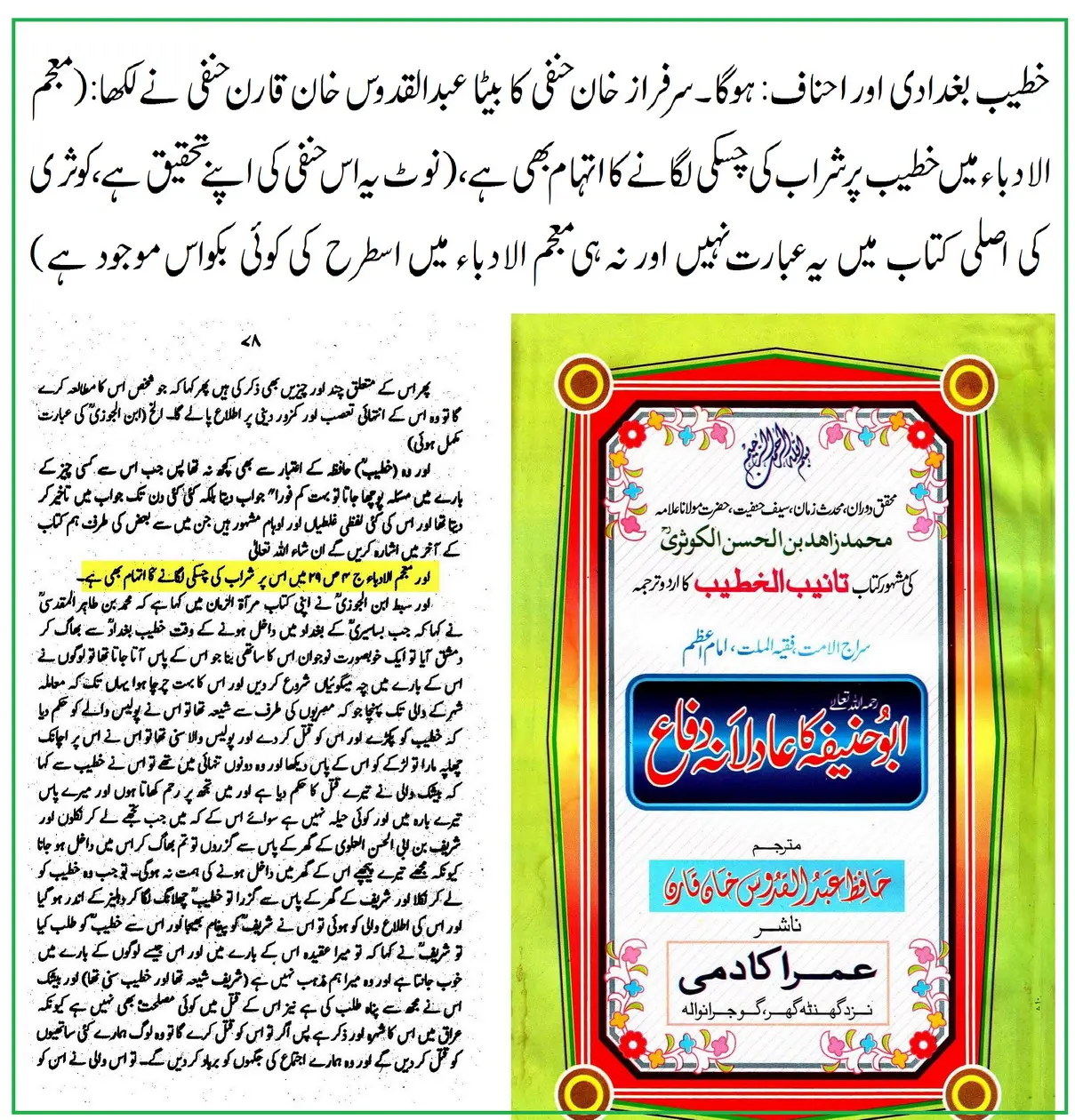
◈ ʿAbd al-Quddus Khan Hanafi wrote that in Muʿjam al-Udabā’ there is even an allegation of wine-drinking against al-Khatib.
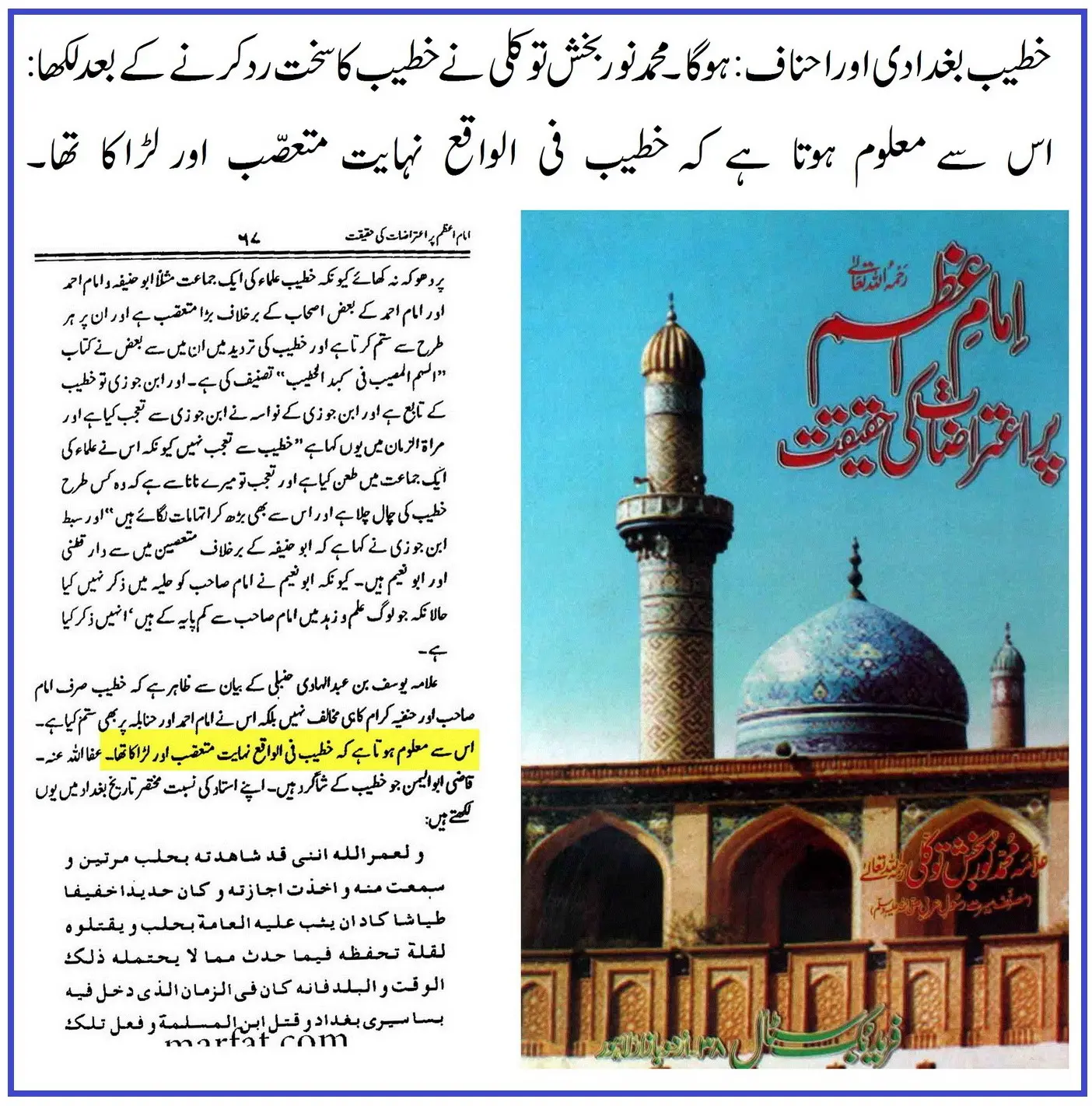
◈ Muhammad Nur Bakhsh Tawakkuli described him as extremely biased and combative, stating that his statements cannot be accepted.
Among these statements, he has been described as:
① Biased
② Frequently mistaken
③ Narrator of rejected reports
④ Unjust
⑤ Even accused of immoral conduct
If any Barelvi or Hanafi presents a statement of al-Khatib al-Baghdadi as evidence, it is necessary first to respond to these criticisms.
Otherwise, it is a clear contradiction to declare a person biased and frequently mistaken, yet use his statements as proof when convenient.
Therefore, no isolated statement of al-Khatib al-Baghdadi can serve as binding proof for the Hanafis unless they first refute the severe criticisms made against him by their own كبار.
الحمد لله وحده، والصلوٰة والسلام على من لا نبي بعده۔
All praise is for Allah alone, and peace and blessings be upon the one after whom there is no Prophet.
Imam al-Khatib al-Baghdadi in the View of Hanafi Scholars
Among the leading authorities of Jarḥ wa Taʿdīl, Imam al-Khatib al-Baghdadi (d. 463 AH) is regarded as a prominent muhaddith and historian. His works—especially Tārīkh Baghdād—form an important part of the scholarly heritage of the muhaddithin.However, it is also an undeniable fact that Hanafi scholars themselves have made severe criticisms against al-Khatib al-Baghdadi, leveling various accusations against him. Some described him as biased, others labeled him as frequently mistaken, some accused him of bad character and injustice, and others even cast allegations upon his personal integrity.
❖ The purpose of this article is to establish that if any Hanafi today presents a statement or verdict of al-Khatib al-Baghdadi as evidence, then it is obligatory upon him to first answer the statements of numerous Hanafi كبار (leading scholars) who themselves declared al-Khatib unreliable and biased.
If all these criticisms and allegations against al-Khatib are true, then presenting any of his statements as proof is open hypocrisy. And if these allegations are false, then the statements of those Hanafi كبار must be rejected.
In any case, this double standard—declaring him biased when he criticizes Abu Ḥanīfah, yet using his words as proof when they are favorable—is contrary to scholarly integrity.
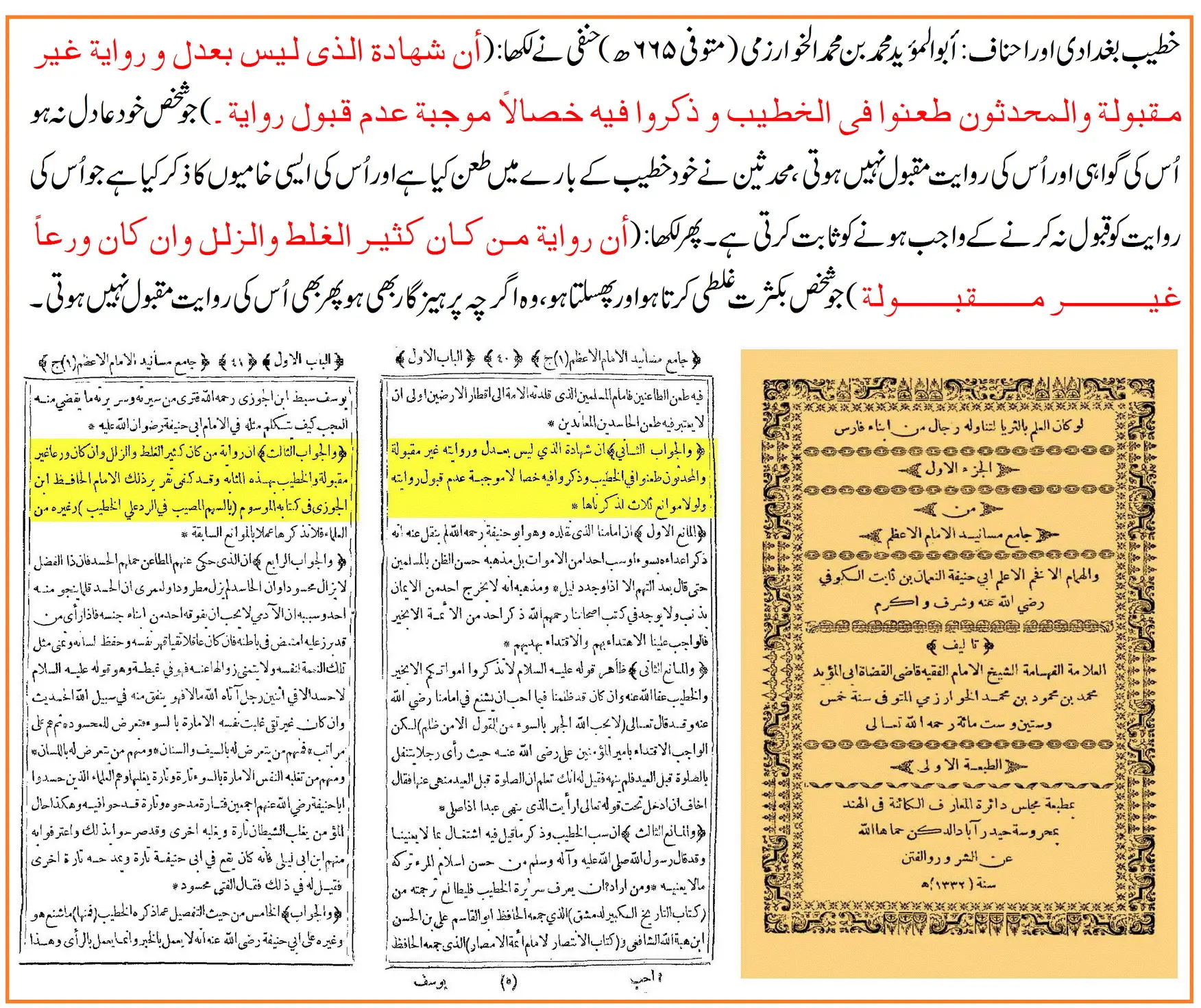
✦ 1. Abu al-Mu’ayyad Muhammad ibn Muhammad al-Khwarizmi al-Hanafi (d. 665 AH)
Arabic Text:
«… والمحدثون طعنوا في الخطيب وذكروا فيه خصالاً موجبة عدم قبول روايته…والجواب الثالث: أن رواية من كان كثير الغلط والزلل وإن كان ورعاً غير مقبولة، والخطيب بهذه المثابة.»
— al-Khwarizmi, Jāmiʿ al-Masānīd
Translation:
“The testimony and narration of one who is not upright is not accepted. The muhaddithin have mentioned such faults in al-Khatib that necessitate rejecting his narration. And the narration of one who frequently errs, even if he is pious, is not accepted—and al-Khatib falls into this category.”✦ 2. Ibn ʿĀbidīn al-Shāmi (d. 1252 AH)
Arabic Text:
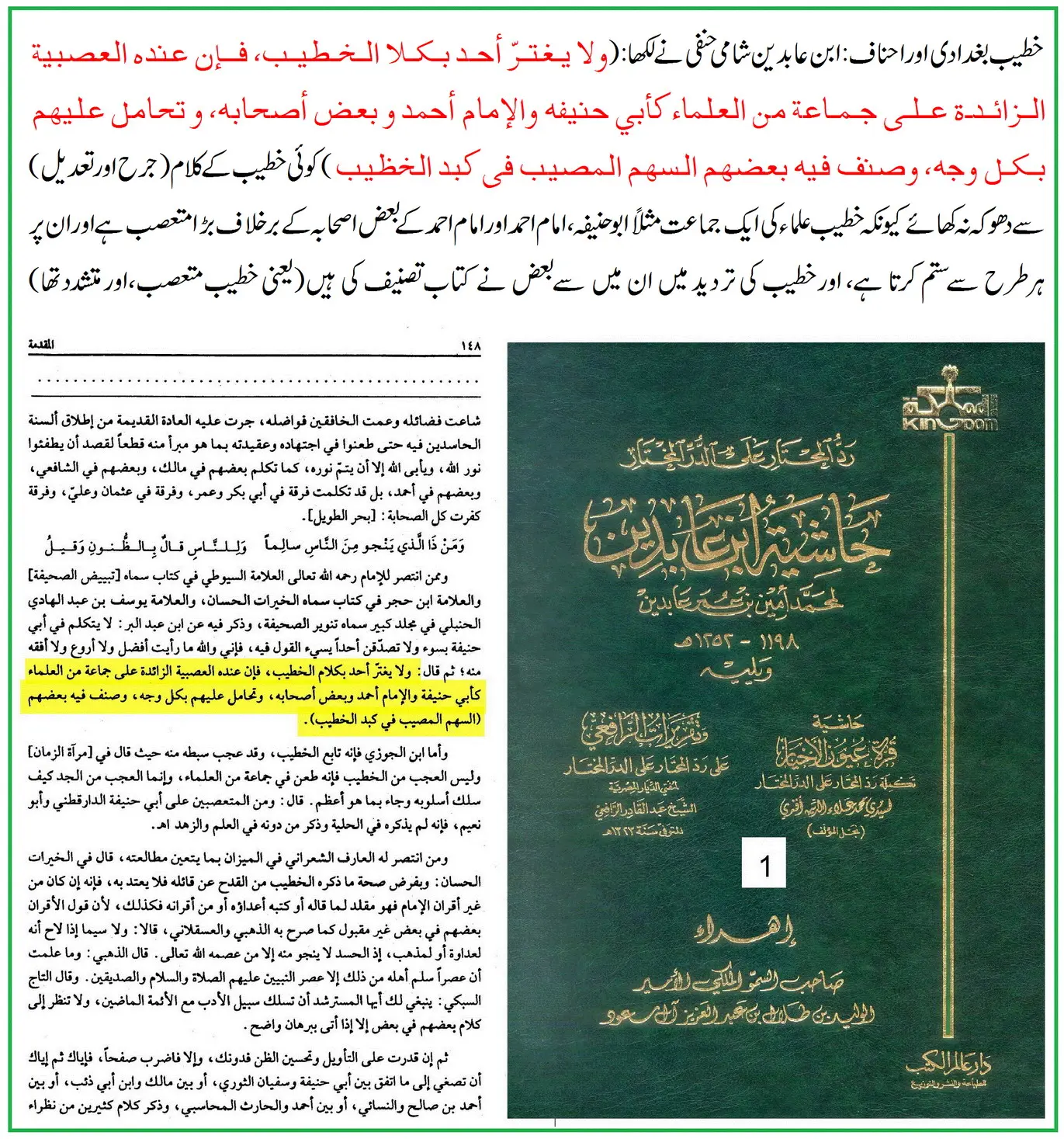
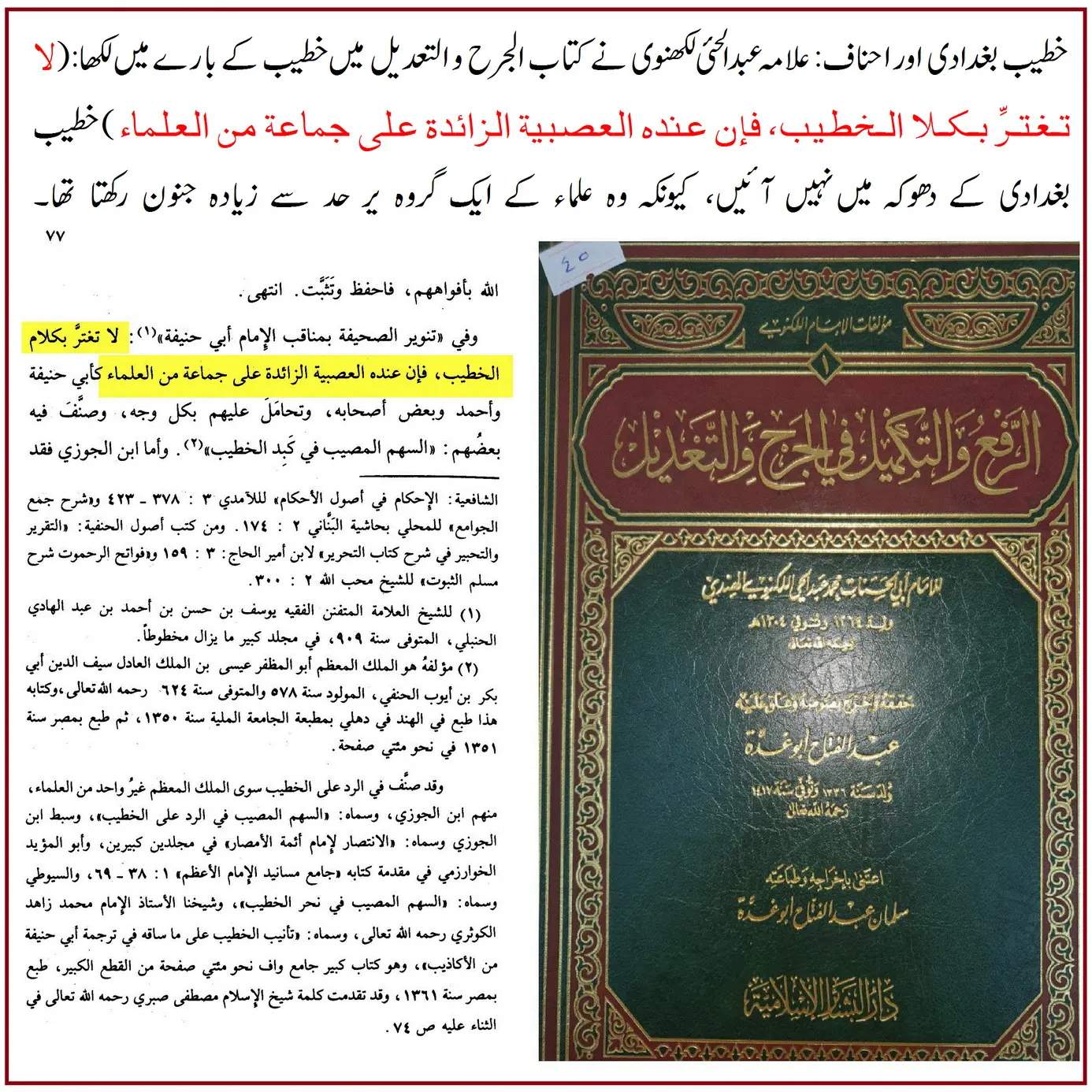
«ولا يغتر أحد بكلام الخطيب، فإن عنده العصبية الزائدة على جماعة من العلماء كأبي حنيفة والإمام أحمد وبعض أصحابه… وصنف بعضهم السهم المصيب في كيد الخطيب.»— Ibn ʿĀbidīn, Radd al-Muḥtār ʿalā al-Durr al-Mukhtār
Translation:
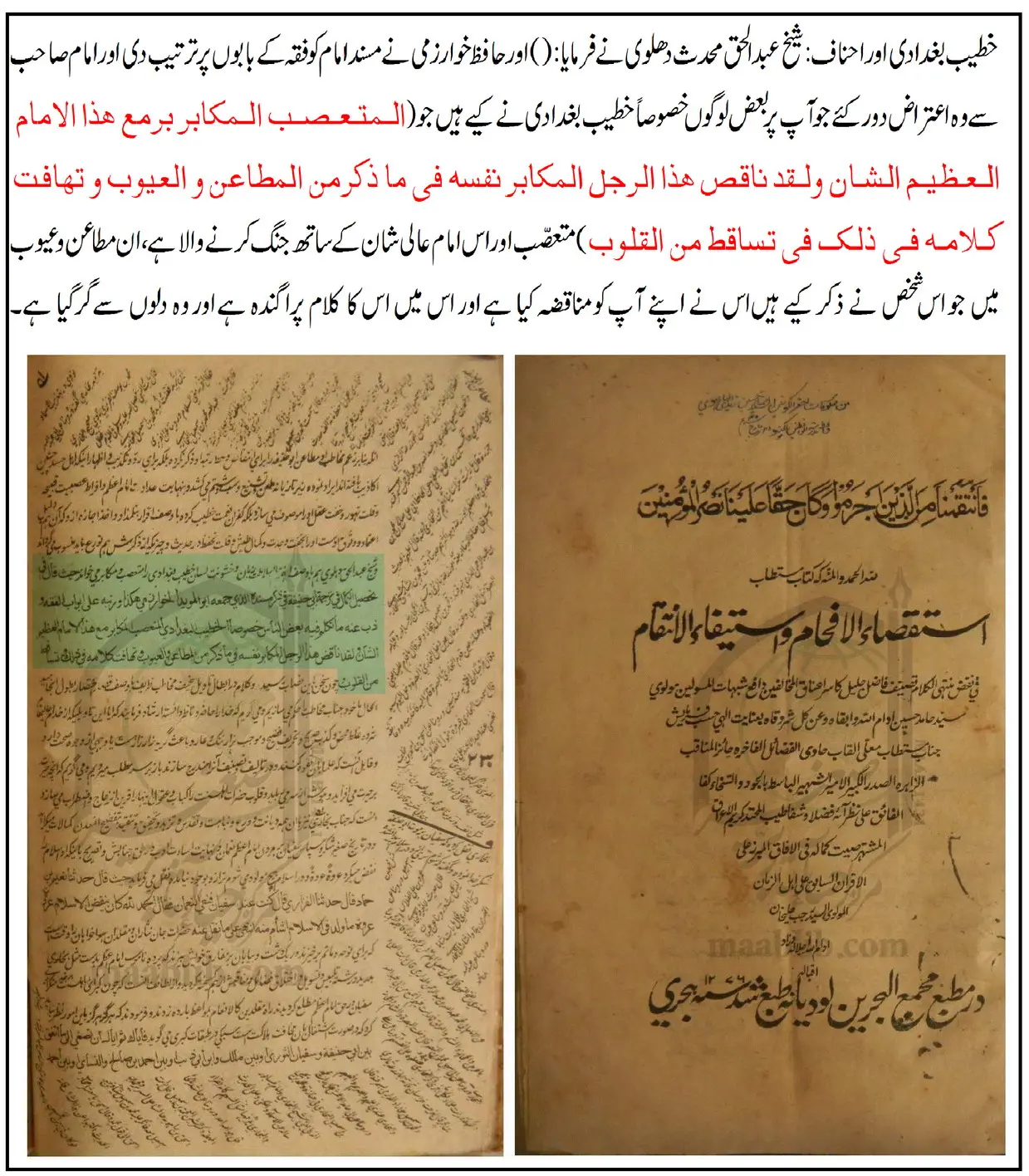
“No one should be deceived by the words of al-Khatib, for he has excessive bias against a number of scholars such as Abu Ḥanīfah and Imam Aḥmad and some of his companions. Some scholars even authored a book titled al-Sahm al-Muṣīb fī Kayd al-Khatib in refutation of him.”✦ 3. Shah ʿAbd al-Ḥaqq al-Muḥaddith al-Dehlawi (d. 1052 AH)
He stated:Al-Ḥāfiẓ al-Khwarizmi arranged Musnad Imam Abu Ḥanīfah according to juridical chapters and answered the objections raised against the Imam by certain individuals, especially al-Khatib al-Baghdadi. Al-Khatib was biased and hostile against Imam Abu Ḥanīfah. In mentioning alleged faults of the Imam, he contradicted himself, and his speech is disordered.
✦ 4. Sibt Ibn al-Jawzi al-Hanafi (d. 654 AH)
Arabic Text:
«… فرأى الصبي عنده وهما في خلوة… فقال للخطيب: قد أمر الوالي بقتلك…»— Sibt Ibn al-Jawzi, Mir’āt al-Zamān
Translation:
It is narrated that when an official raided al-Khatib, he saw a young boy with him in seclusion. The official then said to al-Khatib: “The governor had ordered your execution, but I showed mercy to you.”(Hafiz al-Dhahabi said regarding Sibt Ibn al-Jawzi: «كان واعظاً ومدرّساً للحنفية» — Mīzān al-Iʿtidāl, no. 9880)
✦ 5. ʿAllāmah ʿAbd al-Ḥayy al-Laknawi (d. 1304 AH)
Arabic Text:
«لا تغتر بالخطيب، فإن عنده العصبية الزائدة على جماعة من العلماء.»— al-Laknawi, al-Rafʿ wa al-Takmīl fī al-Jarḥ wa al-Taʿdīl
Translation:
“Do not be deceived by al-Khatib, for he possesses excessive fanatic bias against a number of scholars.”✦ 6. Muhammad ibn Zahid al-Kawthari (d. 1371 AH)
Arabic Text:
«ومن الظلم أن يُعَدَّ مثلُه في عدد علماء الجرح والتعديل.»— al-Kawthari, Ta’nīb al-Khatib, p. 49
Translation:
“It is injustice to count someone like him among the scholars of Jarḥ wa Taʿdīl.”He further stated:
Arabic Text:
«كان مالك قليل الحفظ، والحسن البصري وابن سيرين يقولان بالقدر، ومالك بن دينار ضعيف، ولم يثبت من لسانه إلا القليل.»— al-Kawthari, Ta’nīb al-Khatib, p. 62
Translation:
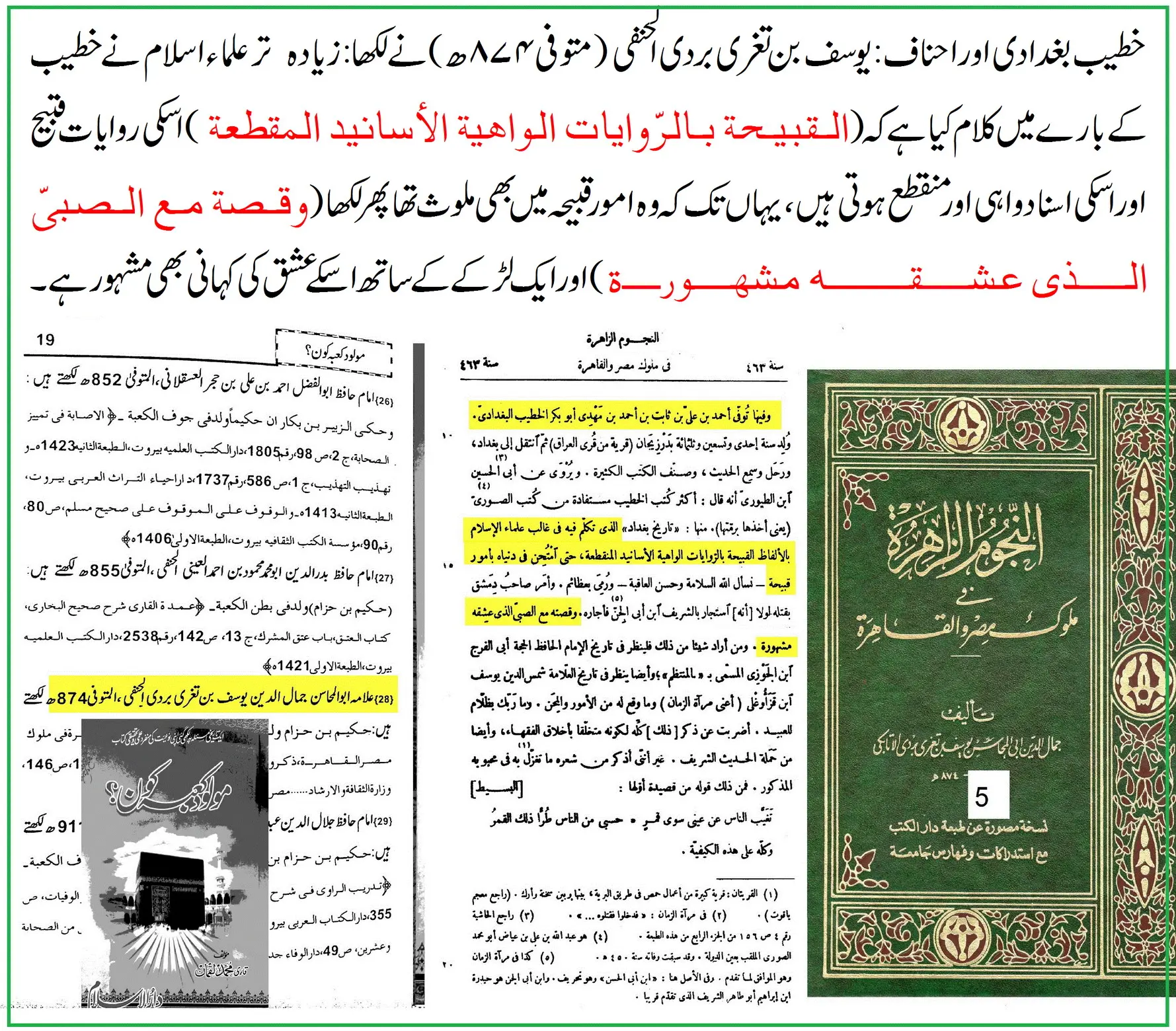
“He described Imam Malik as having weak memory, declared al-Hasan al-Basri and Ibn Sirin to be Qadari, and labeled Malik ibn Dinar as weak. Hardly anyone was spared from his tongue.” According to al-Kawthari, al-Khatib was both overly strict and overly lenient in criticism; therefore, counting him among the Imams of Jarḥ wa Taʿdīl is injustice.✦ 7. Yusuf ibn Taghri Bardi al-Hanafi (d. 874 AH)
Arabic Text:
«الذي تكلّم فيه في غالب علماء الإسلام بالألفاظ القبيحة بالروايات الواهية الأسانيد المنقطعة، حتى امتحن في دنياه بأمور قبيحة… وقصته مع الصبيّ الذي عشقه مشهورة.»— Ibn Taghri Bardi, al-Nujūm al-Zāhirah (6/15)
Translation:
“He spoke against most of the scholars of Islam using vile expressions and weak, disconnected chains of narration, until he was tried in this world with disgraceful matters. His story with the boy whom he allegedly loved is well-known.”✦ 8. Al-Malik al-Muʿaẓẓam Sharaf al-Din (Hanafi ruler)
Ibn Khallikan wrote:Arabic Text:
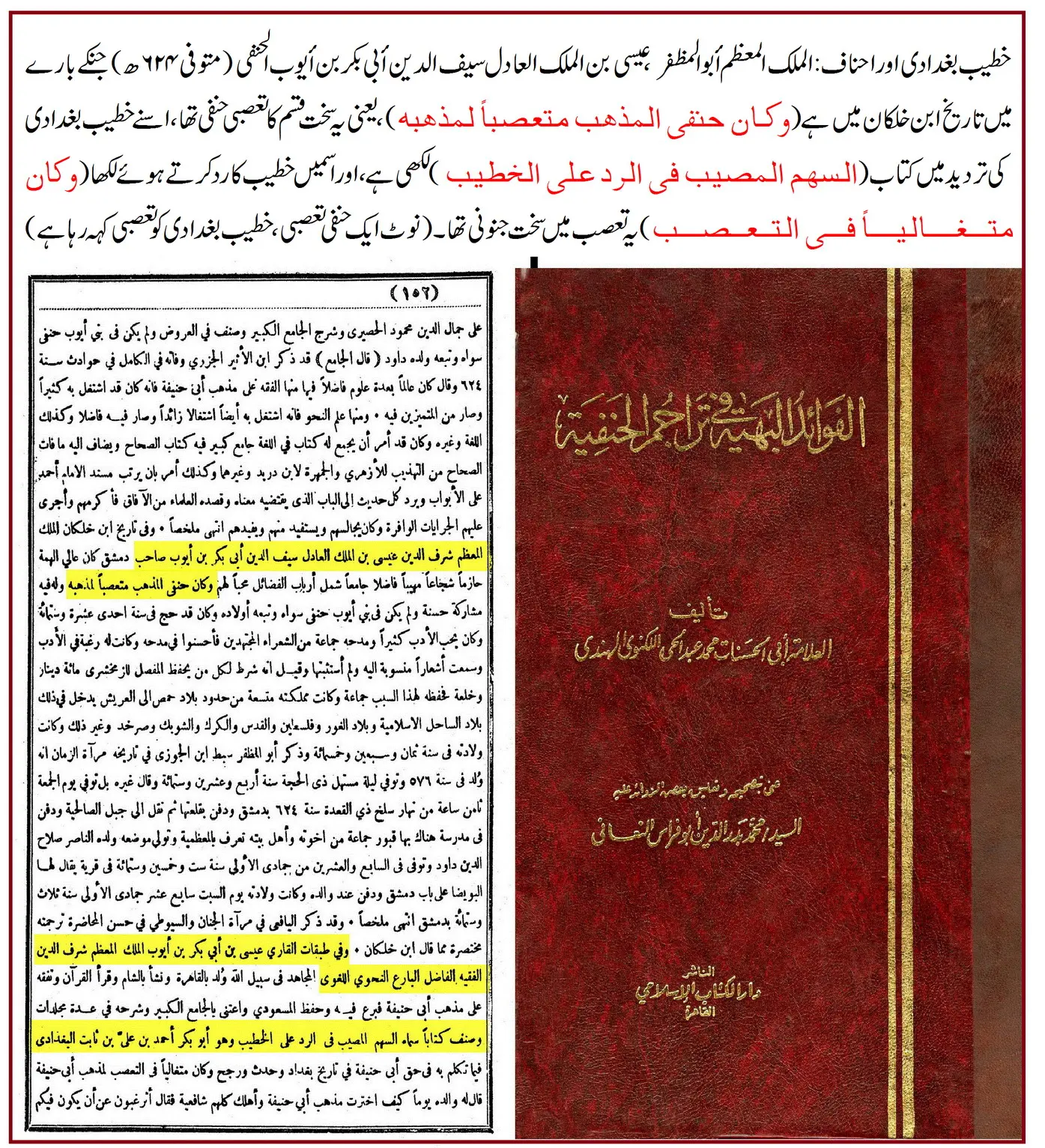
«… وصنّف كتاباً سمّاه السهم المصيب في الرد على الخطيب… وكان متغالياً في التعصب لمذهب أبي حنيفة.»— Ibn Khallikan, Wafayāt al-Aʿyān (3/125); al-Laknawi, al-Fawā’id al-Bahiyyah, p. 62
Translation:
He authored a book titled al-Sahm al-Muṣīb fī al-Radd ʿalā al-Khatib in response to al-Khatib’s criticism of Abu Ḥanīfah. He was extremely partisan toward the Hanafi school.✦ Additional Statements
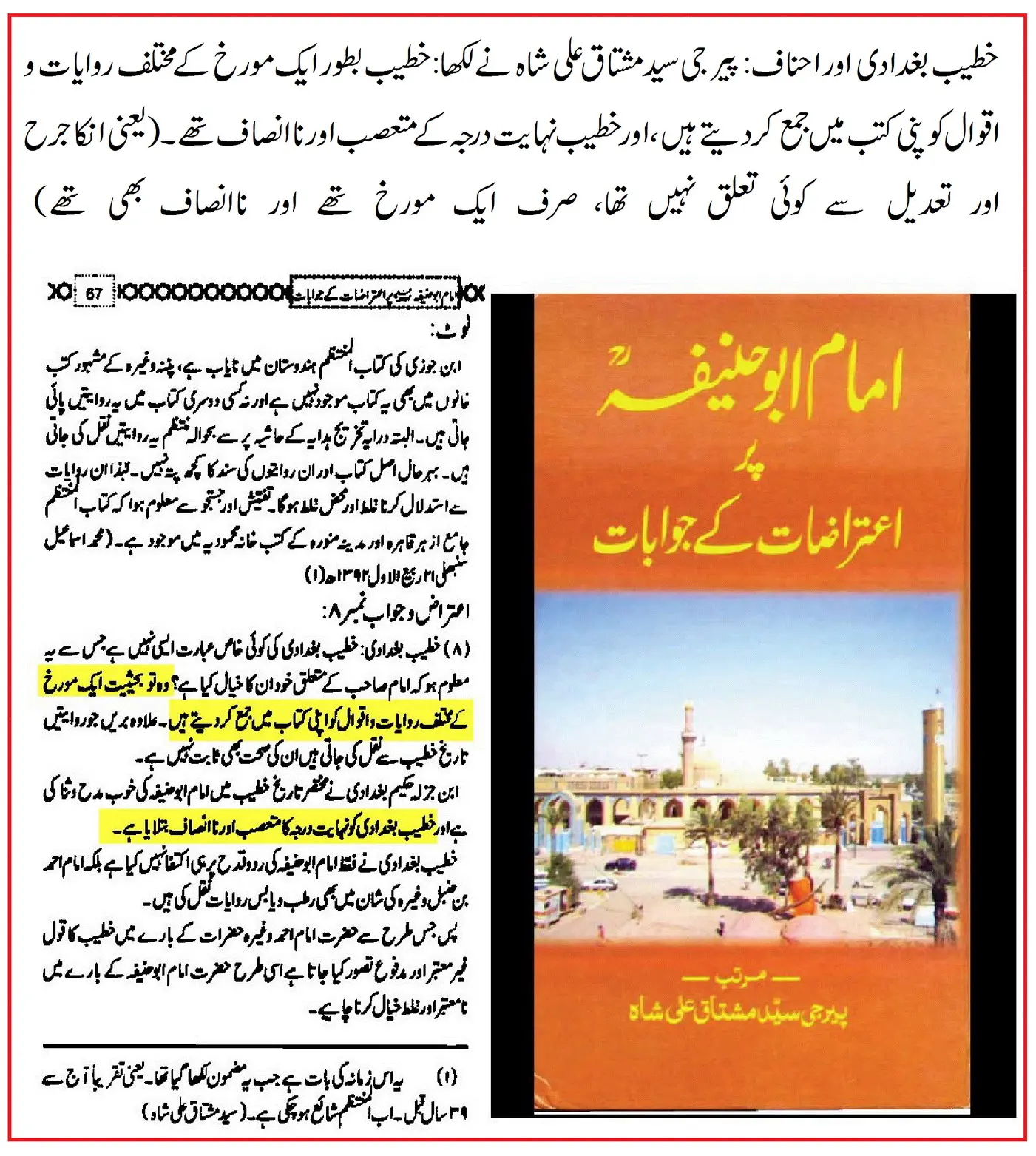
◈ Pir Sayyid Mushtaq ʿAli Shah stated that al-Khatib, though compiling various reports as a historian, was highly biased and unjust.◈ ʿAbd al-Quddus Khan Hanafi wrote that in Muʿjam al-Udabā’ there is even an allegation of wine-drinking against al-Khatib.
◈ Muhammad Nur Bakhsh Tawakkuli described him as extremely biased and combative, stating that his statements cannot be accepted.
✦ Summary and Conclusion
The severe criticisms against al-Khatib al-Baghdadi are directly transmitted from Hanafi كبار and partisan authors themselves.Among these statements, he has been described as:
① Biased
② Frequently mistaken
③ Narrator of rejected reports
④ Unjust
⑤ Even accused of immoral conduct
If any Barelvi or Hanafi presents a statement of al-Khatib al-Baghdadi as evidence, it is necessary first to respond to these criticisms.
Otherwise, it is a clear contradiction to declare a person biased and frequently mistaken, yet use his statements as proof when convenient.
Therefore, no isolated statement of al-Khatib al-Baghdadi can serve as binding proof for the Hanafis unless they first refute the severe criticisms made against him by their own كبار.
✦ Central Point
After such severe criticisms against al-Khatib al-Baghdadi, if any Barelvi or Hanafi presents his statement as proof or relies upon his solitary commendation, he must avoid this contradiction. For how can a person described as biased, frequently mistaken, strict and lenient in criticism—whom Hanafi scholars themselves do not consider qualified in Jarḥ wa Taʿdīl—become a valid proof for a Hanafi?
