Compiled by: Abu Hamza Salafi
This article is a scholarly examination of the claim that Imam Shafi'i (may Allah have mercy on him) was an advocate of "taqlid" (imitation) and that attributions like "I have followed so-and-so in taqlid" can be presented as proof of personal taqlid; based on this attribution, some individuals (Deobandi authors) have accused Hafiz Zubair Ali Za'i (may Allah have mercy on him) of saying "taqlid is for the ignorant," thereby seemingly placing Imam Shafi'i (may Allah have mercy on him) among the ignorant. In this section, we will clarify that:
- There is a fundamental difference between personal taqlid (Blind Personal Taqlid) and non-personal taqlid/following evidence;
- The authentic texts of Imam Shafi'i (may Allah have mercy on him) negate personal taqlid and explicitly emphasize following the Sunnah/evidence;
- Attributions like “قلتُه تقليداً لعمر/عثمان/عطاء” if they exist anywhere, pertain to non-personal taqlid/following influence, not to continuous personal taqlid of a single Imam; the chains of these attributions are also missing or unauthenticated;
- The "obligatory taqlid" mentioned by Ibn al-Qayyim (may Allah have mercy on him) refers to temporary, non-personal referral when the text is not present—not permanent personal taqlid. Cutting this phrase and presenting it as proof of personal taqlid is distortion.
Fundamental Difference: What is Personal Taqlid and What is Non-Personal Following/Taqlid?
- Personal Taqlid: Making the statement of a particular Imam/Sheikh a substitute for a Shariah proof and always following only him, even if a stronger proof appears—this is rejected according to Ahl al-Hadith.
- Non-Personal Following/Taqlid: Trusting the text or the apparent temporary report/fatwa/effect of the scholars to the extent of the proofs; immediately referring back once the text becomes clear—this is what the Imams clarify by “إذا صح الحديث فهو مذهبي” (If the hadith is authentic, then it is my madhhab).
Explicit Statements of Imam Shafi‘i (may Allah have mercy on him) — Denial of Personal Taqlid and Obligation of Following Hadith
In the statements of Imam Shafi‘i (may Allah have mercy on him), not only is there no concept of personal taqlid, but in every statement there is clear teaching of “following the Sunnah” and “abandoning taqlid.” Below are all the authentic and well-established texts from which this reality becomes as clear as daylight.
 “Do not imitate me; authentic hadith takes precedence”
Arabic text: «كُلُّ مَا قُلْتُ، وَكَانَ عَنِ النَّبِيِّ ﷺ خِلَافُ قَوْلِي مِمَّا يَصِحُّ، فَحَدِيثُ النَّبِيِّ ﷺ أَوْلَى، وَلَا تُقَلِّدُونِي.»
Translation: “Whatever I have said, if it is against the authentic hadith of the Messenger of Allah ﷺ, then the hadith of the Prophet ﷺ takes precedence, and do not imitate me.”
Reference:  Adab al-Shafi'i wa Manaqibih by Ibn Abi Hatim (327 AH) with an authentic chain from Harmala bin Yahya.
Adab al-Shafi'i wa Manaqibih by Ibn Abi Hatim (327 AH) with an authentic chain from Harmala bin Yahya.
Explanation: This statement is the basis for the invalidity of personal imitation. Imam Shafi'i (RA) did not consider his own opinion as proof but rather regarded authentic Hadith as the standard of Shariah. This is the principle of following evidence, on which there is consensus among Ahl al-Hadith.
 “When an authentic Hadith comes, I retract my statement”
Arabic text: «إِذَا صَحَّ الْحَدِيثُ عَنْ رَسُولِ اللَّهِ ﷺ، فَقُلْتُ قَوْلًا، فَأَنَا رَاجِعٌ عَنْ قَوْلِي، وَقَائِلٌ بِذَلِكَ.» With an authentic chain from Al-Hasan bin Saeed → Zakariya al-Saji → Ahmad bin Muhammad al-Makki → Abu al-Walid al-Jarudi → Al-Shafi'i.
Translation: “When an authentic Hadith is established from the Messenger of Allah ﷺ and I have said something contrary to it, I retract my statement and adopt that Hadith as my position.”
Reference: Hilyat al-Awliya (Abu Nu'aym al-Isfahani, 430 AH)
Hilyat al-Awliya (Abu Nu'aym al-Isfahani, 430 AH)
Explanation: This is the exact meaning of “non-personal imitation.” Imam Shafi'i (RA) declares retraction as soon as a clear legal text appears, which contradicts personal imitation.
 “If you find something in my book contrary to the Sunnah, then leave my statement”
Arabic text: «إِذَا وَجَدْتُمْ فِي كِتَابِي خِلَافَ سُنَّةِ رَسُولِ اللَّهِ ﷺ فَقُولُوا بِسُنَّةِ رَسُولِ اللَّهِ ﷺ وَدَعُوا مَا قُلْتُ.»
Translation: “If you find anything in my book that is contrary to the Sunnah of the Messenger of Allah ﷺ, then leave my statement and follow the Sunnah of the Messenger of Allah ﷺ.”
Reference: Criticism of Speech and Its People by Al-Harawi (481 AH) with a chain from Al-Rabi' ibn Sulayman.
Criticism of Speech and Its People by Al-Harawi (481 AH) with a chain from Al-Rabi' ibn Sulayman.
Explanation: This clarification highlights Imam Shafi'i's scholarly methodology that every statement of his is subject to the Sunnah. Any statement contrary to the Sunnah is considered invalid.
 “I do not narrate any hadith which I do not act upon”
Arabic text: «سُبْحَانَ اللَّهِ! أَرْوِي عَنْ رَسُولِ اللَّهِ ﷺ شَيْئًا وَلَا آخُذُ بِهِ؟ مَتَى عَرَفْتُ لِرَسُولِ اللَّهِ ﷺ حَدِيثًا وَلَمْ آخُذْ بِهِ فَأَنَا أُشْهِدُكُمْ أَنَّ عَقْلِي قَدْ ذَهَبَ.» Translation: “Glory be to Allah! Should I narrate something from the Messenger of Allah ﷺ and not act upon it? Whenever I know a hadith of the Prophet ﷺ and do not act upon it, I make you witness that my intellect has vanished!”
Reference: Adab al-Shafi'i wa Manaqibuh (Ibn Abi Hatim) with an authentic chain from Al-Rabi' ibn Sulayman.
Adab al-Shafi'i wa Manaqibuh (Ibn Abi Hatim) with an authentic chain from Al-Rabi' ibn Sulayman.
Explanation: This statement represents the utmost adherence to the Sunnah. According to Imam Shafi'i, knowledge of hadith without action is inconceivable, thus leaving no room for blind imitation.
 “Every hadith of the Messenger ﷺ is my statement”
Arabic text: «كُلُّ حَدِيثٍ عَنِ النَّبِيِّ ﷺ فَهُوَ قَوْلِي، وَإِنْ لَمْ تَسْمَعُوهُ مِنِّي.» Translation: “Every hadith of the Messenger of Allah ﷺ is my statement, even if you have not heard it directly from me.”
Reference: Adab al-Shafi'i wa Manaqibuh (327 AH) from Abu Thawr with an authentic chain.
Adab al-Shafi'i wa Manaqibuh (327 AH) from Abu Thawr with an authentic chain.
Explanation: These words are the foundation of Imam Shafi'i's theory of jurisprudence — that is, the original source of Shariah is the authentic Hadith, not the Imam or the follower's ijtihad.
 “If there is something in my book contrary to the Quran and Sunnah, then I have withdrawn it”
Arabic text: «فما وجدتم في كتبي هذه مما يخالف الكتاب والسنة فقد رجعت عنه.» Translation: “If you find anything in my books that is against the Quran and Sunnah, then know that I have withdrawn it.”
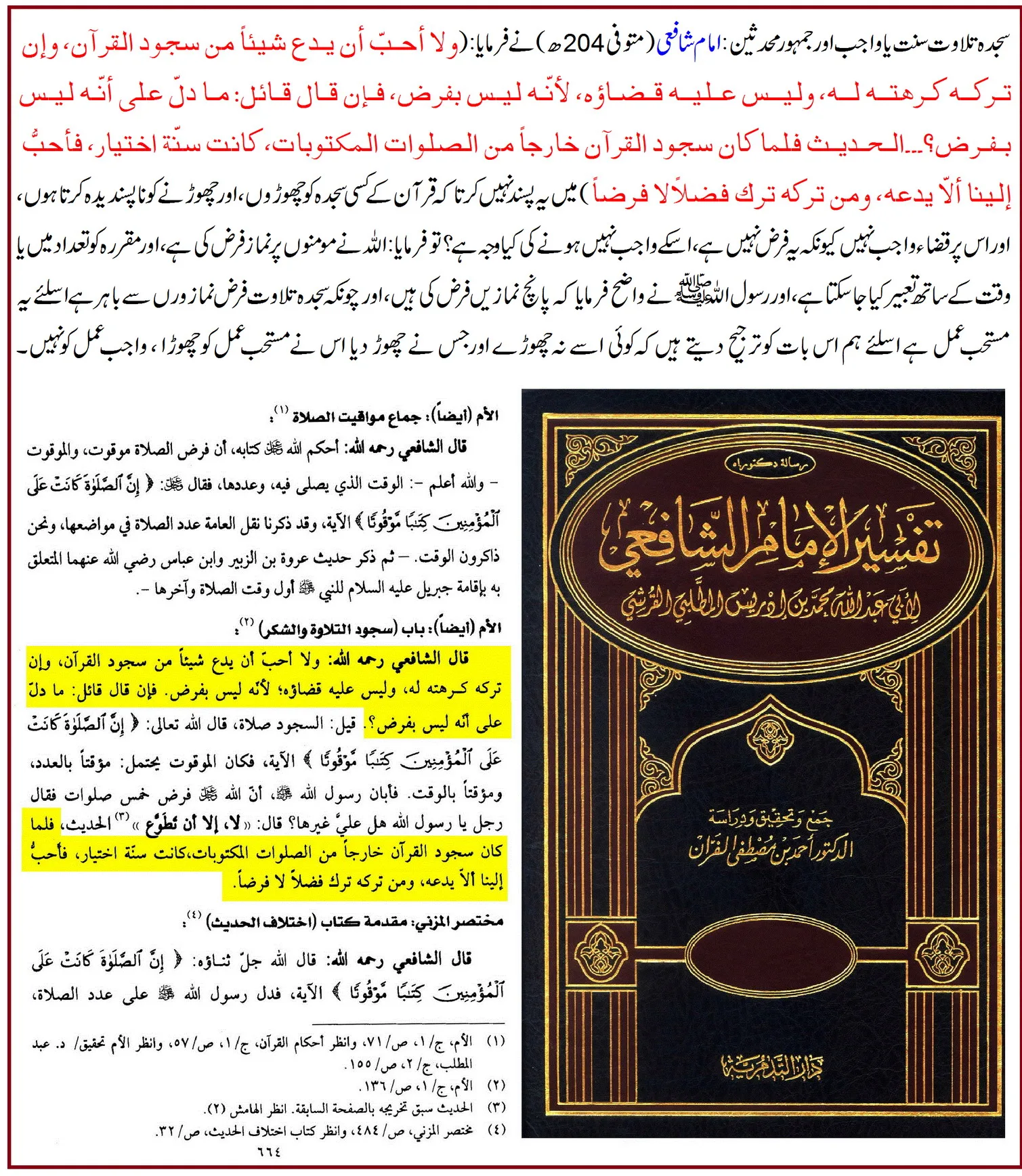
Reference: Tafsir al-Imam al-Shafi'i (204 AH)
Tafsir al-Imam al-Shafi'i (204 AH)
Explanation: This clarification indicates that according to Imam Shafi'i, the truth lies only in the text, and even his own ijtihad is subject to rejection if it contradicts the text.
Summary of all statements of Imam Shafi'i:
- Imam Shafi'i repeatedly declared that his imitation is forbidden, and every authentic Hadith is his doctrine.
- His sayings “ولا تقلدوني” (Do not imitate me), “إذا صح الحديث فهو مذهبي” (If the Hadith is authentic, it is my doctrine), and “دعوا قولي” (Leave my statement) invalidate personal imitation.
- According to him, the sayings of a jurist, muhaddith, companion, or follower — all are subject to the text, not a substitute for the text.
- Whoever tries to prove personal imitation of Imam Shafi'i despite this clear methodology is actually distorting the texts of the Imam.
The Original Text of Ibn al-Qayyim, Context, and a Comprehensive Analysis of the Deobandi Scholars' Distortion of the Text
Now we present a scholarly analysis of the original dispute:
A Deobandi author took only a fragment from a statement of Ibn al-Qayyim — “قلتُه تقليدًا لعطاء” — and then claimed:
“See! Imam Shafi‘i used to follow taqlid (imitation), therefore calling non-taqlid followers (Ahl al-Hadith) ignorant for rejecting taqlid is to declare Imam Shafi‘i ignorant.”
This mode of reasoning is not only invalid in terms of chain of transmission but is also a severe distortion in meaning. Below is a complete analysis with evidence and references.
What is the original text of Ibn al-Qayyim? (What did the Deobandi cut out?)
This text is quoted from Ibn al-Qayyim in
Reference: “Ibn al-Qayyim al-Jawziyyah: His Era, Methodology, and Views in Jurisprudence, Creed, and Tasawwuf”
(Abdul Azim Sharaf al-Din).The original Arabic text is as follows:
Complete Arabic Text:
«ذَكَرَ ابْنُ القَيِّمِ أَنَّ التَّقْلِيدَ ثَلاثَةُ أَضْرُبٍ:تَقْلِيدٌ مَحْظُور، وَتَقْلِيدٌ مَسْنُون، وَتَقْلِيدٌ مُبَاح.
فَأَمَّا التَّقْلِيدُ المَحْظُورُ فَهُوَ تَقْلِيدُ مَنْ يَجِبُ اتِّبَاعُهُ فِي خِلَافِ مَا جَاءَ بِهِ الرَّسُولُ ﷺ،
وَأَمَّا التَّقْلِيدُ الْمُبَاحُ فَهُوَ تَقْلِيدُ مَنْ لَيْسَ قَوْلُهُ حُجَّةً مَعَ قُدْرَةِ الْمُقَلِّدِ عَلَى الِاسْتِدْلَالِ،
وَأَمَّا التَّقْلِيدُ الْوَاجِبُ:فَهُوَ تَقْلِيدُ الْأَعْلَمِ عِنْدَ عَدَمِ الظَّفَرِ بِنَصٍّ مِنْ كِتَابٍ أَوْ سُنَّةٍ،كَقَوْلِ الشَّافِعِيِّ: قُلْتُهُ تَقْلِيدًا لِعُمَرَ، وَقُلْتُهُ تَقْلِيدًا لِعُثْمَانَ، وَقُلْتُهُ تَقْلِيدًا لِعَطَاءٍ.»
Reference: (Source: Abdul Azim Sharaf al-Din, Ibn al-Qayyim al-Jawziyyah: His Era and Methodology… p. 108)
Translation (without any addition or omission):
Ibn al-Qayyim mentioned three types of taqlid (imitation):
(1) Forbidden taqlid: It is when one follows a person whose statement is in opposition to the Messenger of Allah ﷺ.
(2) Permissible Taqlid: It is when a person’s statement is not based on evidence, but the follower has the ability to investigate themselves.
(3) Obligatory Taqlid: It is when no text from the Quran and Sunnah can be found, then the statement of the one who has the most knowledge should be followed, as Imam Shafi'i said: "I said this in the taqlid of Umar (RA), I said this in the taqlid of Uthman (RA), I said this in the taqlid of Ata (RA)."
 First Reality: Ibn al-Qayyim (RA) here is not affirming “personal taqlid,” rather he is rejecting the statement
Ibn al-Qayyim (RA) has explained three levels of taqlid:
- Forbidden Taqlid (Haram): → To follow someone against the Messenger ﷺ. → This is the “personal taqlid” which Ibn al-Qayyim (RA) and all the Salaf have declared forbidden.
- Permissible Taqlid: → When a person has the ability to know the evidences but for convenience follows someone’s statement—this is also not preferred.
- Obligatory Taqlid: → That is non-personal, temporary referral: when a common person or student cannot find a text, and the statement of a scholar is available, then temporarily follow that statement—but as soon as a text is found, immediate referral is obligatory.
This is proven by the sayings of Imam Shafi'i himself:
“إذا وجدتم قولي يخالف الحديث فاضربوا بقولي الحائط.” (If my statement is against the Hadith, then strike my statement against the wall)
Therefore, Ibn Qayyim explains wajib taqlid (obligatory imitation) as temporary scholarly support in the absence of a text, and haram taqlid (forbidden imitation) as permanent personal imitation.
Second Reality: Deobandi cut only one sentence from Ibn Qayyim’s three types
In Ibn Qayyim’s text, there were three types. Deobandi only cut this part:
“قلتُه تقليداً لعطاء”
And deleted everything else:
- “Haram taqlid”
- “Mubah taqlid”
- “Wajib taqlid = temporary ijtihadi referral” and even the mention of the taqlid of “Umar (RA)” and “Uthman (RA)” was cut.
This is a severe scholarly betrayal.
Did Imam Shafi'i practice “personal taqlid” (imitation)?
No — here are 7 strong evidences
 Evidence 1 — He used to follow the statements of three different personalities at the same time
- Umar (RA)
- Uthman (RA)
- Ata (RA)
If this were “personal taqlid,” he would have followed only one person, but here it is “reasoning by influence,” meaning non-personal following.
Evidence 2 — There is no chain of narration for “qultuhu taqlidan”
This phrase is not preserved anywhere with an uninterrupted chain of narration from Imam Shafi'i. At most, it is a jurisprudential attribution—not a Hadith or an athar (narration).
Argument 3 — Imam Shafi'i explicitly forbade personal taqlid (imitation)
«ولا تقلدوني»"Do not imitate me"
Reference: (Adab al-Shafi'i, with authentic chain)
Argument 4 — Imam Shafi'i immediately referred to the text when it was present
This negates "personal taqlid."
Argument 5 — Ibn al-Qayyim brought this very phrase under the chapter of non-personal taqlid
Deobandi's claim that this is personal taqlid is a clear rebellion against Ibn al-Qayyim.
Argument 6 — If Imam Shafi'i ever took the statement of any Sahabi/Tabi'i,
then it was following the effect, not continuous servitude to any one Imam.
Argument 7 — Deobandis themselves call "non-personal taqlid" forbidden
- Rashid Ahmad Gangohi: Non-Imam taqlid is forbidden
- Taqi Usmani: Non-personal taqlid is misguidance that leads to disbelief
[Proofs of both statements are scanned below]
Whereas Ibn al-Qayyim says non-personal taqlid is obligatory. Deobandis have completely concealed this fact.
Summary of the discussion
- Ibn Qayyim's statement declares personal taqlid (imitation) as forbidden and non-personal referral as obligatory.
- “I followed Umar/Uthman/Ataa in taqlid” means temporary following of effect, not personal taqlid.
- There is no chain of narration evidence from Imam Shafi'i for this.
- Deobandi has presented the statement with distortion.
- Imam Shafi'i's explicit statements negate personal taqlid.
- If this were “personal taqlid,” one would follow only one Imam, not three different personalities.
- Ahl al-Hadith consider “non-personal taqlid” permissible, and that is Ibn Qayyim's position—Deobandi school calls it “misguidance.”