


Compiled by: Abu Hamza Salafi
The summary of this article is that due to tadlis (concealment), the possibility of sama‘/ittisal (hearing/connection) in a mu‘annan (narration with ‘an) hadith is compromised; accordingly, just like the well-known principle of Imam Shafi‘i (may Allah have mercy on him), there are numerous explicit reports from Imam Ahmad ibn Hanbal (may Allah have mercy on him) stating that if a narrator is accused of tadlis, his “‘an” narration will only be acceptable if he explicitly indicates sama‘ (e.g., haddathani, akhbarani, sami‘tu)—otherwise, Imam Ahmad (may Allah have mercy on him) in many places considers such ‘an narration to be disconnected/weak as evidence. The purpose of this article is to clarify, in light of these texts, that Imam Ahmad’s approach regarding the mu‘annan narration of a tadlis narrator is fundamentally in agreement with Imam Shafi‘i’s, and this is not merely a claim but is proven by numerous details.
Introduction: Tadlis, Mu‘annan Narration, and the Point of Dispute
 In tadlees, the narrator sometimes mentions his Sheikh/source in such a way that the explicitness of hearing (sama') is lost, especially in the form "عن". Therefore, among the Muhaddithin, a fundamental discussion arises about when a mudelees's mu'anna narration will be accepted. The point under discussion is that Imam Ahmad (may Allah have mercy on him) repeatedly states in his fatwas, sayings, and applications that:
 Where there is explicit hearing (sama'), the narration is strong, and where there is tadlees/'an 'anah, the fear of discontinuity prevails—hence caution is necessary.
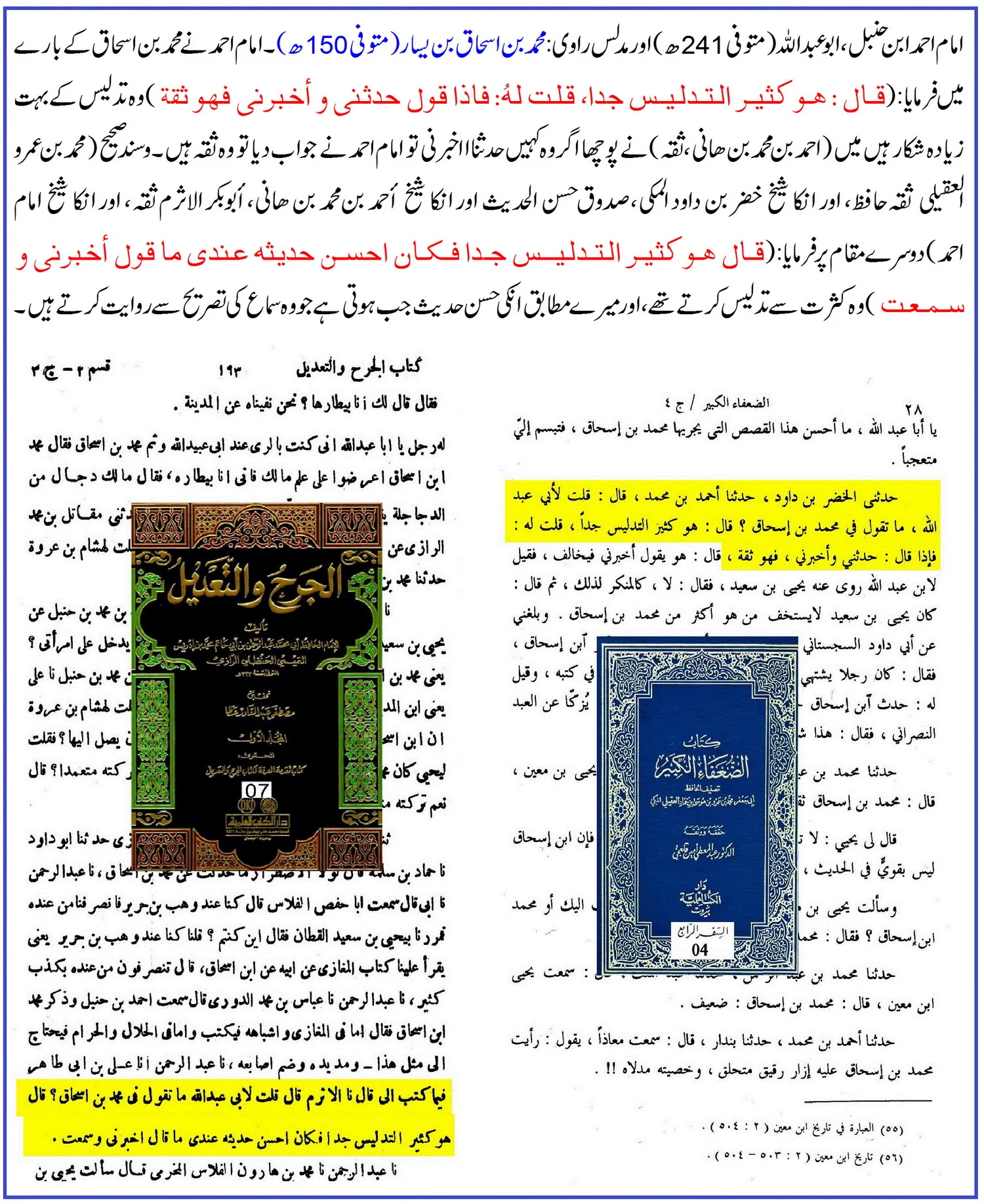
① Muhammad ibn Ishaq ibn Yasar (d. 150 AH) and the Condition of Sama'
حَدَّثَنِي الْخَضِرُ بْنُ دَاوُدَ، حَدَّثَنَا أَحْمَدُ بْنُ مُحَمَّدٍ قَالَ: قُلْتُ لِأَبِي عَبْدِ اللَّهِ: مَا تَقُولُ فِي مُحَمَّدِ بْنِ إِسْحَاقَ؟ قَالَ: هُوَ كَثِيرُ التَّدْلِيسِ جِدًّا، قُلْتُ لَهُ: فَإِذَا قَالَ: حَدَّثَنِي وَأَخْبَرَنِي فَهُوَ ثِقَةٌ؟
Translation:
Khidr ibn Dawood says: Ahmad ibn Muhammad said: I asked Abu Abdullah (Imam Ahmad): What do you say about Muhammad ibn Ishaq? He replied: He practices tadlees a lot. I asked: If he says "haddathani/akhbarani" (he narrated to me/told me), will he then be considered trustworthy? (i.e., will the narration then be reliable?)
Reference: (Al-Du'afa al-Kabeer by Al-'Uqaili)
Explanation:
Here Imam Ahmad (may Allah have mercy on him) clarified the main issue (excessive tadlees) and also explained the principle that the weight of a narration changes with explicit expression of hearing (sama‘).
Further confirmation of the same meaning:
فيما كتب إلى قال نا الأثرم قال قلت لأبي عبد الله ما تقول في محمد بن إسحاق؟ قال هو كثير التدليس جدا فكان احسن حديثه عندي ما قال اخبرني وسمعت.
Translation:
Athram says: I asked Abu Abdullah (Imam Ahmad) about Muhammad bin Ishaq, and he said: He practices tadlees excessively; and in my view, his best (more reliable) hadith is the one in which he explicitly states “أخبرني” and “سمعت” indicating clear sama‘.
Reference: (Al-Jarh wa al-Ta‘deel by Ibn Abi Hatim)
Conclusion of the Evidence:
According to Imam Ahmad (may Allah have mercy on him), the criterion for acceptance in the case of a mudallis is not “عن” but explicit clarification of sama‘.
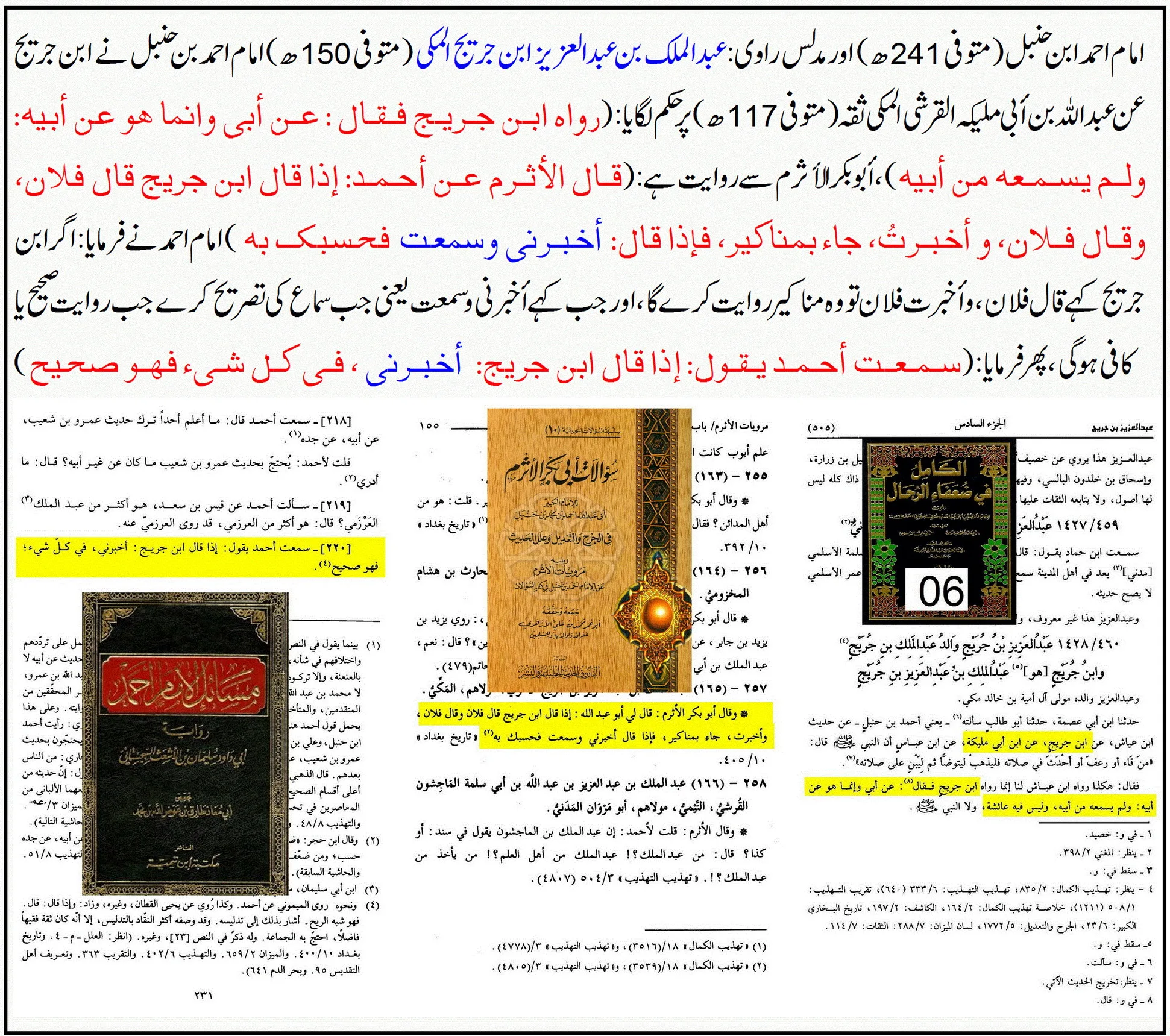
② Ibn Jurayj (Abdul Malik bin Abdul Aziz Al-Makki, died 150 AH) and “قال/أخبرت” versus “أخبرني/سمعت”
فقال هكذا رواه ابن عياش إنما رواه ابن جُرَيج فقال، عَن أبي وإنما هُوَ، عَنْ أَبِيهِ ولم يسمعه من أبيه وليس فيه عائشة،
Translation:
(The summary of Imam Ahmad’s ruling is that) Ibn ‘Ayyash narrated it like this, but the reality is that Ibn Jurayj said “عن أبي” whereas the correct is “عن أبيه”; and he did not hear it from his father, nor is there mention of ‘A’ishah (may Allah be pleased with her) in it.
Reference: (Al-Kamil fi Du‘afa’ al-Rijal by Ibn ‘Adi)
Further Clarification:
قال الأثرم عن أحمد بن حنبل: "إذا قال ابن جريج: قال فلان، وقال فلان، وأُخبرتُ، جاء بمناكير، وإذا قال: أخبرني، وسمعت فحسبک بہ
Translation:
Athram narrates from Imam Ahmad: When Ibn Jurayj says "Qala fulan" (so-and-so said) and "Ukhbirat" (I was informed), he brings weak narrations; but when he says "Ukhbirani" (he informed me) and "Sami'tu" (I heard), that is sufficient (meaning the narration becomes strong).
Reference: (Questions of Abu Bakr Athram to Ahmad ibn Hanbal)
An even more decisive standard:
[220] سَمِعت أَحْمد يَقُول إِذا قَالَ ابْن جريج أَخْبرنِي فِي كل شَيْء فَهُوَ صَحِيح
Translation:
I heard Imam Ahmad say: When Ibn Jurayj says "Ukhbirani" in everything, then it is authentic.
Reference: Al-Kitab: Questions of Abu Dawood for Imam Ahmad ibn Hanbal regarding criticism and praise of narrators
Author: Abu Abdullah Ahmad ibn Muhammad ibn Hanbal ibn Hilal ibn Asad al-Shaybani (died 241 AH)
Author: Abu Abdullah Ahmad ibn Muhammad ibn Hanbal ibn Hilal ibn Asad al-Shaybani (died 241 AH)
Conclusion of the evidence:
According to Imam Ahmad (may Allah have mercy on him), the basis for acceptance from a mudallis like Ibn Jurayj is "Ukhbirani/Sami'tu," and the forms "Qala/Ukhbirat" open the door to rejection/discontinuity.
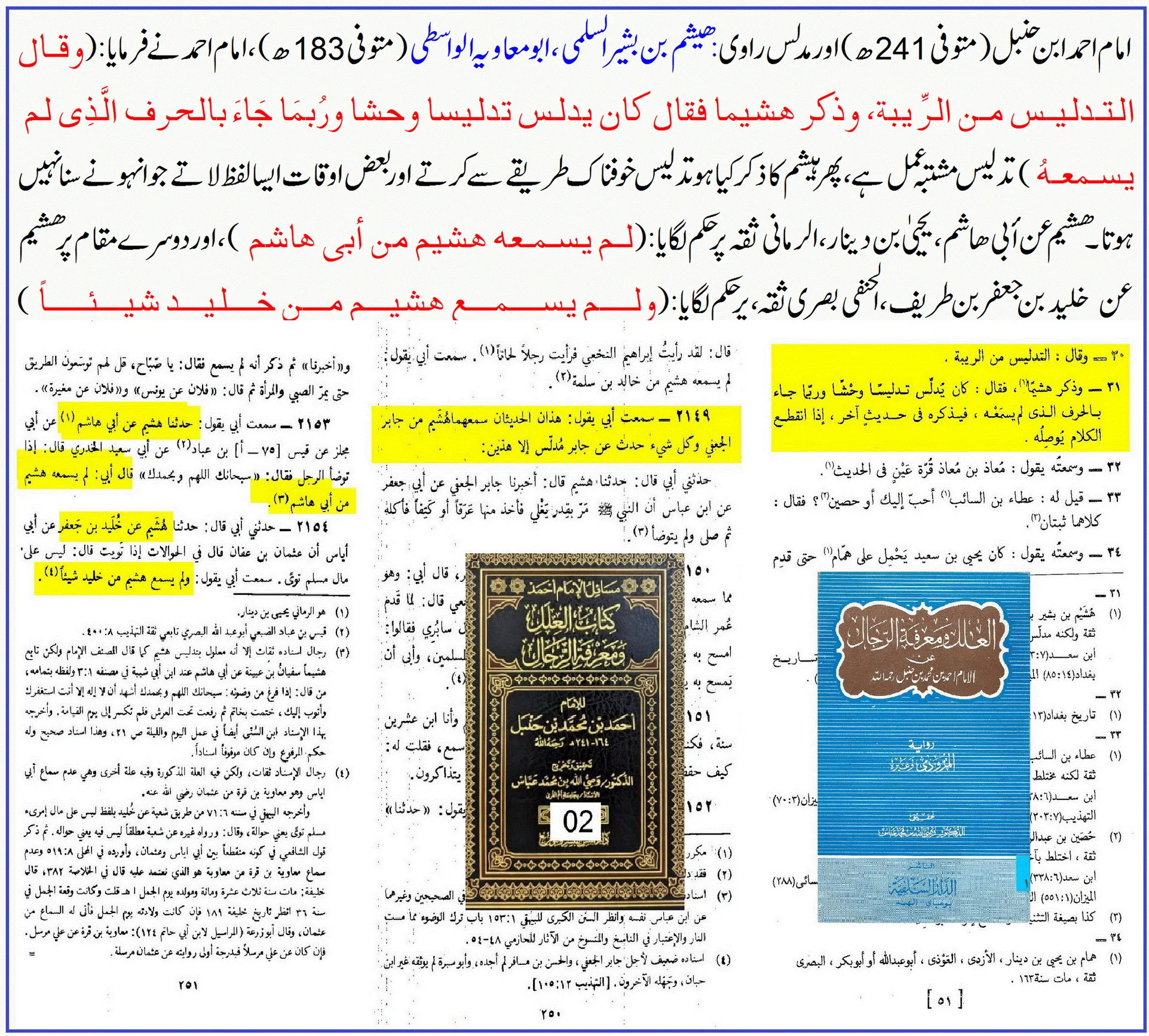
③ Hisham ibn Bashir (died 183 AH) and calling tadlees "doubt"
28 - وَقَالَ التَّدْلِيس من الرِّيبَة وَذكر هشيما فَقَالَ كَانَ يُدَلس تدليسا وحشا وَرُبمَا جَاءَ بالحرف الَّذِي لم يسمعهُ .
فيذكره فِي حَدِيث آخر إِذا انْقَطع الْكَلَام يوصله
Translation:
Imam Ahmad said: Tadlees is a cause of doubt and suspicion (doubt). Then he mentioned Hisham and said: He used to practice tadlees in a very severe (wild) manner; sometimes he would even bring a word that he had not heard; then in another hadith, where the speech breaks off, he would connect it (i.e., create the impression of continuity).
Reference: Al-Kitab: From the Words of Ahmad ibn Hanbal on the Defects of Hadith and the Knowledge of Narrators
Author: Abu Abdullah Ahmad ibn Muhammad ibn Hanbal ibn Hilal ibn Asad al-Shaybani (d. 241 AH)
Author: Abu Abdullah Ahmad ibn Muhammad ibn Hanbal ibn Hilal ibn Asad al-Shaybani (d. 241 AH)
Further Applied Ruling (Explicit Denial of Hearing):
2153 - سَمِعت أَبِي يَقُول حَدَّثَنَا هُشَيْم عَن أبي هَاشم عَن أبي مِجْلَزٍ عَنْ قَيْسِ بْنِ عَبَّادٍ عَن أَبِي سَعِيد الْخُدْرِيّ قَالَ إِذَا تَوَضَّأَ الرَّجُلُ فَقَالَ سُبْحَانَكَ اللَّهُمَّ وَبِحَمْدِكَ قَالَ أَبِي لَمْ يَسْمَعْهُ هُشَيْمٌ مِنْ أَبِي هَاشِمٍ
Translation:
(Regarding this chain) Imam Ahmad said: Hisham did not hear this from Abu Hashim.
2154 - حَدَّثَنِي أَبِي قَالَ حَدَّثَنَا هُشَيْمٌ عَنْ خُلَيْدِ بْنِ جَعْفَرٍ عَنْ أَبِي إِيَاسٍ أَنَّ عُثْمَانَ بْنَ عَفَّانَ قَالَ فِي الْحَوَالاتِ إِذَا تُوِيَتْ قَالَ لَيْسَ عَلَى مَالِ مُسْلِمٍ تَوًى سَمِعْتُ أَبِي يَقُولُ وَلَمْ يَسْمَعْ هُشَيْمٌ مِنْ خُلَيْدٍ شَيْئا
Translation:
Imam Ahmad said: Hisham did not hear anything from Khalid.
Reference: Al-Kitab: Al-‘Ilal wa Ma’rifat al-Rijal
Author: Abu Abdullah Ahmad ibn Muhammad ibn Hanbal ibn Hilal ibn Asad al-Shaybani (d. 241 AH)
Author: Abu Abdullah Ahmad ibn Muhammad ibn Hanbal ibn Hilal ibn Asad al-Shaybani (d. 241 AH)
Conclusion of the Evidence:
Imam Ahmad (may Allah have mercy on him) does not stop at merely saying “the narrator is a mudallis,” but by denying hearing, he clarifies the discontinuity in the narration—this approach confirms the principled stance of Imam Shafi‘i (may Allah have mercy on him).
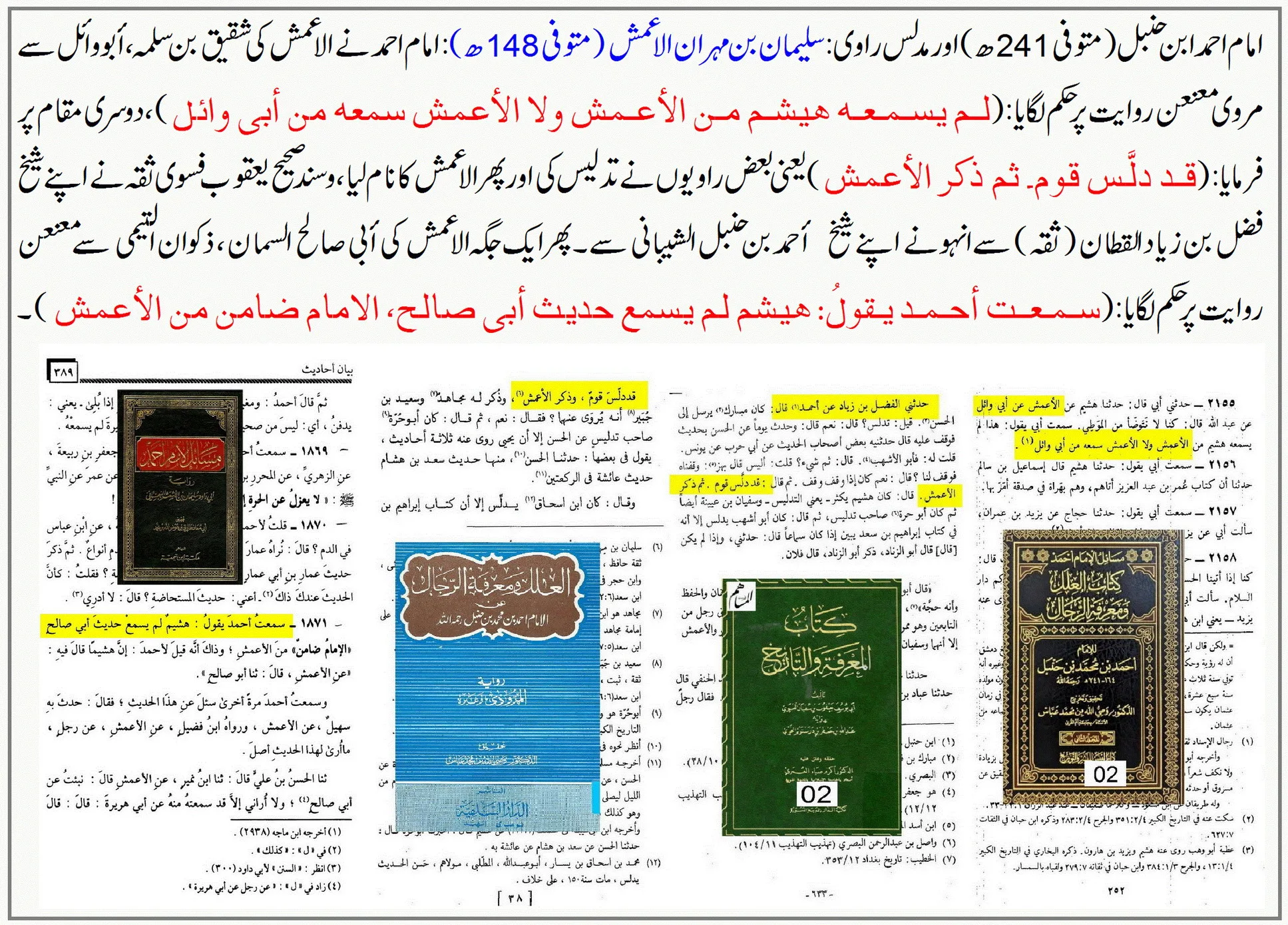
④ Al-A’mash (Sulaiman ibn Mihran, died 148 AH) and the Clarifications of “Lam Yasma’hu”
2155 - حَدثنِي أبي قَالَ حَدَّثَنَا هُشَيْم عَن الْأَعْمَش عَن أَبِي وَائِل عَن عَبْد اللَّه قَالَ كُنَّا لَا نَتَوَضَّأ من الموطي سَمِعت أَبِي يَقُول هَذَا لم يسمعهُ هُشَيْم من الْأَعْمَش وَلَا الْأَعْمَش سَمعه من أَبِي وَائِل
Translation:
Imam Ahmad said: This narration was not heard by Hisham from Al-A'mash, nor did Al-A'mash hear it from Abu Wa'il.
Reference: Book: Al-‘Ilal wa Ma‘rifat al-Rijal
Author: Abu Abdullah Ahmad ibn Muhammad ibn Hanbal ibn Hilal ibn Asad al-Shaybani (d. 241 AH)
Author: Abu Abdullah Ahmad ibn Muhammad ibn Hanbal ibn Hilal ibn Asad al-Shaybani (d. 241 AH)
General indication in the same chapter:
حَدَّثَنِي الْفَضْلُ بْنُ زِيَادٍ عَنْ أَحْمَدَ [1] قَالَ: -----. ثُمَّ قَالَ: قَدْ دَلَّسَ قَوْمٌ. ثُمَّ ذَكَرَ الْأَعْمَشَ.
Translation:
Fadl ibn Ziyad narrates from Imam Ahmad that he said: Some people practiced tadlis (concealment); then he mentioned Al-A'mash.
Reference: Book: Al-Ma‘rifah wa al-Tarikh
Author: Ya‘qub ibn Sufyan ibn Juwan al-Farsi al-Fasawi, Abu Yusuf (d. 277 AH)
Author: Ya‘qub ibn Sufyan ibn Juwan al-Farsi al-Fasawi, Abu Yusuf (d. 277 AH)
And in another place, confirmation:
1871 - سَمِعْتُ أَحْمَدَ، يَقُولُ: هُشَيْمٌ لَمْ يَسْمَعْ حَدِيثَ أَبِي صَالِحٍ «الْإِمَامُ ضَامِنٌ» مِنَ الْأَعْمَشِ،
Translation:
I heard Imam Ahmad say: Hisham did not hear the hadith containing “al-Imam Dhamin” from Abu Salih through Al-A'mash.
Reference: Book: Masa'il al-Imam Ahmad Riwayat Abi Dawud al-Sijistani
Author: Abu Dawud Sulayman ibn al-Ash‘ath ibn Ishaq ibn Bashir ibn Shaddad ibn Amr al-Azdi al-Sijistani (d. 275 AH)
Author: Abu Dawud Sulayman ibn al-Ash‘ath ibn Ishaq ibn Bashir ibn Shaddad ibn Amr al-Azdi al-Sijistani (d. 275 AH)
Conclusion of the evidence:
Imam Ahmad (may Allah have mercy on him) considers the verification of hearing (sama‘) as the standard, and where hearing is not established, he does not accept the continuity of the narration.
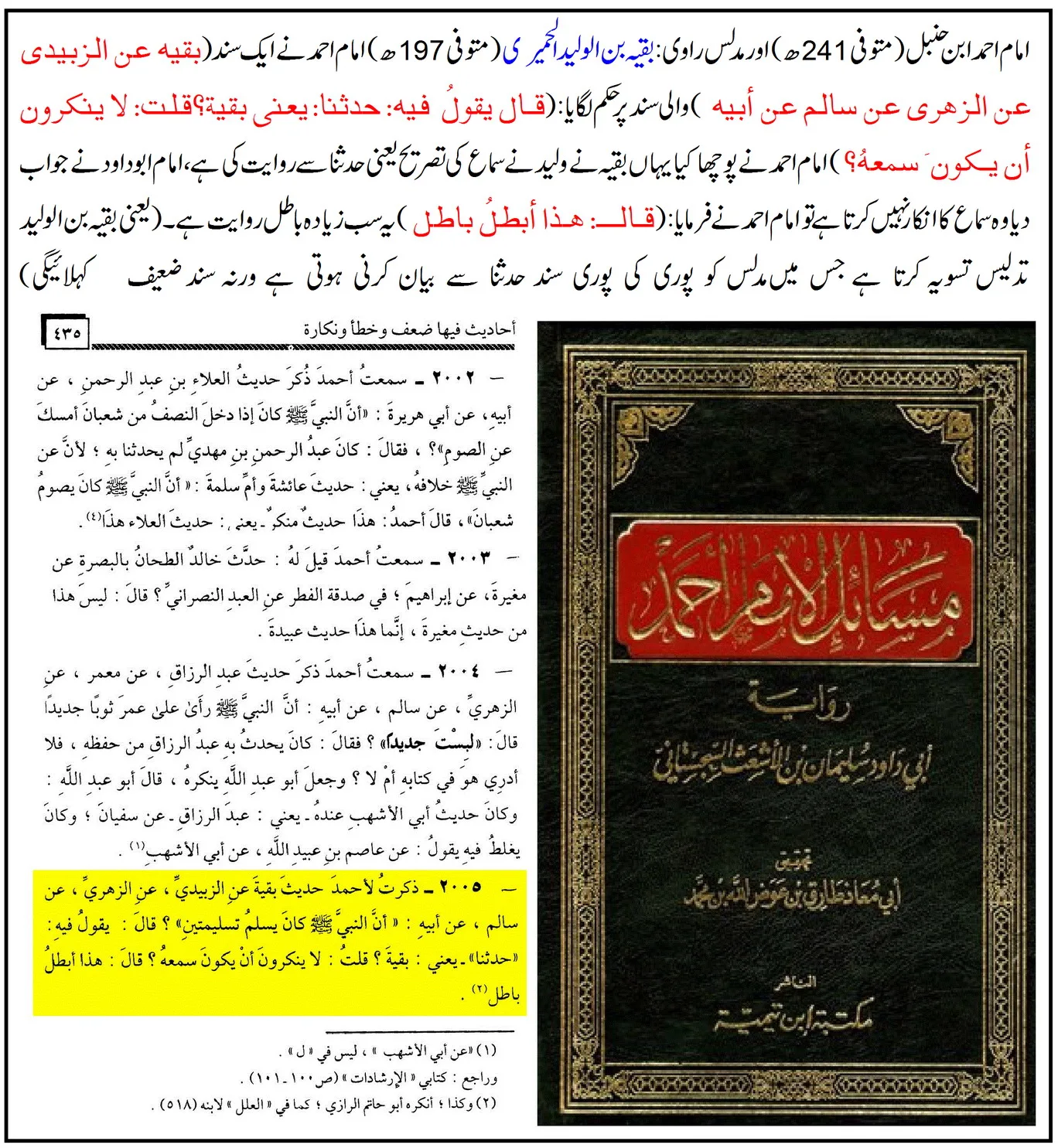
⑤ Baqiyyah ibn al-Walid (d. 197 AH) and the problem despite “Hadathana”
2005 - ذَكَرْتُ لِأَحْمَدَ حَدِيثَ بَقِيَّةَ عَنِ الزُّبَيْدِيِّ، عَنِ الزُّهْرِيِّ، عَنْ سَالِمٍ، عَنْ أَبِيهِ «أَنَّ النَّبِيَّ صَلَّى اللَّهُ عَلَيْهِ وَسَلَّمَ كَانَ يُسَلِّمُ تَسْلِيمَتَيْنِ»
, قَالَ: يَقُولُ فِيهِ: حَدَّثَنَا، يَعْنِي: بَقِيَّةَ، قُلْتُ: لَا يُنْكِرُونَ أَنْ يَكُونَ سَمِعَهُ، قَالَ: هَذَا أَبْطَلُ بَاطِلٍ
Translation:
I mentioned the rest of this hadith in front of Imam Ahmad… Imam Ahmad said: It says "حدثنا" (meaning the rest). I said: People do not deny that it is possible he heard it. Imam Ahmad said: This is the most false among all falsehoods.
Reference: Al-Kitab: Masa'il al-Imam Ahmad, narration of Abu Dawood al-Sijistani
Author: Abu Dawood Sulaiman ibn al-Ash'ath ibn Ishaq ibn Bashir ibn Shaddad ibn Amr al-Azdi al-Sijistani (died 275 AH)
Author: Abu Dawood Sulaiman ibn al-Ash'ath ibn Ishaq ibn Bashir ibn Shaddad ibn Amr al-Azdi al-Sijistani (died 275 AH)
Explanation:
Here it is implied that Imam Ahmad (may Allah have mercy on him) is not satisfied merely by the word "حدثنا"; rather, he also examines the narrator's method of tadlees (concealment) and the actual status of the hearing.
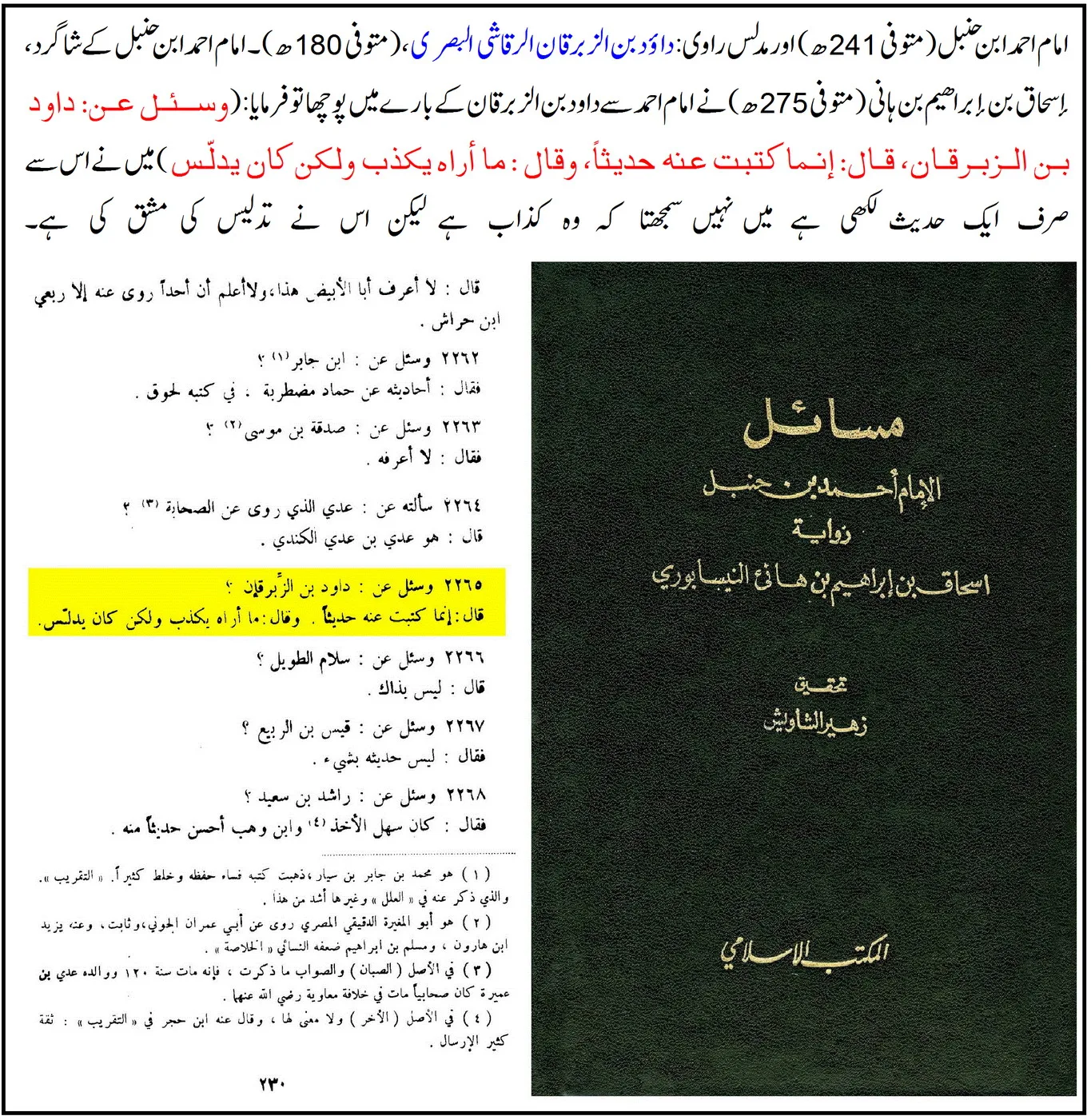
⑥ Dawood ibn al-Zubayrqan (died 180 AH) and not "yakdhib" but "yudlis"
2265 - وسئل عن داود بن الزبرقان؟
قال: إنما كتبت عنه حديثًا. وقال: ما أراه يكذب، ولكن كان يدلس.
Translation:
When asked about Dawood ibn al-Zubayrqan, Imam Ahmad said: I wrote only one hadith from him. And he said: I do not consider him a liar, but he used to practice tadlees (concealment).
Reference: Masa'il Ibn Hani for Imam Ahmad
Abu Ya'qub Ishaq ibn Ibrahim ibn Hani Thaqafi Nishapuri (218 AH - 275 AH)
Abu Ya'qub Ishaq ibn Ibrahim ibn Hani Thaqafi Nishapuri (218 AH - 275 AH)
Conclusion of the argument:
According to Imam Ahmad (may Allah have mercy on him), a narrator is never weak in truthfulness, but tadlis (concealment) itself affects the acceptance of the narration.
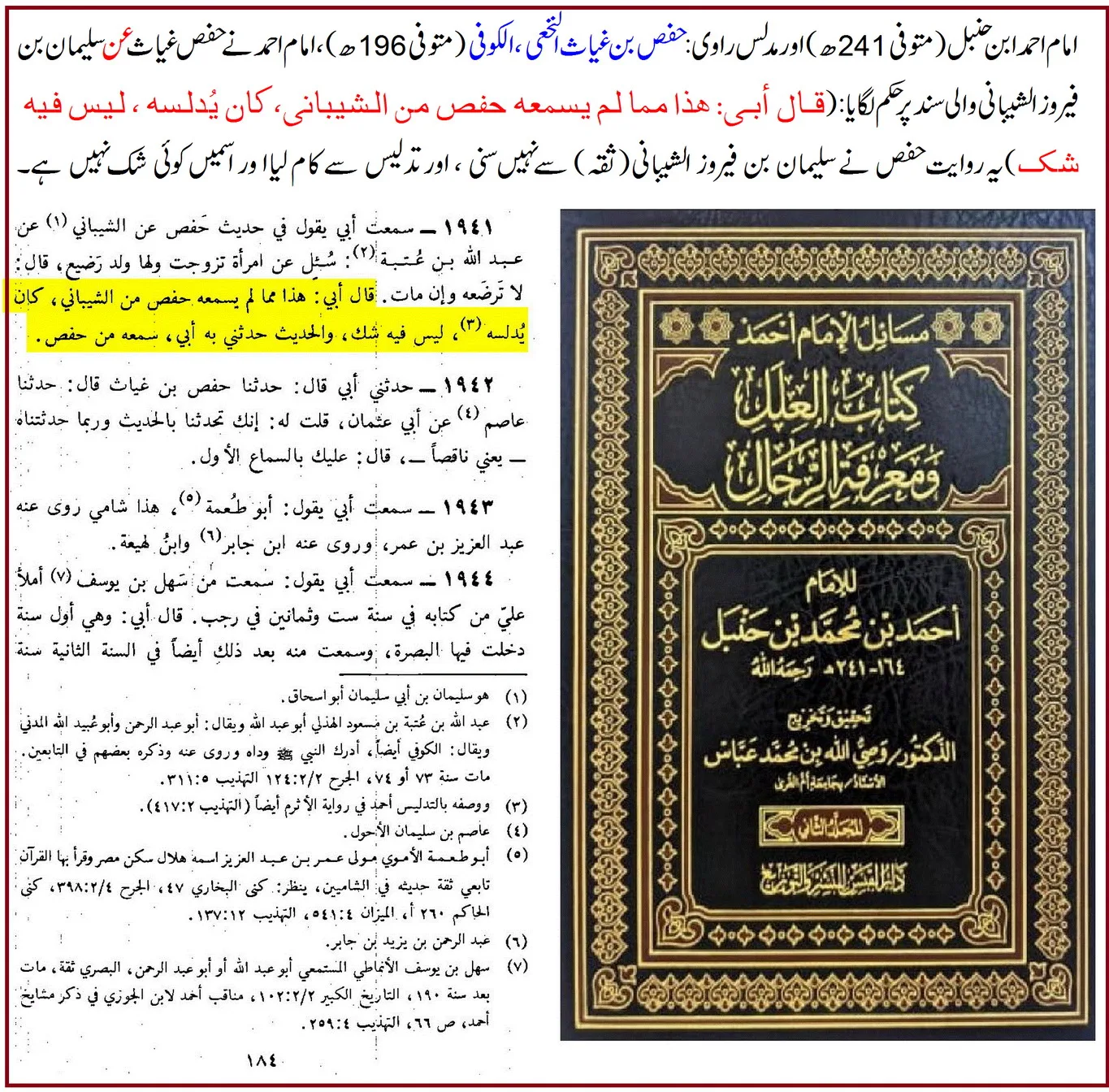
⑦ Hafs bin Ghiyath (died 196 AH) and the explicit ruling on tadlis/non-hearing
1941 - سَمِعت أبي يَقُول فِي حَدِيث حَفْص عَن الشَّيْبَانِيّ عَن عَبْد اللَّه بْن عتبَة سُئِلَ عَن امْرَأَة تزوجت وَلها ولد رَضِيع قَالَ لَا ترْضِعه وَإِن مَاتَ
قَالَ أَبِي هَذَا مِمَّا لم يسمعهُ حَفْص من الشَّيْبَانِيّ كَانَ يدلسه لَيْسَ فِيهِ شكّ والْحَدِيث حَدَّثَنِي بِهِ أَبِي سَمعه من حَفْص
Translation:
Imam Ahmad said: This is among the narrations that Hafs did not hear from Shaybani; he used to practice tadlis in it, there is no doubt about that. (And) this hadith was narrated to me by my father, who heard it from Hafs.
Reference: Al-Kitab: Al-‘Ilal wa Ma‘rifat al-Rijal
Author: Abu Abdullah Ahmad bin Muhammad bin Hanbal bin Hilal bin Asad al-Shaybani (died: 241 AH)
Author: Abu Abdullah Ahmad bin Muhammad bin Hanbal bin Hilal bin Asad al-Shaybani (died: 241 AH)
Conclusion of the argument:
This is an explicit application that Imam Ahmad (may Allah have mercy on him) takes the custom of the mudallis (one who practices tadlis) towards non-authenticity, and by negating hearing, he weakens the narration.
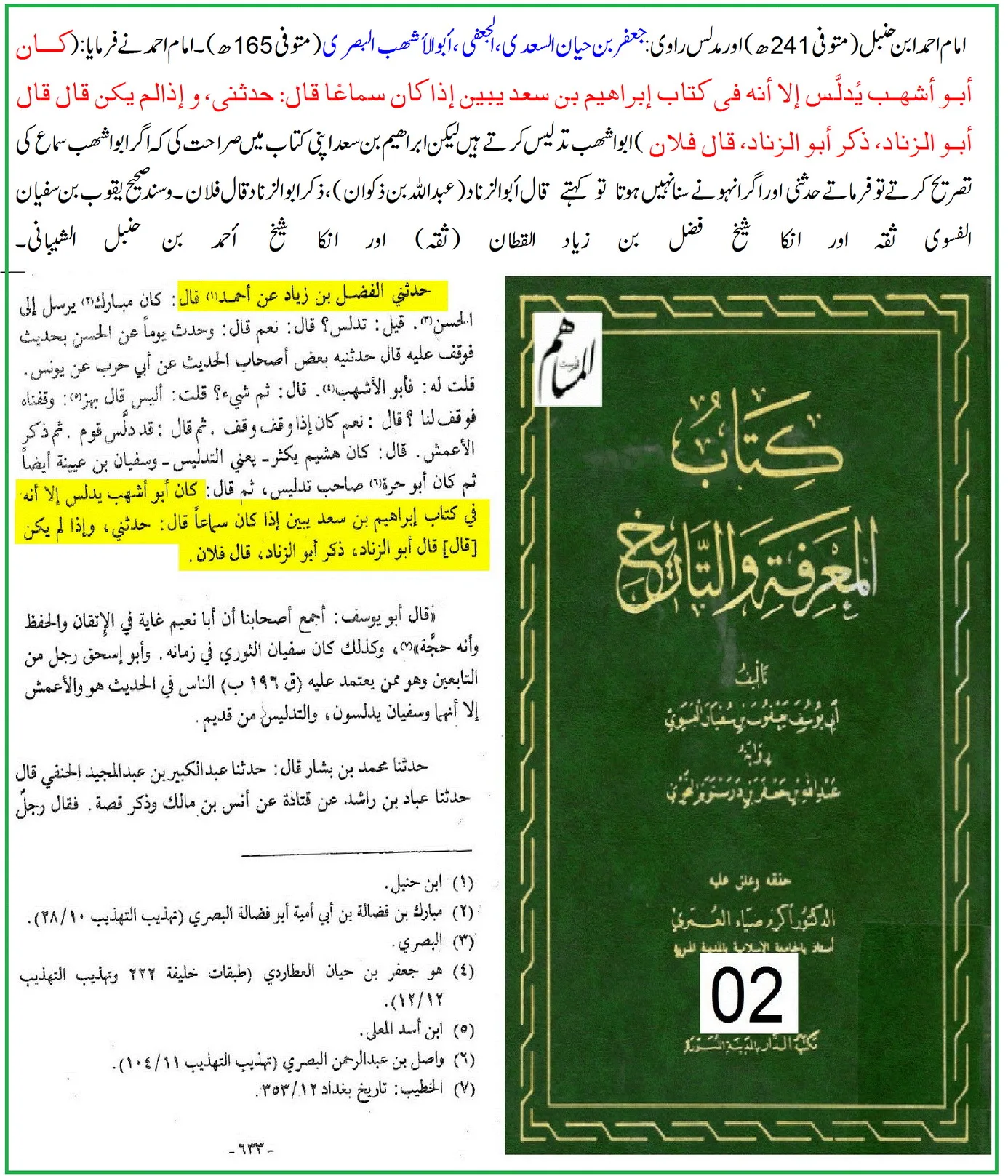
⑧ Abu Ashhab (Ja'far bin Hayyan, died 185 AH) and “Haddathani” versus “Qala/Dhakar”
حَدَّثَنِي الْفَضْلُ بْنُ زِيَادٍ عَنْ أَحْمَدَ [1] قَالَ: -----قَالَ:
كَانَ أَبُو أَشْهَبَ يُدَلِّسُ إِلَّا أَنَّهُ فِي كِتَابِ إِبْرَاهِيمَ بْنِ سَعْدٍ يُبِينُ إِذَا كَانَ سَمَاعًا قَالَ: حَدَّثَنِي، وَإِذَا لَمْ يَكُنْ [قَالَ] قَالَ أَبُو الزِّنَادِ، ذَكَرَ أَبُو الزِّنَادِ، قَالَ فُلَانٌ.
Translation:
Imam Ahmad said: Abu Ashhab used to practice tadlis, but in Ibrahim bin Sa’d’s book he clarifies: if there is hearing, he says “Haddathani” (he narrated to me), and if there is no hearing, he uses phrases like “Qala Abu al-Zinad / Dhakar Abu al-Zinad / Qala so-and-so.”
Reference: Book: Knowledge and History
Author: Ya'qub ibn Sufyan ibn Juwan al-Farsi al-Fasawi, Abu Yusuf (died: 277 AH)
Author: Ya'qub ibn Sufyan ibn Juwan al-Farsi al-Fasawi, Abu Yusuf (died: 277 AH)
Conclusion of the argument:
Imam Ahmad (may Allah have mercy on him) here also highlighted the specification of hearing (sama') as a distinguishing criterion.
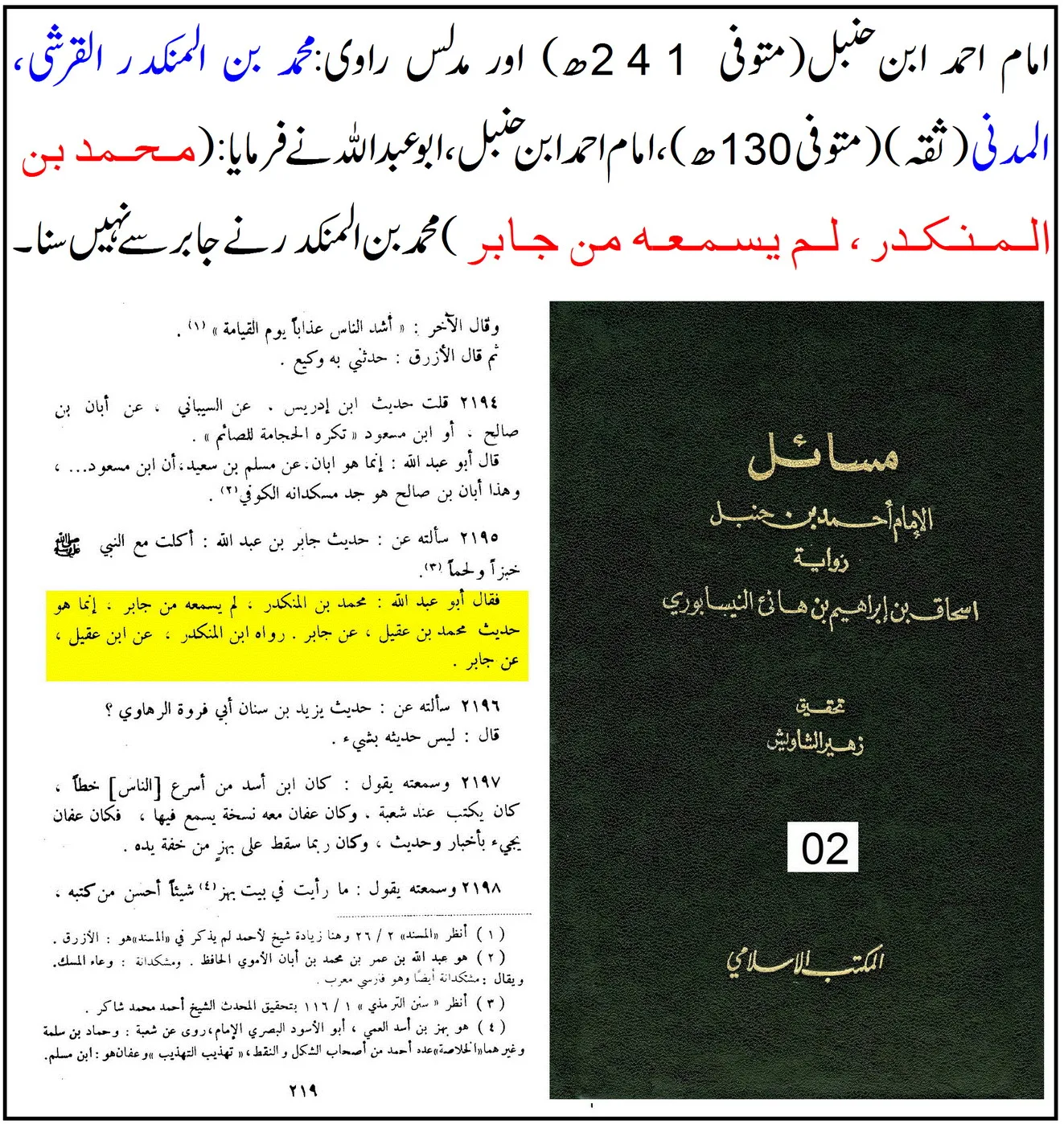
⑨ Muhammad ibn al-Munkadir (died 130 AH) and the denial of hearing (sama')
٥. قال ابن هاني: سألته عن حديث جابر بن عبد الله: أكلت مع النبي صلى الله عليه وسلم خبزاً ولحماً فقال أبو عبد الله: محمد بن المنكدر لم يسمعه من جابر، إنما هو حديث محمد بن عقيل، عن جابر، رواه ابن المنكدر، عن ابن عقيل، عن جابر
Translation:
Ibn Hani says: I asked Imam Ahmad about the hadith of Jabir (may Allah be pleased with him)... so Imam Ahmad said: Muhammad ibn al-Munkadir did not hear this from Jabir; rather, this is the narration of Muhammad ibn Aqil from Jabir, which Ibn al-Munkadir narrated from Ibn Aqil, who narrated from Jabir.
Reference: (Issues of Imam Ahmad – narrated by Ibn Hani)
Conclusion of the argument:
Imam Ahmad (may Allah have mercy on him) here also denies hearing (sama') and does not accept the apparent continuity of the narration.
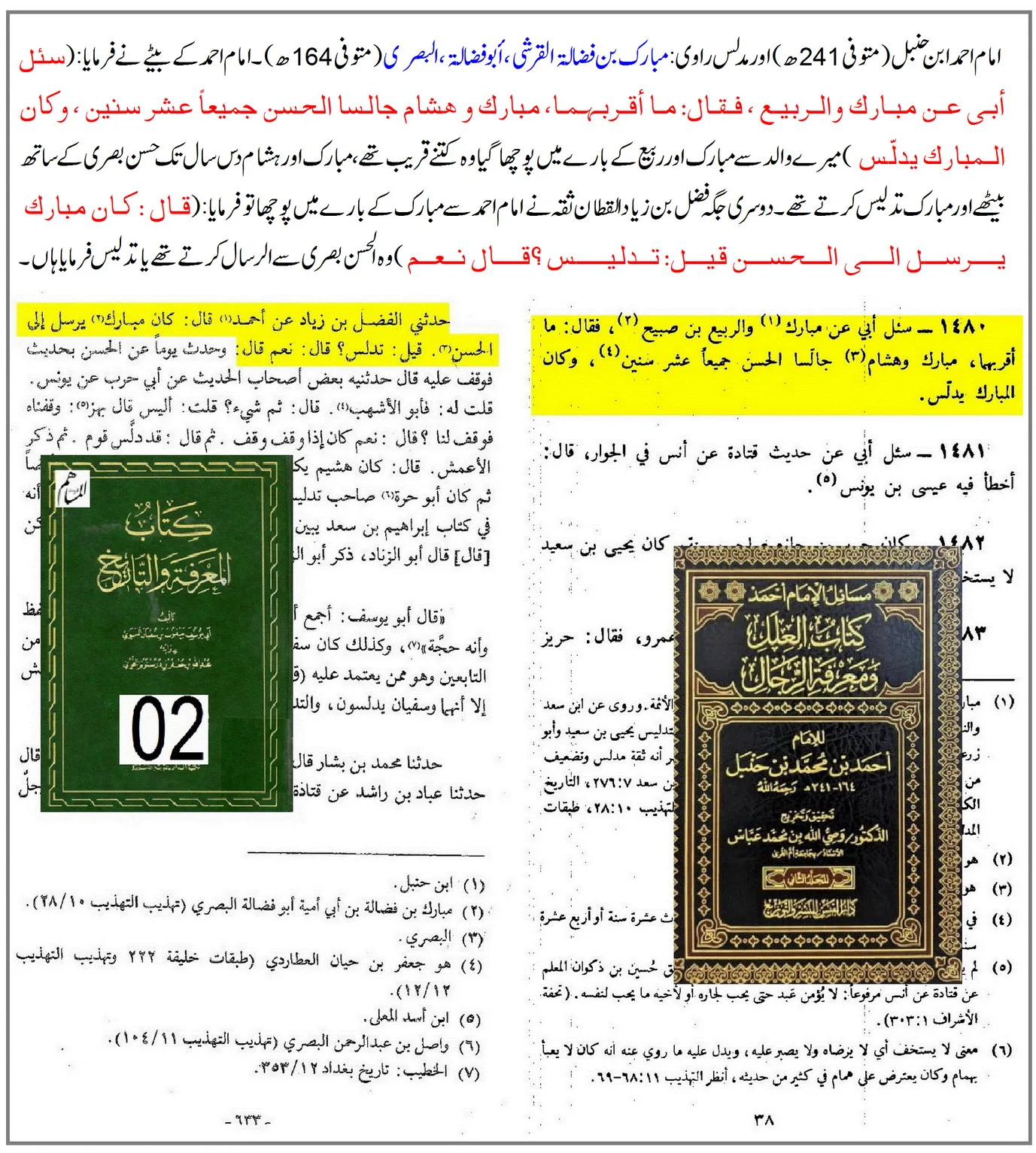
⑩ Mubarak ibn Fudala (died 164 AH) and the explicitness of “kan yadallis”
1480 - سُئِلَ أبي عَن مبارك وَالربيع بن صبيح فَقَالَ مَا أقربهما مبارك وَهِشَام جَالِسا الْحسن جَمِيعًا عشر سِنِين وَكَانَ الْمُبَارك يُدَلس
Translation:
When asked about Mubarak and Rabi', Imam Ahmad said: They are both close... Mubarak and Hisham sat with Hasan (al-Basri) for ten years, and Mubarak used to practice tadlis (concealment or misrepresentation in narration).
Reference: Book: Al-‘Ilal wa Ma’rifat al-Rijal
Author: Abu Abdullah Ahmad ibn Muhammad ibn Hanbal ibn Hilal ibn Asad al-Shaybani (died: 241 AH)
Author: Abu Abdullah Ahmad ibn Muhammad ibn Hanbal ibn Hilal ibn Asad al-Shaybani (died: 241 AH)
Further:
حَدَّثَنِي الْفَضْلُ بْنُ زِيَادٍ عَنْ أَحْمَدَ [1] قَالَ: كَانَ مُبَارَكٌ [2] يُرْسِلُ إِلَى الْحَسَنِ [3] . قِيلَ: تَدَلَّسَ؟ قَالَ: نَعَمْ
Translation:
Imam Ahmad said: He used to send to Mubarak Hasan. It was asked: Did he practice tadlis? He said: Yes.
Reference: Al-Kitab: Al-Ma'rifah wa At-Tarikh
Author: Ya'qub ibn Sufyan ibn Juwan Al-Farsi Al-Fasawi, Abu Yusuf (d. 277 AH)
Author: Ya'qub ibn Sufyan ibn Juwan Al-Farsi Al-Fasawi, Abu Yusuf (d. 277 AH)
Conclusion of the Evidence:
This also supports the principle that in the presence of tadlis, narration without explicit hearing (sama') becomes cautious/defective.
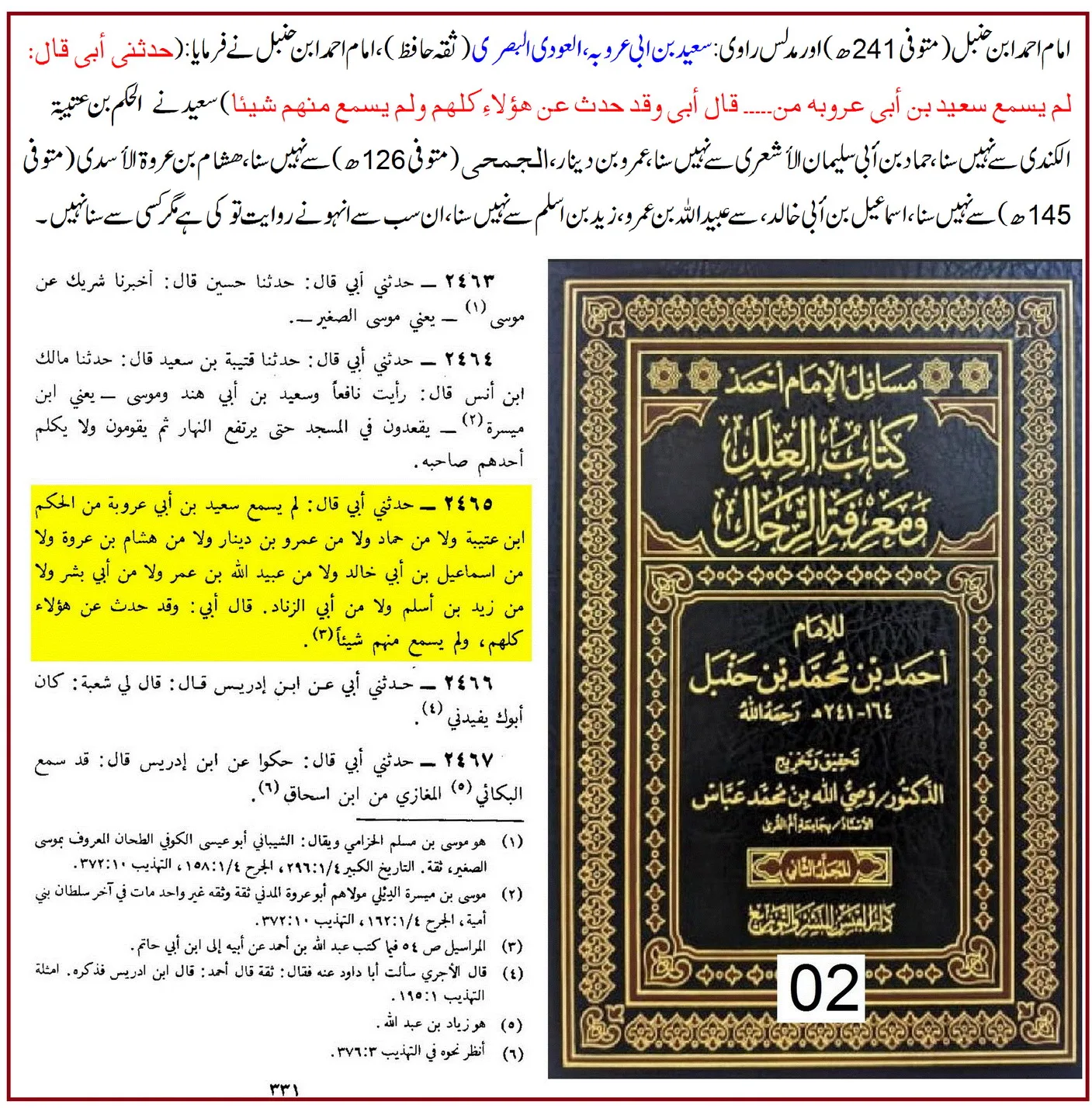
⑪ Sa'id ibn Abi 'Aroobah and the Absence of Sama' from Multiple Sheikhs
2465 - حَدثنِي أبي قَالَ لم يسمع سَعِيد بْن أَبِي عرُوبَة من الحكم بْن أبي عتيبة(الحكم بن عتيبة الكندي) وَلَا من حَمَّاد(حماد بن أبي سليمان الأشعري) وَلَا من عَمْرو بْن دِينَار(عمرو بن دينار الجمحي) وَلَا من هِشَام بْن عُرْوَة(هشام بن عروة الأسدي) وَلَا من إِسْمَاعِيل بن أبي خَالِد وَلَا من عُبَيْد اللَّه بْن عُمَر وَلَا من أَبِي بشر وَلَا من زَيْد بْن أسلم وَلَا من أأبي الزِّنَاد قَالَ أَبِي وَقد حدث عَن هَؤُلَاءِ كلهم وَلم يسمع مِنْهُم شَيْئا
Translation:
Imam Ahmad said: Sa'id ibn Abi 'Aroobah did not have sama' from Hakam ibn Abi 'Utaybah, Hammad, 'Amr ibn Dinar, Hisham ibn 'Urwah, Isma'il ibn Abi Khalid, 'Ubaidullah ibn 'Umar, Abu Bishr, Zayd ibn Aslam, and Abu Al-Zinad, etc.; although he narrated from all of them, he did not hear from any of them.
Reference: Al-Kitab: Al-'Ilal wa Ma'rifat Ar-Rijal
Author: Abu Abdullah Ahmad ibn Muhammad ibn Hanbal ibn Hilal ibn Asad Ash-Shaibani (d. 241 AH)
Author: Abu Abdullah Ahmad ibn Muhammad ibn Hanbal ibn Hilal ibn Asad Ash-Shaibani (d. 241 AH)
Conclusion of the Evidence:
This is a clear example of Imam Ahmad's strict standard of connection: mere narration is not sufficient; establishing sama' is necessary.
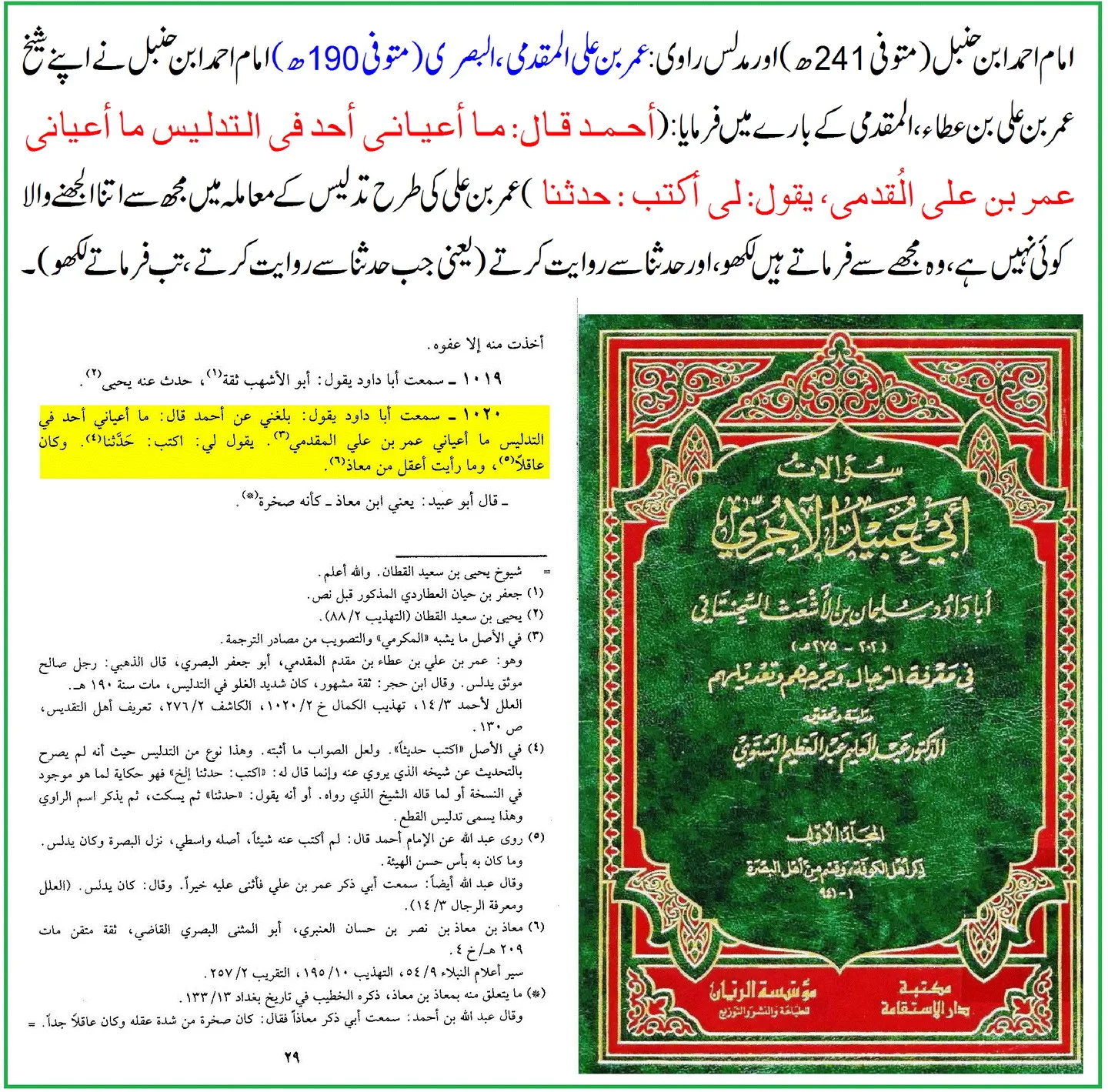
⑫ 'Umar ibn 'Ali Al-Muqaddami (d. 190 AH) and the "Most Difficult" Tadlis
1020- سمعتُ أَبا داود يقول: بلغني عن أحمد قال: ما أعياني أحد في التدليس ما أعياني عُمر بن علي المُقدمي.
Translation:
I heard Abu Dawood say: I heard from Imam Ahmad that no one troubled me as much in the matter of tadlees as Umar bin Ali al-Muqaddami did.
Reference: (Sualat al-Ajri li Abu Dawood)
Conclusion of the Evidence:
For Imam Ahmad (may Allah have mercy on him), tadlees is not just a theoretical debate but a very serious practical issue in the field of narration.
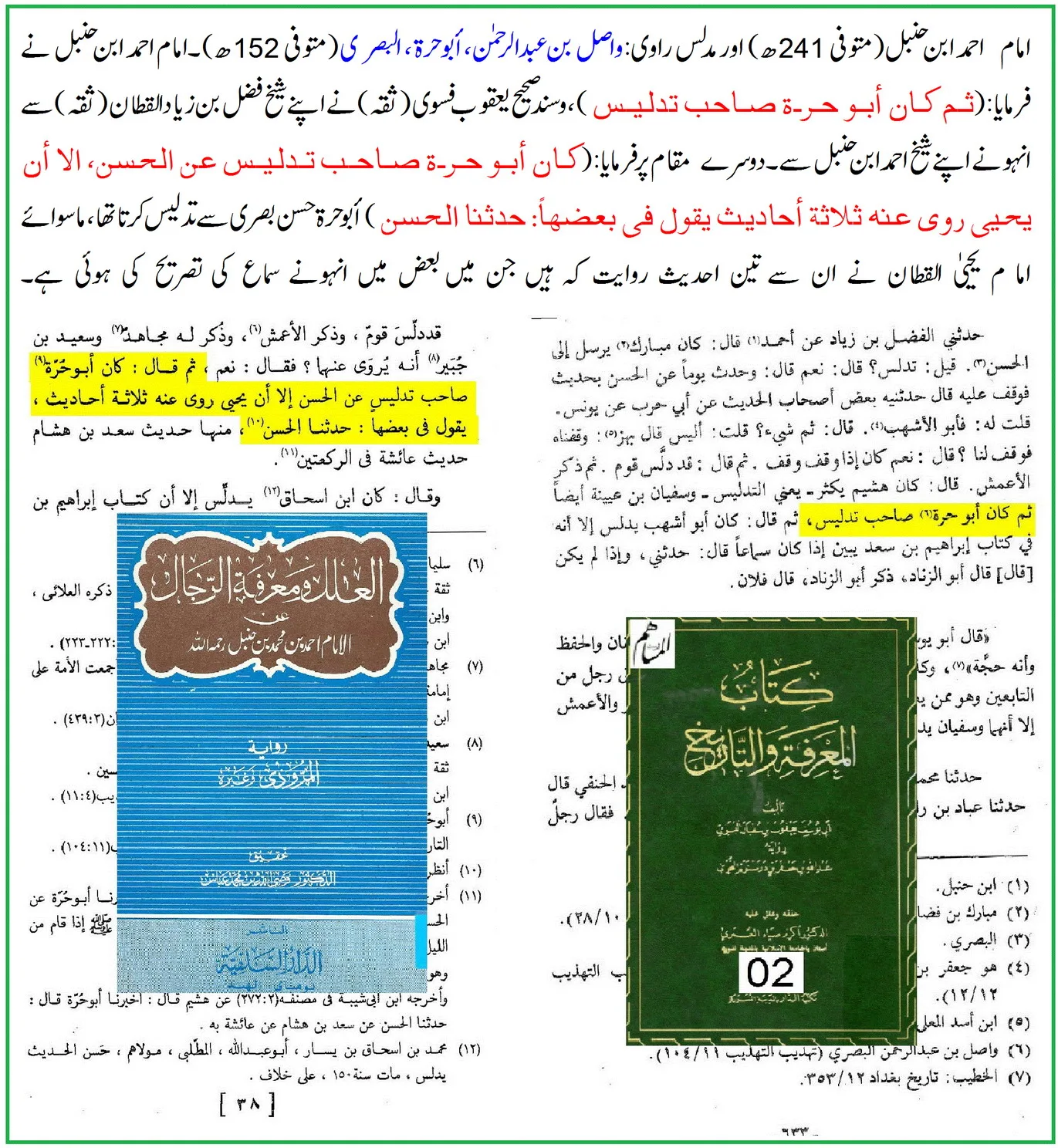
⑬ Abu Hurrah (Wasel bin Abdul Rahman, died 152 AH) and the "One Who Practices Tadlees"
• وقال الفضل بن زياد، عن أحمد. قال: كان أبو حرة صاحب تدليس.
Translation:
Fadl bin Ziyad narrates from Imam Ahmad: Abu Hurrah was one who practiced tadlees.
Reference: Al-Kitab: Al-Ma'rifah wa al-Tarikh
Author: Ya'qub bin Sufyan bin Jawan al-Farsi al-Fasawi, Abu Yusuf (died 277 AH)
Author: Ya'qub bin Sufyan bin Jawan al-Farsi al-Fasawi, Abu Yusuf (died 277 AH)
Further:
• وقال سؤالاته المروذي: قال: أحمد بن حنبل:
كان أبو حرة صاحب تدليس عن الحسن إلا أن يحيى روى عنه ثلاثة أحاديث يقول في بعضها: حدثنا الحسن، منها حديث سعد بن هشام، حديث عائشة في الركعتين. «سؤالاته» ( ) .
Translation:
(In Marwazi’s questions it is mentioned that) Imam Ahmad said: Abu Hurrah used to practice tadlees from Hasan (al-Basri), but Yahya narrated three hadiths from him in which sometimes he says "Haddathana al-Hasan" ... (etc.)
Reference: «Su'alatuhu» .
Conclusion of the Evidence:
Here too Imam Ahmad (may Allah have mercy on him) gives a distinctive status to the specification like "Haddathana" — meaning where there is specification, the matter becomes different.
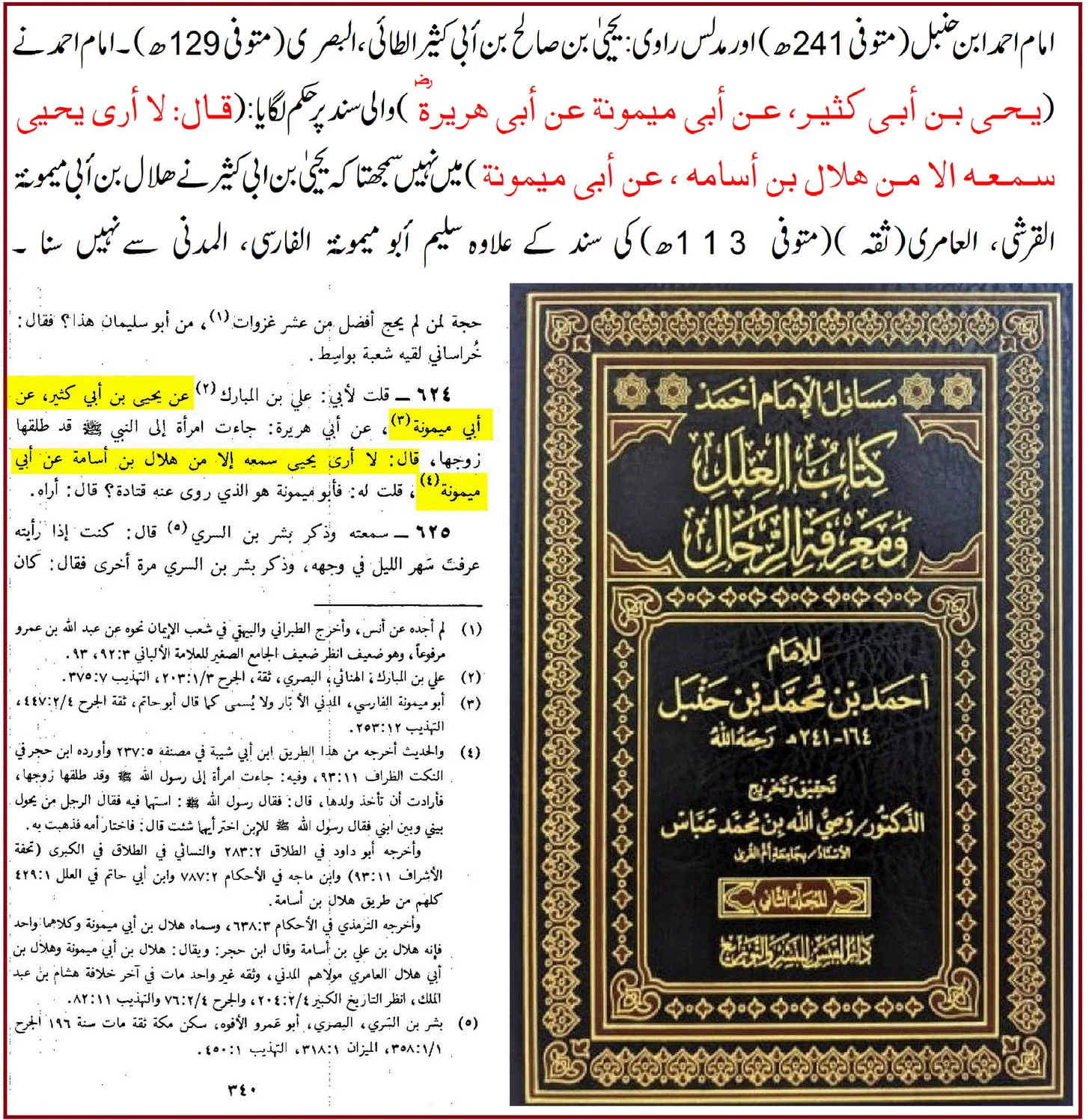
⑭ Yahya bin Abi Kathir and the Restriction of Sama‘
وقال عبد الله: قلت لأبي: علي بن المبارك، عن يحيى بن أبي كثير، عن أبي ميونة، عن أبي هريرة، جاءت امرأه إلى النبي صلى الله عليه وسلم -، قد طلقها زوجها. قال: لا أرى يحيى سمعه إلا من هلال بن أسامة، عن أبي ميمونة.
Translation:
Abdullah says: I asked my father (Imam Ahmad)… Imam Ahmad said: I do not think that Yahya heard it from Abu Maimunah except through Hilal bin Usamah.
Reference: Al-Kitab: Al-‘Ilal wa Ma‘rifat al-Rijal
Author: Abu Abdullah Ahmad bin Muhammad bin Hanbal bin Hilal bin Asad al-Shaybani (d. 241 AH)
Author: Abu Abdullah Ahmad bin Muhammad bin Hanbal bin Hilal bin Asad al-Shaybani (d. 241 AH)
Conclusion of the Evidence:
Imam Ahmad (may Allah have mercy on him) determines the direction of the original hearing within the same narration—this is precisely the caution required in the chapter of mudallis/ma‘nan.
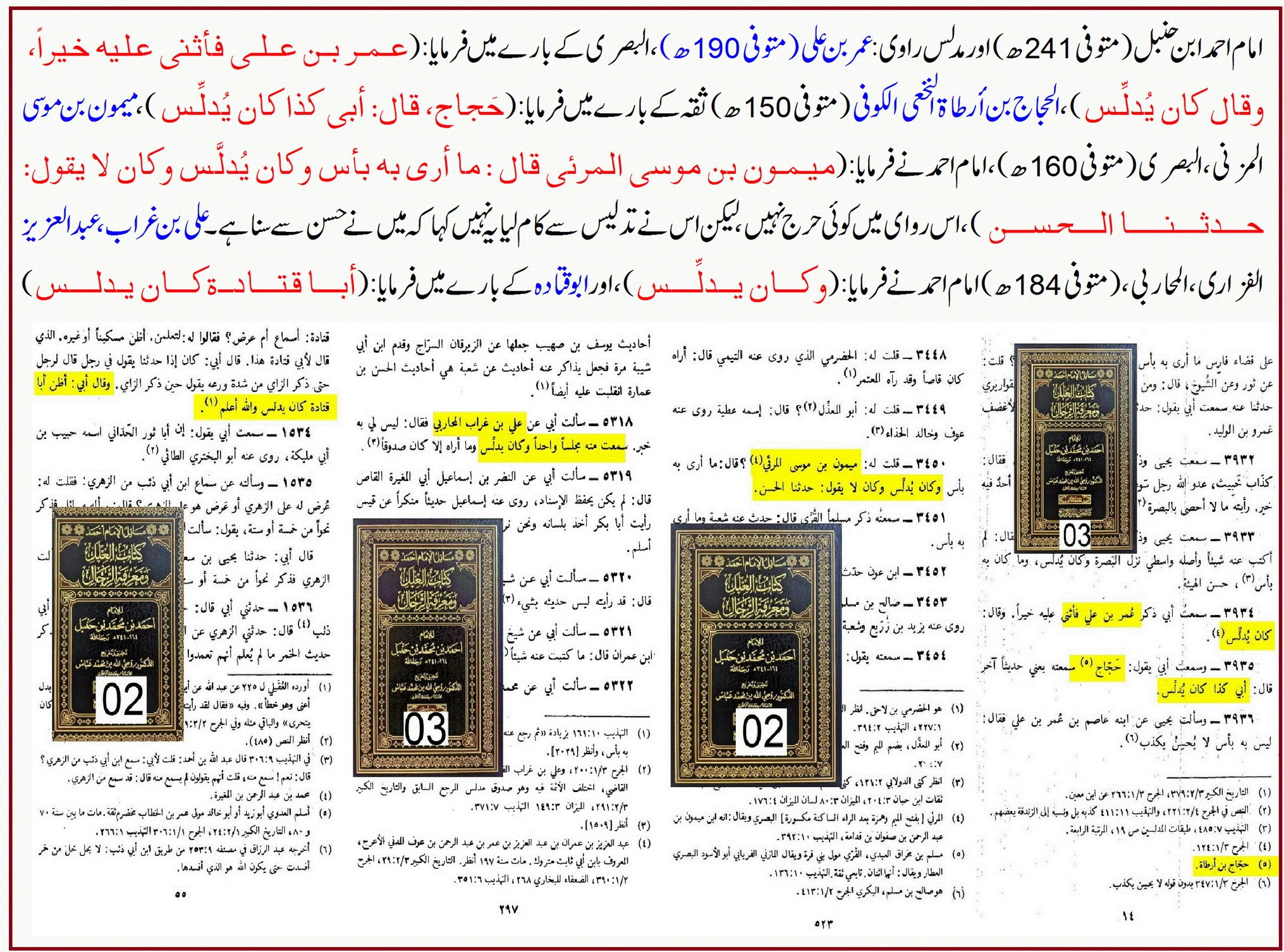
⑮ Umar bin Ali and the General Attribution of Tadlis
3934 - سَمِعت أبي ذكر عمر بن عَليّ فَأثْنى عَلَيْهِ خيرا وَقَالَ كَانَ يُدَلس
Translation:
I heard my father (Imam Ahmad) mention Umar bin Ali, he praised him and said: He used to practice tadlis.
Reference: Al-Kitab: Al-‘Ilal wa Ma‘rifat al-Rijal
Author: Abu Abdullah Ahmad bin Muhammad bin Hanbal bin Hilal bin Asad al-Shaybani (d. 241 AH)
Author: Abu Abdullah Ahmad bin Muhammad bin Hanbal bin Hilal bin Asad al-Shaybani (d. 241 AH)
Conclusion of the Evidence:
Here too, it is clear that after attributing tadlis, there arises a need to specify the hearing in the chapter of narration.
⑯ Al-Hajjaj bin Arta’ah (d. 150 AH) and the Attribution of Tadlis
3935 - وَسمعت أبي يَقُول حجاج سمعته يَعْنِي حَدِيثا آخر قَالَ أبي كَذَا كَانَ يُدَلس
Translation:
I heard my father (Imam Ahmad) say… then he said: He used to practice tadlis in the same manner.
Reference: Book: Al-‘Ilal wa Ma‘rifat al-Rijal
Author: Abu Abdullah Ahmad ibn Muhammad ibn Hanbal ibn Hilal ibn Asad al-Shaybani (died 241 AH)
Author: Abu Abdullah Ahmad ibn Muhammad ibn Hanbal ibn Hilal ibn Asad al-Shaybani (died 241 AH)
Conclusion of the evidence:
The ruling of tadlis itself is evidence that Imam Ahmad (may Allah have mercy on him) did not place unconditional trust in the mu‘annān.
⑰ Maymun ibn Musa (died 160 AH) and not saying “ḥaddathnā al-Hasan”
3450 - قلت لَهُ مَيْمُون بن مُوسَى المرئي قَالَ مَا أرى بِهِ بَأْس وَكَانَ يُدَلس وَكَانَ لَا يَقُول حَدثنَا الْحسن
Translation:
I asked (Imam Ahmad) about Maymun ibn Musa, and he said: I do not see any harm in him, but he used to practice tadlis, and he did not say “ḥaddathnā al-Hasan.”
Reference: Book: Al-‘Ilal wa Ma‘rifat al-Rijal
Author: Abu Abdullah Ahmad ibn Muhammad ibn Hanbal ibn Hilal ibn Asad al-Shaybani (died 241 AH)
Author: Abu Abdullah Ahmad ibn Muhammad ibn Hanbal ibn Hilal ibn Asad al-Shaybani (died 241 AH)
Conclusion of the evidence:
The absence of “ḥaddathnā” (especially where hearing is expected) is a warning in the view of Imam Ahmad (may Allah have mercy on him).
⑱ ‘Ali ibn Ghurab (died 184 AH) and tadlis with truthfulness
5318 - سَأَلت أبي عَن عَليّ بن غراب الْمحَاربي فَقَالَ لَيْسَ لي بِهِ خبر سَمِعت مِنْهُ مَجْلِسا وَاحِدًا وَكَانَ يُدَلس وَمَا أرَاهُ إِلَّا كَانَ صَدُوقًا
Translation:
I asked my father (Imam Ahmad) about ‘Ali ibn Ghurab, and he said: I do not have much information about him; I only heard one session from him; he practiced tadlis, and in my view, he was truthful.
Reference: Book: Al-‘Ilal wa Ma‘rifat al-Rijal
Author: Abu Abdullah Ahmad ibn Muhammad ibn Hanbal ibn Hilal ibn Asad al-Shaybani (d. 241 AH)
Author: Abu Abdullah Ahmad ibn Muhammad ibn Hanbal ibn Hilal ibn Asad al-Shaybani (d. 241 AH)
Conclusion of the evidence:
The principle here is clear: truthfulness is one thing, but tadlis (concealment) is another and has its effect—therefore caution is necessary in mu‘annann.
⑲ Abu Qatada and the concern of tadlis with “Aẓunn”
1533 - وَقَالَ أبي أَظن أَبَا قَتَادَة كَانَ يُدَلس وَالله أعلم
Translation:
Imam Ahmad said: I think that Abu Qatada used to practice tadlis, and Allah knows best.
Reference: Book: Al-‘Ilal wa Ma‘rifat al-Rijal
Author: Abu Abdullah Ahmad ibn Muhammad ibn Hanbal ibn Hilal ibn Asad al-Shaybani (d. 241 AH)
Author: Abu Abdullah Ahmad ibn Muhammad ibn Hanbal ibn Hilal ibn Asad al-Shaybani (d. 241 AH)
Conclusion of the evidence:
This “concern” also guides towards the same caution that where there is a possibility of tadlis, the ‘an‘anah should not be taken unconditionally.
⑳ Sufyan al-Thawri (d. 161 AH) and Imam Ahmad’s practical standard
⑳-a) The condition of Yahya ibn Sa‘id al-Qattan:
318 - قَالَ أبي قَالَ يحيى بن سعيد مَا كتبت عَن سُفْيَان شَيْئا إِلَّا قَالَ حَدثنِي أَو حَدثنَا إِلَّا حديثين
Translation:
Imam Ahmad narrated (through his father/teacher) from Yahya ibn Sa‘id: I never wrote anything from Sufyan except that he said “ḥaddathani/ḥaddathana” (he narrated to me/us), except for two hadiths.
Reference: Book: Al-‘Ilal wa Ma‘rifat al-Rijal
Author: Abu Abdullah Ahmad ibn Muhammad ibn Hanbal ibn Hilal ibn Asad al-Shaybani (d. 241 AH)
Author: Abu Abdullah Ahmad ibn Muhammad ibn Hanbal ibn Hilal ibn Asad al-Shaybani (d. 241 AH)
⑳-b) Strong dislike regarding “Jami‘ Sufyan”:
1582 - حَدثنَا قَالَ سَمِعت ابي وَذكر وضع كتب------وَعَابَ وضع الْكتب وَكَرِهَهُ كَرَاهِيَة شَدِيدَة وَكَانَ ابي يكره جَامع سُفْيَان وينكره ويكرهه كَرَاهِيَة شَدِيدَة وَقَالَ من سمع هَذَا من سُفْيَان وَلم ارْمِ يصحح لأحد سَمعه من سُفْيَان وَلم يرض ابي ان يسمع من اُحْدُ حَدِيثا
Translation:
(Implicitly) Imam Ahmad (may Allah have mercy on him) disliked compiling books (other than hadith), and he strongly disliked the "Jami' Sufyan"... and he said: Whoever heard this from Sufyan, I am not inclined to authenticate/verify it for him... (etc.)
Reference: (Masa'il Ahmad ibn Hanbal narrated by his son Abdullah)
⑳-c) Preference in the chapter of practice:
1779 - سَمِعْتُ أَحْمَدَ، وَقَالَ لَهُ رَجُلٌ " جَامِعُ سُفْيَانَ نَعْمَلُ بِهِ؟ قَالَ: عَلَيْكَ بِالْآثَارِ ".
Translation:
I heard Imam Ahmad say: Someone asked, "Should we act upon the 'Jami' Sufyan'?" He said: The reports (texts/narrations) are binding upon you.
Reference: (Questions of Abu Dawood Sulayman ibn al-Ash'ath al-Sijistani, author of Sunan)
⑳-d) Denial of hearing the "Jami'" and ruling on the narrator:
3605 - سمعته يَقُول كتبنَا عَن غَسَّان بن عبيد الْموصِلِي قدم علينا هَهُنَا وَكَانَ قد سمع من سُفْيَان فَكتبت مِنْهَا أَحَادِيث وخرقت حَدِيثه مذ حِين وَإِنَّمَا كَانَ سمع من سُفْيَان شَيْئا يَسِيرا وَأنكر أَن يكون سمع الْجَامِع من سُفْيَان
Translation:
Imam Ahmad (may Allah have mercy on him) said: We wrote to Ghassan ibn Ubayd al-Mawsili... then I tore up his hadith... He had heard very little from Sufyan, and it was denied that he had heard the "Al-Jami'" from Sufyan.
Reference: (Al-‘Ilal wa Ma’rifat al-Rijal)
Conclusion of the evidence (⑳):
This collection strengthens the point that, according to Imam Ahmad (may Allah have mercy on him), only that is authentic in which the hearing (sama‘) is explicitly stated; and in those collections/narrations where there is a fear of frequent broken chains (mu‘ann‘an) or unspecified hearing, he exercises strict caution and rejection.
Conclusion: What principle is established from these texts?
The common point in all the presented evidences is that Imam Ahmad (may Allah have mercy on him):Identifies the mudallis (one who conceals a defect in the chain),
Then makes the explicit statement of hearing (sama‘) the criterion,
And where hearing is not established, he explicitly states: "He did not hear it" or at least points towards interruption/negation.
This is the essence which scholars consider in the chapter of "the mudallis’s musannad narration" in accordance with Imam Shafi‘i’s (may Allah have mercy on him) principle: acceptance is not without explicit hearing (especially when tadlis is established or predominant).Conclusion
In light of all these detailed evidences, the following point becomes clear:Imam Ahmad bin Hanbal’s methodology is not that "the narrator is a mudallis (one who conceals the source) but still his ‘an‘anah (continuous chain) is unconditionally accepted"; rather, in many places, he does not consider the ‘an‘anah of a mudallis reliable without the specification of “sama‘” (hearing), and practically adopts the standard that if it is “حدثني/أخبرني/سمعت” (he narrated to me / informed me / I heard), then the narration is strong, otherwise the continuity is questionable.
Therefore, overall it is proven that in the matter of the mudallis’s ‘an‘anah narration, Imam Ahmad’s applications are closer to Imam Shafi‘i’s principled stance.
Last edited:

