


This excerpt is taken from the book Masnoon Hajj o Umrah published by Maktaba Darussalam Research Center.
Makkah Mukarramah is an ancient, historical, and greatly blessed city. Loving it and respecting it is a religious duty for every Muslim. Sayyiduna Ibrahim (peace be upon him) declared it a sacred sanctuary [Haram].
Virtues of Makkah Mukarramah:
Makkah Mukarramah has virtues in many respects:
① In the Holy Quran, Allah Almighty has described Makkah Mukarramah as a city of peace.
Reference: At-Tin:3
② The Prophet Muhammad ﷺ loved Makkah Mukarramah very much.
Reference: Jami` at-Tirmidhi, Al-Manaqib, Hadith:3925
③ The Dajjal will not be able to enter Makkah and Madinah.
Reference: Sahih Muslim, Al-Fitan, Hadith:2943
For a detailed study on the virtues of Makkah, see: Tarikh Makkah Darussalam, Al-Riyadh, Lahore
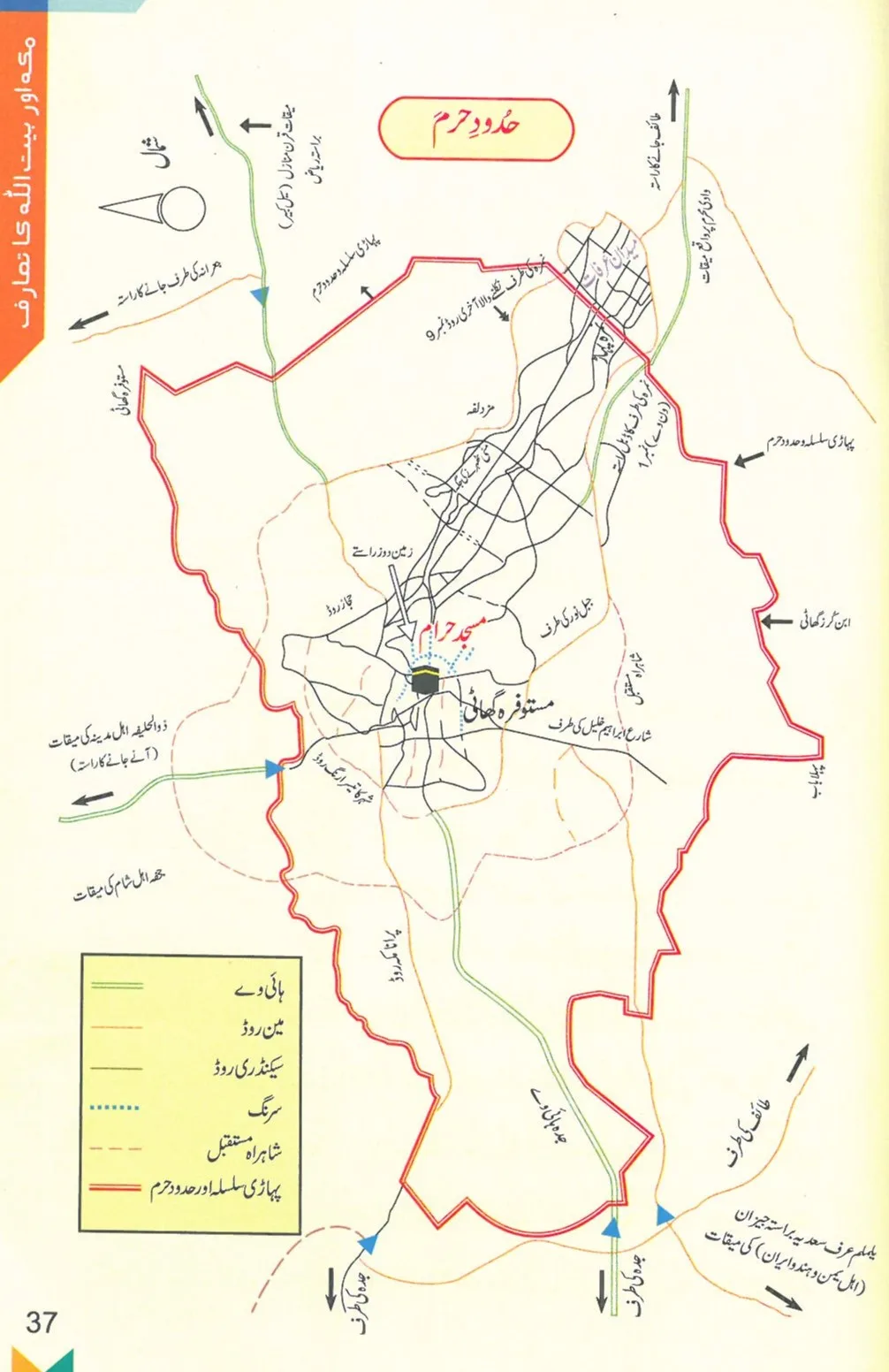
To the north, the Haram extends up to Maqam Taneem (Masjid Aisha, may Allah be pleased with them both).
To the east, the Haram of Makkah extends near Jaranah.
To the northeast, it extends up to Wadi Nakhlah.
To the west, it extends up to Hudaybiyyah (solar).
Now the Saudi government has placed pillars at the beginning and end of the Haram boundaries, on which بدایة الحرم and نہایة الحرم are written.
Issue:
Hunting or frightening game within the boundaries of the Haram, and cutting or breaking wild grass, trees, thorns, and leaves except for Azkhar grass is prohibited.
Reference: Sahih al-Bukhari, Punishment for Hunting, Hadith: 1834,1833
Remember!
Just as the reward and blessings for any good deed in the Haram of Makkah are multiplied many times, similarly the sin of any bad deed is also multiplied many times. In fact, there is a threat of punishment even for the intention of sin in it:
[وَ مَنۡ یُّرِدۡ فِیۡہِ بِاِلۡحَادٍۭ بِظُلۡمٍ نُّذِقۡہُ مِنۡ عَذَابٍ اَلِیۡمٍ]
And whoever intends a wrongdoing therein - We will make him taste a painful punishment.
Reference: Al-Hajj: 25
Whereas this threat for intention alone is not present in other places.
Therefore, pilgrims performing Hajj and Umrah and the residents of Makkah should be inclined towards good deeds in this blessed city and avoid all kinds of bad deeds. Do not consider this city and this place like ordinary cities and places.
Brief Introduction to the House of Allah:
The way of people in every era has been to consider a place or location sacred in order to attain spiritual solace, and they go there merely with the intention of blessing, visitation, and reward. With this purpose in mind, Islam has permitted Muslims to travel for visitation to only three sacred places for spiritual peace and obtaining reward:
① Masjid al-Haram
② Masjid al-Nabawi
③ Masjid al-Aqsa
Reference: Sahih al-Bukhari, The Virtue of Prayer in the Mosque of Mecca and Medina, Hadith: 1189
Masjid al-Haram:
The Holy House of Allah and the buildings spread around it are called Masjid al-Haram. One prayer performed in it is superior to one hundred thousand prayers.
Reference: Musnad Ahmad: 397/3
Masjid al-Nabawi:
In Islam, after Masjid Quba, this is the second mosque, which was built by the blessed hands of the Prophet Muhammad ﷺ and the noble companions رضي الله عنهم in Madinah Munawwarah after the migration.
Reference: Sahih al-Bukhari, Virtues of the Ansar, Hadith: 3932
One prayer performed in this mosque is superior to one thousand prayers.
Reference: Sahih al-Bukhari, The Virtue of Prayer in the Mosque of Mecca and Medina, Hadith: 1190
Masjid al-Aqsa:
This is the first Qibla of the Muslims, and it is located in the city of Jerusalem in Palestine. The Holy Prophet ﷺ departed from here for the journey of Mi'raj, and here he led all the Prophets and Messengers, peace be upon them, in prayer. The reward of one prayer offered in this mosque is equivalent to 250 prayers.
Reference: Al-Mustadrak lil-Hakim:509/4
It was built 40 years after the construction of the Kaaba by Ibrahim.
Reference: Sahih al-Bukhari with Fath al-Bari, Ahadith al-Anbiya:495/6, Hadith:3366
Bayt Allah:
Regarding its history and virtue, the command of Allah Almighty is sufficient:
[اِنَّ اَوَّلَ بَیۡتٍ وُّضِعَ لِلنَّاسِ لَلَّذِیۡ بِبَکَّۃَ مُبٰرَکًا وَّ ہُدًی لِّلۡعٰلَمِیۡنَ]
Indeed, the first House established for mankind is that at Makkah - blessed and a guidance for the worlds.
Reference: Al-Imran:96
Allah’s very first house, the Qibla and Kaaba of the Muslims, a center of blessings and spiritual manifestations located at the very center of the earth. It was first built by angels by the command of Allah Almighty; it was destroyed by the flood of Noah. Then, Prophet Ibrahim and Ismail, peace be upon them, rebuilt it with their own hands.
Hatim:
Before Islam, during the Age of Ignorance, the Kaaba was once affected by a flood, and the disbelievers of Mecca began to rebuild it on the previous foundations using only lawful earnings. However, before its completion, the funds ran out, and a part of it was left incomplete. This part still exists in the form of a semicircle on one side of the current building, known as Hatim or Hijr.
Reference: Sahih al-Bukhari, Hajj, Hadith: 1584, 1583, and Manaqib al-Ansar, Hadith: 3887
The ruling for offering prayer in this area is the same as the ruling for praying inside the Kaaba.
Reference: Sunan Abi Dawood, Manasik, Hadith: 2028
Bait al-Ma'mur:
At this point, it is also interesting to mention that directly above the Kaaba, in the seventh heaven, is Bait al-Ma'mur, which is the place of worship for the angels. Every day, seventy thousand angels perform Tawaf there. Once an angel has performed Tawaf there, he will not return to do it again until the Day of Judgment.
Reference: Sahih al-Bukhari, Bada' al-Khalq, Hadith: 3207], [Tafsir Ibn Kathir: 306, 305/4], [Tafsir al-Tabari: 27/22]
Multazam:
The area between the door of the Kaaba and the Black Stone is called the Multazam. Placing one's face on it, pressing the chest against it, and praying with utmost humility and submission is a permissible and recommended act. This practice is also established from some Companions, such as Abdullah ibn Abbas, Abdullah ibn Umar, and Zubair ibn Awam, may Allah be pleased with them.
Reference: Sahih Al-Albani, Hadith: 2138
Maqam Ibrahim:
This is a stone on which Prophet Ibrahim (peace be upon him) stood while raising the walls of the Kaaba. Miraculously, to this day, the footprints of Prophet Ibrahim (peace be upon him) remain on this stone. This stone is preserved inside a glass case under a dome near the door of the Kaaba. Allah Almighty says about it:
[وَ اتَّخِذُوۡا مِنۡ مَّقَامِ اِبۡرٰہٖمَ مُصَلًّی]
And take the Maqam Ibrahim as a place of prayer.
Reference: Al-Baqarah:125
Remember! Kissing or touching the casing or grille outside this stone with the intention of blessing is not proven.
Mataf:
The area around the Kaaba where Tawaf (circumambulation) is performed is called the Mataf.
Well of Zamzam:
The blessed well which Allah, the Lord of the Worlds, had granted for Sayyida Hajar and Sayyidna Ismail (peace be upon them). Thousands of years have passed, yet its blessed water still flows. Now this well is located in the basement beneath the Mataf.
Safa and Marwah:
These are the names of two hills located near the Kaaba, which have been declared a symbol of Allah’s honor in the Holy Quran. When by Allah’s command, Sayyidna Ibrahim, Sayyida Hajar, and the infant Ismail (peace be upon them) were left in this desolate mountainous area and they returned to Sham, soon their food and drink supplies ran out. Then, in search of water, Sayyida Hajar ran back and forth between these hills. After that, Allah, by His perfect power, caused the spring of Zamzam to flow. Allah made Sayyida Hajar’s action a part of Hajj and Umrah. Pilgrims, following this Sunnah, perform seven circuits between Safa and Marwah during Hajj and Umrah, which is called Sa’i.
Nowadays, it has been expanded by doubling its width and adding two more floors. A basement and a third upper floor. Thus, it has now become a four-story building and, due to its adjacency to Masjid al-Haram, it has practically become a part of Masjid al-Haram.

