

✍ Written by: Abu Hamzah Salafi
This article compiles the statements of the Imams of al-Jarḥ wa al-Taʿdīl regarding Ḥammād ibn Abī Sulaymān al-Ashʿarī al-Kūfī (the jurist of Kūfah, attributed to Irjāʾ).
His position in jurisprudence is well-known. However, in the field of ḥadīth, the majority of the scholars of ḥadīth spoke critically of him:
◈ Some declared him weak (ḍaʿīf).
◈ Some described him as frequently mistaken and prone to error (kathīr al-khaṭaʾ wa al-wahm).
◈ Others labeled him a Murjiʾī and one who became confused (mukhtaliṭ).
Here, the statements of eighteen (18) Imams are presented with the original Arabic text and translation to clarify that, in terms of ḥadīth, reliance was not placed upon Ḥammād.
«هو صدوق ولا يحتج بحديثه … هو مستقيم في الفقه وإذا جاء الآثار شوش.»
Translation:
He is truthful (ṣadūq), but his ḥadīth is not used as proof. He is sound in fiqh, but when it comes to narrations (āthār), he becomes confused.
Clarification:
Not relied upon in ḥadīth, though strong in jurisprudence.
«الغالب عليه الفقه، ولم يرزق حفظ الآثار … مع سوء حفظه للآثار أحفظ من الحكم.»
Translation:
Fiqh predominated over him, and he was not granted preservation of narrations… Despite his weak memory in ḥadīth, he was better than al-Ḥakam.
Clarification:
Weak in ḥadīth retention, though acceptable in juristic reasoning.
«كان حماد … لا يحفظ.»
Translation:
Ḥammād did not have strong memorization.
Clarification:
Explicit criticism of his memory.
«كان حماد ضعيفًا في الحديث فاختلط … وكان مرجيًا.»
Translation:
Ḥammād was weak in ḥadīth, later became confused, and he was a Murjiʾī.
Clarification:
Weakness, confusion, and innovation explicitly mentioned.
«ورواه حماد … مرسلاً … وهما ضعيفان.»
Translation:
Ḥammād narrated it in mursal form… and both narrators are weak.
Clarification:
Declared weak by al-Dāraquṭnī.
«حماد بن أبي سليمان غير محتج به.»
Translation:
Ḥammād ibn Abī Sulaymān is not relied upon as proof.
Clarification:
Declared non-authoritative.
«حماد بن أبي سليمان زاد فيه … وهو منكر.»
Translation:
Ḥammād added to it… and it is rejected (munkar).
Clarification:
Declared munkar due to contradiction of stronger narrators.
«لم يُقبل من حديث حماد إلا ما رواه عنه القدماء …»
Translation:
Only those narrations of Ḥammād are accepted which were transmitted by his early students…
Clarification:
Acceptance limited to early transmissions only.
«يخطئ وكان مرجئًا.»
Translation:
He made mistakes and was a Murjiʾī.
Clarification:
Frequent errors and innovation.
«فقيه صدوق له أوهام … ورمي بالإرجاء.»
Translation:
A jurist, truthful, but had errors… and was accused of Irjāʾ.
Clarification:
Recognized in fiqh, but unreliable in ḥadīth.
«إذا قال برأيه أصاب، وإذا حدث عن إبراهيم أخطأ.»
Translation:
When he spoke by his opinion, he was correct; but when he narrated from Ibrāhīm, he erred.
Clarification:
Sound in juristic opinion, mistaken in transmission.
«حماد كثير الخطأ والوهم.»
Translation:
Ḥammād frequently made mistakes and errors.
Clarification:
Abundant errors and confusion.
«كان الأعمش سيء الرأي فيه … ولم يكن يصدق حماد.»
Translation:
Al-Aʿmash held a poor opinion of him… and did not consider Ḥammād truthful.
Clarification:
Severe criticism from a reliable contemporary.
«وكان غير ثقة.»
Translation:
He was not trustworthy.
Clarification:
Declared unreliable.
«ذكره أبو العرب في جملة الضعفاء.»
Translation:
Abū al-ʿArab included him among the weak narrators.
Clarification:
Listed among the weak by early scholars.
«لما مات إبراهيم جلس الحكم وأصحابه إلى حماد حتى أحدث ما أحدث.»
Translation:
After Ibrāhīm died, al-Ḥakam and his companions sat with Ḥammād until he introduced what he introduced (i.e., Irjāʾ).
Clarification:
Abandoned due to adopting Irjāʾ.
«يروي عن إبراهيم … وكذبه مغيرة … وكان ضعيفًا في الحديث … ومرجيًا.»
Translation:
He narrated from Ibrāhīm… Mughīrah declared him a liar… He was weak in ḥadīth and a Murjiʾī.
Clarification:
Counted among the weak and abandoned narrators.
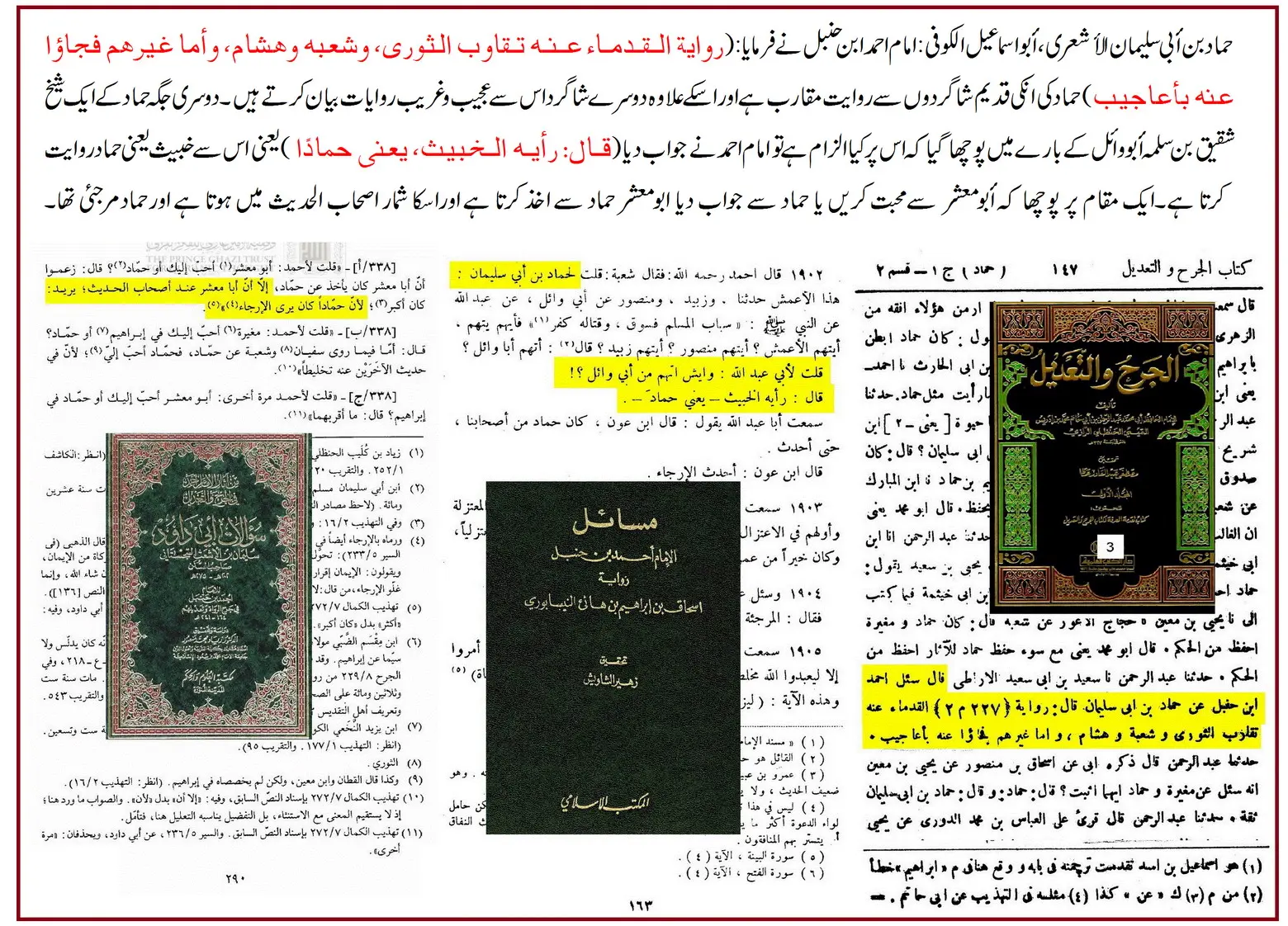
«رواية القدماء عنه مقاربة … وأما غيرهم فجاؤوا عنه بأعاجيب.»
Translation:
The narrations of his early students are closer to accuracy… but others transmitted strange reports from him.
Clarification:
Disturbance and irregularity in narrations; only early transmissions somewhat acceptable.
Imām Shuʿbah, Muḥammad ibn Yaḥyā al-Dhuhlī, and others described him as frequently mistaken and prone to error.
② Weakness in ḥadīth:
Ibn Saʿd, al-Dāraquṭnī, Ibn al-Jawzī, and others declared him weak.
③ Confusion (Ikhtilāṭ):
It was stated that his memory deteriorated toward the end of his life.
④ Innovation (Irjāʾ):
Many scholars mentioned his association with Irjāʾ, and some explicitly stated that he was abandoned for this reason.
⑤ Limited acceptance:
Some scholars restricted acceptance to narrations transmitted by his early students (such as Shuʿbah and Sufyān al-Thawrī); later narrations were rejected.
◈ Ibn Ḥibbān said: «يخطئ وكان مرجئًا»
◈ Ibn Ḥajar stated: «فقيه صدوق له أوهام ورمي بالإرجاء»
◈ Contemporaries like al-Aʿmash and Ibrāhīm al-Nakhaʿī expressed severe distrust.
◈ Abū al-ʿArab, Ibn al-Jawzī, and others included him among the weak narrators.
The statements of eighteen (18) scholars clearly demonstrate that his narrations do not constitute ḥadīth evidence according to the principles of the scholars of ḥadīth.
His juristic standing remains acknowledged, but in ḥadīth methodology, his reports are not considered authoritative proof.




This article compiles the statements of the Imams of al-Jarḥ wa al-Taʿdīl regarding Ḥammād ibn Abī Sulaymān al-Ashʿarī al-Kūfī (the jurist of Kūfah, attributed to Irjāʾ).
His position in jurisprudence is well-known. However, in the field of ḥadīth, the majority of the scholars of ḥadīth spoke critically of him:
◈ Some declared him weak (ḍaʿīf).
◈ Some described him as frequently mistaken and prone to error (kathīr al-khaṭaʾ wa al-wahm).
◈ Others labeled him a Murjiʾī and one who became confused (mukhtaliṭ).
Here, the statements of eighteen (18) Imams are presented with the original Arabic text and translation to clarify that, in terms of ḥadīth, reliance was not placed upon Ḥammād.
18 Criticisms of Ḥammād ibn Abī Sulaymān
➊ Imām Abū Ḥātim al-Rāzī
Arabic:«هو صدوق ولا يحتج بحديثه … هو مستقيم في الفقه وإذا جاء الآثار شوش.»
Reference: الجرح والتعديل 642
Translation:
He is truthful (ṣadūq), but his ḥadīth is not used as proof. He is sound in fiqh, but when it comes to narrations (āthār), he becomes confused.
Clarification:
Not relied upon in ḥadīth, though strong in jurisprudence.
➋ Imām Ibn Abī Ḥātim (Abū Muḥammad)
Arabic:«الغالب عليه الفقه، ولم يرزق حفظ الآثار … مع سوء حفظه للآثار أحفظ من الحكم.»
Reference: الجرح والتعديل 642
Translation:
Fiqh predominated over him, and he was not granted preservation of narrations… Despite his weak memory in ḥadīth, he was better than al-Ḥakam.
Clarification:
Weak in ḥadīth retention, though acceptable in juristic reasoning.
➌ Imām Shuʿbah ibn al-Ḥajjāj
Arabic:«كان حماد … لا يحفظ.»
Reference: الجرح والتعديل
Translation:
Ḥammād did not have strong memorization.
Clarification:
Explicit criticism of his memory.
➍ Ibn Saʿd
Arabic:«كان حماد ضعيفًا في الحديث فاختلط … وكان مرجيًا.»
Reference: الطبقات الكبرى
Translation:
Ḥammād was weak in ḥadīth, later became confused, and he was a Murjiʾī.
Clarification:
Weakness, confusion, and innovation explicitly mentioned.
➎ Imām al-Dāraquṭnī
Arabic:«ورواه حماد … مرسلاً … وهما ضعيفان.»
Reference: العلل الواردة 798
Translation:
Ḥammād narrated it in mursal form… and both narrators are weak.
Clarification:
Declared weak by al-Dāraquṭnī.
➏ Imām al-Bayhaqī
Arabic:«حماد بن أبي سليمان غير محتج به.»
Reference: مختصر الخلافيات
Translation:
Ḥammād ibn Abī Sulaymān is not relied upon as proof.
Clarification:
Declared non-authoritative.
➐ Imām Abū Dāwūd
Arabic:«حماد بن أبي سليمان زاد فيه … وهو منكر.»
Reference: سنن أبي داود 3529
Translation:
Ḥammād added to it… and it is rejected (munkar).
Clarification:
Declared munkar due to contradiction of stronger narrators.
➑ ʿAllāmah al-Haythamī
Arabic:«لم يُقبل من حديث حماد إلا ما رواه عنه القدماء …»
Reference: مجمع الزوائد 472
Translation:
Only those narrations of Ḥammād are accepted which were transmitted by his early students…
Clarification:
Acceptance limited to early transmissions only.
➒ Imām Ibn Ḥibbān
Arabic:«يخطئ وكان مرجئًا.»
Reference: الثقات 2273
Translation:
He made mistakes and was a Murjiʾī.
Clarification:
Frequent errors and innovation.
➓ Ḥāfiẓ Ibn Ḥajar
Arabic:«فقيه صدوق له أوهام … ورمي بالإرجاء.»
Reference: تقريب التهذيب 1500
Translation:
A jurist, truthful, but had errors… and was accused of Irjāʾ.
Clarification:
Recognized in fiqh, but unreliable in ḥadīth.
⓫ Imām ʿUthmān ibn Muslim al-Battī
Arabic:«إذا قال برأيه أصاب، وإذا حدث عن إبراهيم أخطأ.»
Reference: الضعفاء الكبير
Translation:
When he spoke by his opinion, he was correct; but when he narrated from Ibrāhīm, he erred.
Clarification:
Sound in juristic opinion, mistaken in transmission.
⓬ Muḥammad ibn Yaḥyā al-Dhuhlī
Arabic:«حماد كثير الخطأ والوهم.»
Reference: إكمال تهذيب الكمال 1341
Translation:
Ḥammād frequently made mistakes and errors.
Clarification:
Abundant errors and confusion.
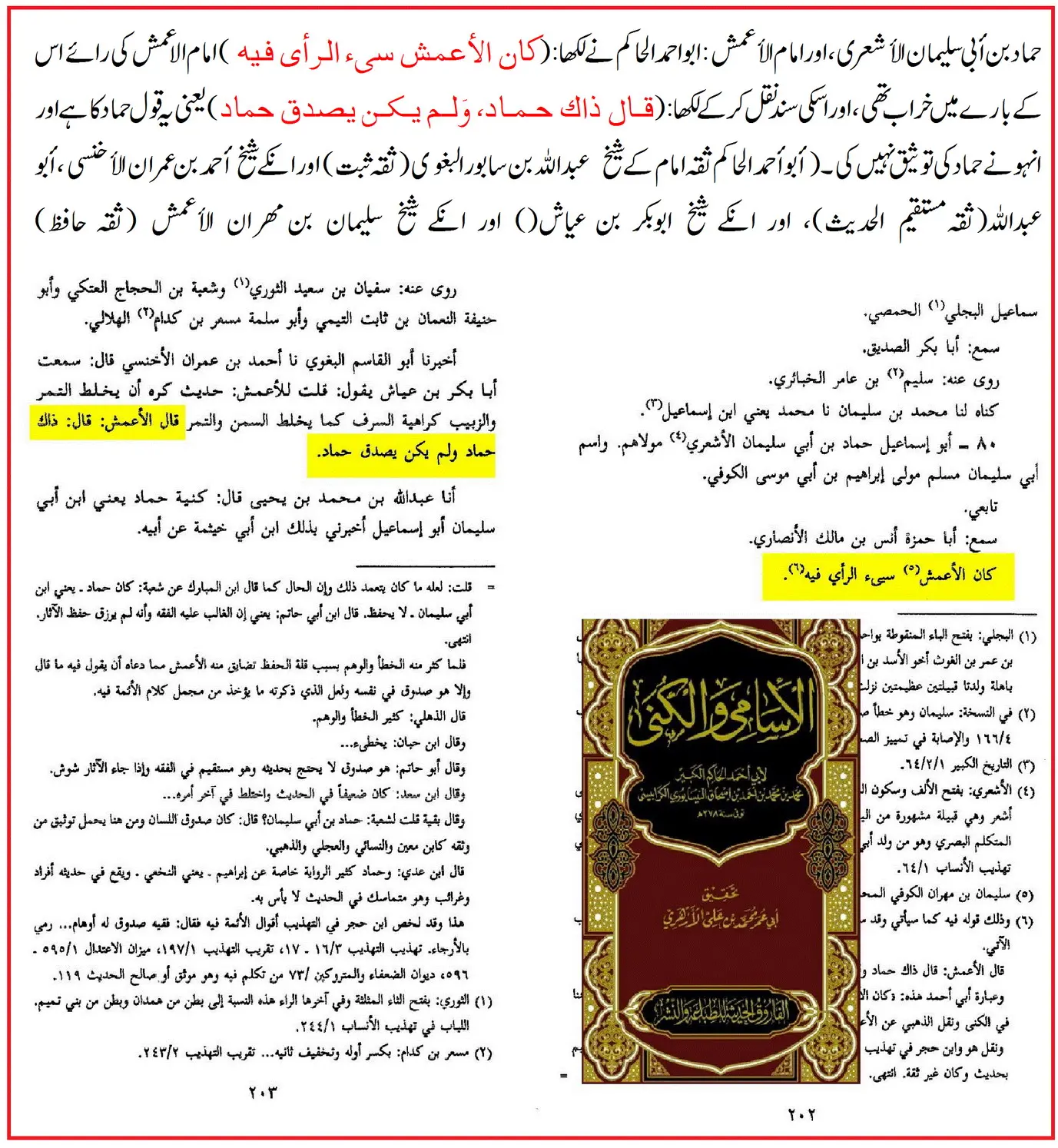
⓭ Imām al-Aʿmash
Arabic:«كان الأعمش سيء الرأي فيه … ولم يكن يصدق حماد.»
Reference: الأسامي والكنى
Translation:
Al-Aʿmash held a poor opinion of him… and did not consider Ḥammād truthful.
Clarification:
Severe criticism from a reliable contemporary.
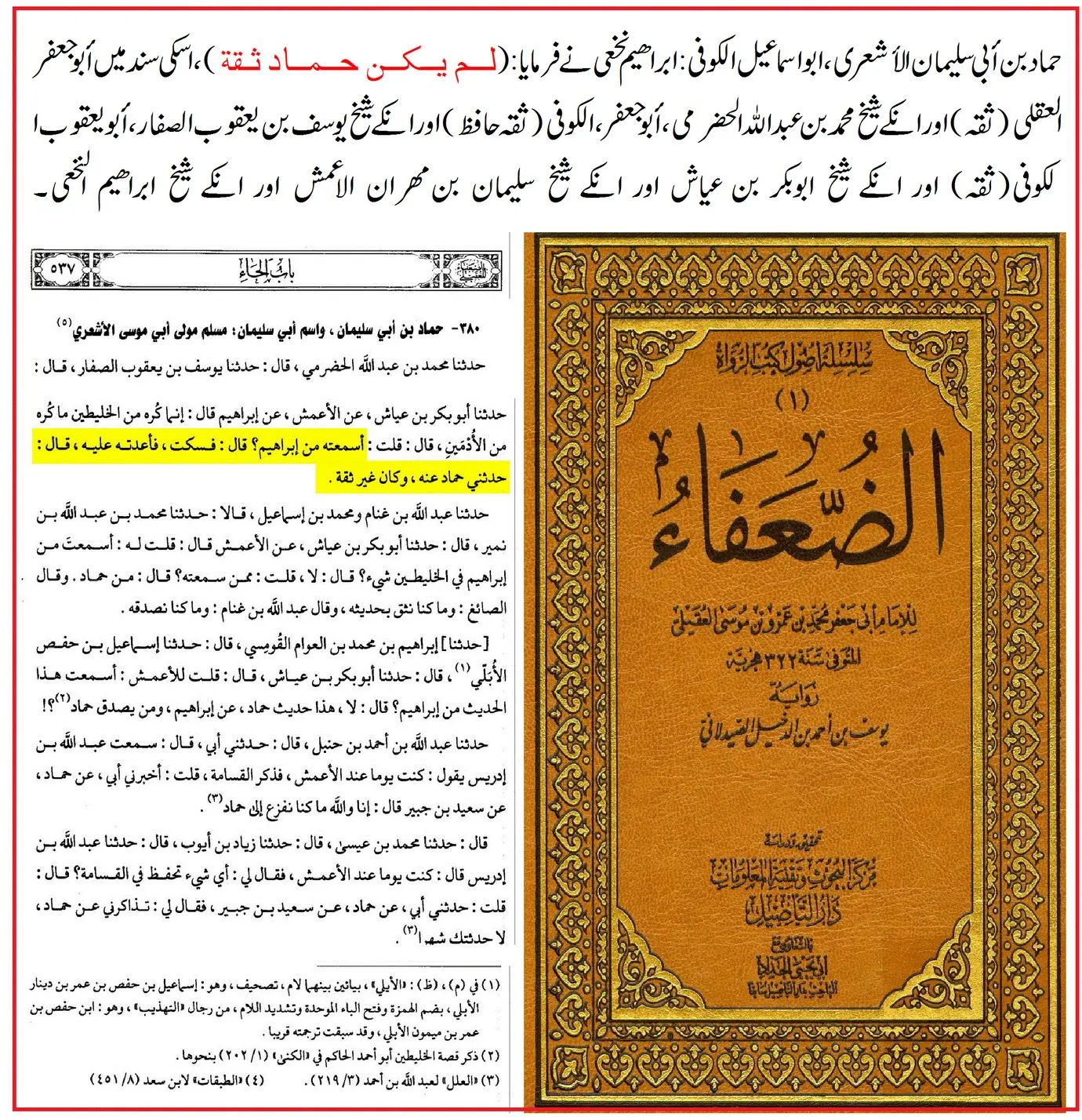
⓮ Imām Ibrāhīm al-Nakhaʿī
Arabic:«وكان غير ثقة.»
Reference: الضعفاء الكبير
Translation:
He was not trustworthy.
Clarification:
Declared unreliable.
⓯ Imām Abū al-ʿArab al-Ifrīqī (as cited by Mughlṭāy)
Arabic:«ذكره أبو العرب في جملة الضعفاء.»
Translation:
Abū al-ʿArab included him among the weak narrators.
Clarification:
Listed among the weak by early scholars.
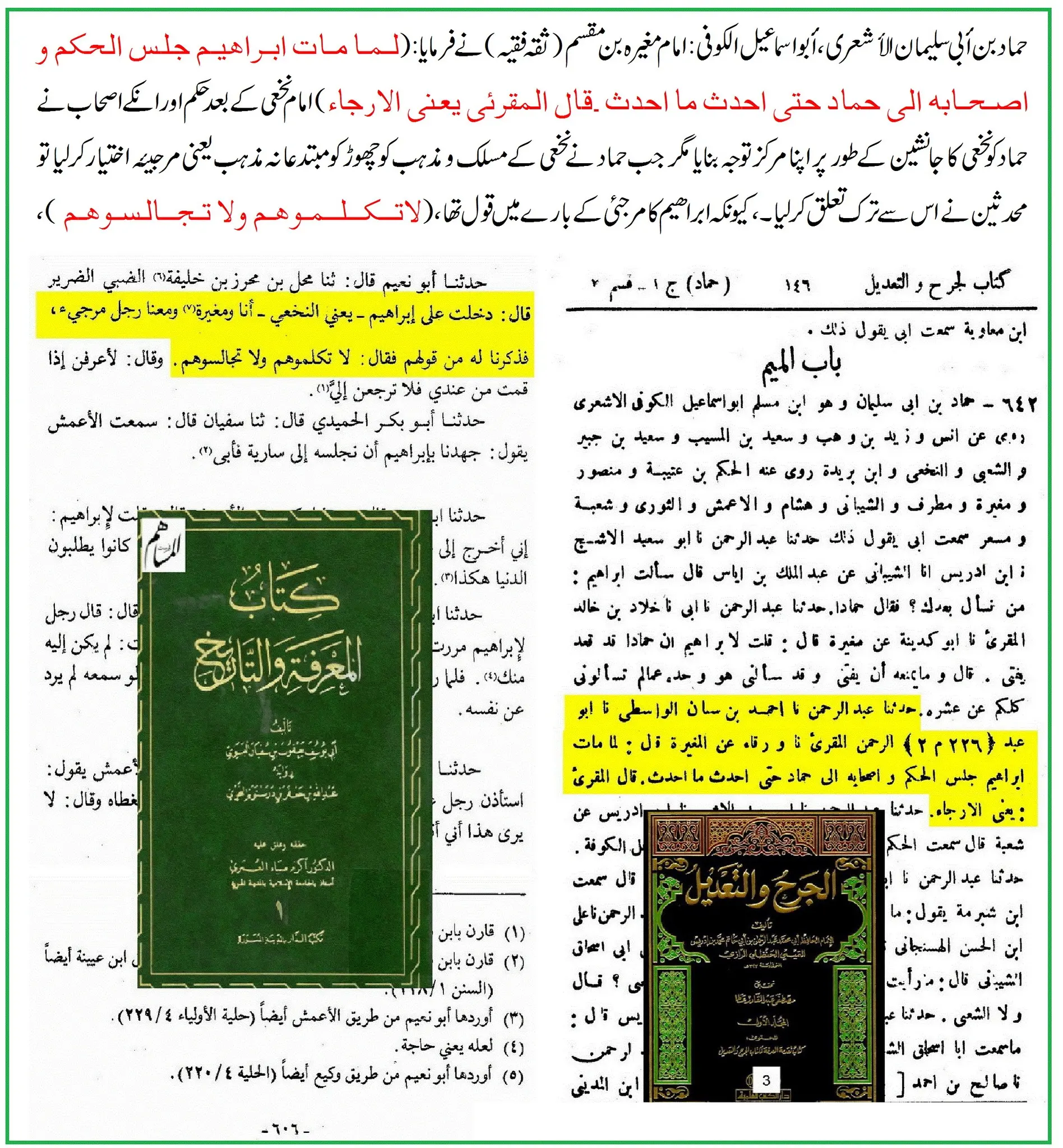
⓰ Imām Mughīrah ibn Miqsam
Arabic:«لما مات إبراهيم جلس الحكم وأصحابه إلى حماد حتى أحدث ما أحدث.»
Reference: الجرح والتعديل
Translation:
After Ibrāhīm died, al-Ḥakam and his companions sat with Ḥammād until he introduced what he introduced (i.e., Irjāʾ).
Clarification:
Abandoned due to adopting Irjāʾ.
⓱ Imām Ibn al-Jawzī
Arabic:«يروي عن إبراهيم … وكذبه مغيرة … وكان ضعيفًا في الحديث … ومرجيًا.»
Reference: الضعفاء والمتروكون 994
Translation:
He narrated from Ibrāhīm… Mughīrah declared him a liar… He was weak in ḥadīth and a Murjiʾī.
Clarification:
Counted among the weak and abandoned narrators.
⓲ Imām Aḥmad ibn Ḥanbal
Arabic:«رواية القدماء عنه مقاربة … وأما غيرهم فجاؤوا عنه بأعاجيب.»
Reference: الجرح والتعديل
Translation:
The narrations of his early students are closer to accuracy… but others transmitted strange reports from him.
Clarification:
Disturbance and irregularity in narrations; only early transmissions somewhat acceptable.
Summary and Conclusion
Ḥammād ibn Abī Sulaymān al-Ashʿarī al-Kūfī (d. 120 AH) was a prominent jurist and regarded as a leading scholar of Kūfah in fiqh. However, in the science of ḥadīth, the majority of the scholars criticized him on the following grounds:✦ Major Criticisms
① Poor memory and frequent errors:Imām Shuʿbah, Muḥammad ibn Yaḥyā al-Dhuhlī, and others described him as frequently mistaken and prone to error.
② Weakness in ḥadīth:
Ibn Saʿd, al-Dāraquṭnī, Ibn al-Jawzī, and others declared him weak.
③ Confusion (Ikhtilāṭ):
It was stated that his memory deteriorated toward the end of his life.
④ Innovation (Irjāʾ):
Many scholars mentioned his association with Irjāʾ, and some explicitly stated that he was abandoned for this reason.
⑤ Limited acceptance:
Some scholars restricted acceptance to narrations transmitted by his early students (such as Shuʿbah and Sufyān al-Thawrī); later narrations were rejected.
✦ Overall Scholarly Assessment
◈ Abū Ḥātim, al-Bayhaqī, al-Haythamī, and Aḥmad ibn Ḥanbal stated that his narrations are not used as proof, except those transmitted by early students.◈ Ibn Ḥibbān said: «يخطئ وكان مرجئًا»
◈ Ibn Ḥajar stated: «فقيه صدوق له أوهام ورمي بالإرجاء»
◈ Contemporaries like al-Aʿmash and Ibrāhīm al-Nakhaʿī expressed severe distrust.
◈ Abū al-ʿArab, Ibn al-Jawzī, and others included him among the weak narrators.
Final Verdict
Ḥammād ibn Abī Sulaymān was a well-known jurist and recognized authority in fiqh in Kūfah. However, according to the majority of ḥadīth scholars, he was weak, frequently mistaken, associated with Irjāʾ, and not relied upon as proof in ḥadīth.The statements of eighteen (18) scholars clearly demonstrate that his narrations do not constitute ḥadīth evidence according to the principles of the scholars of ḥadīth.
His juristic standing remains acknowledged, but in ḥadīth methodology, his reports are not considered authoritative proof.

